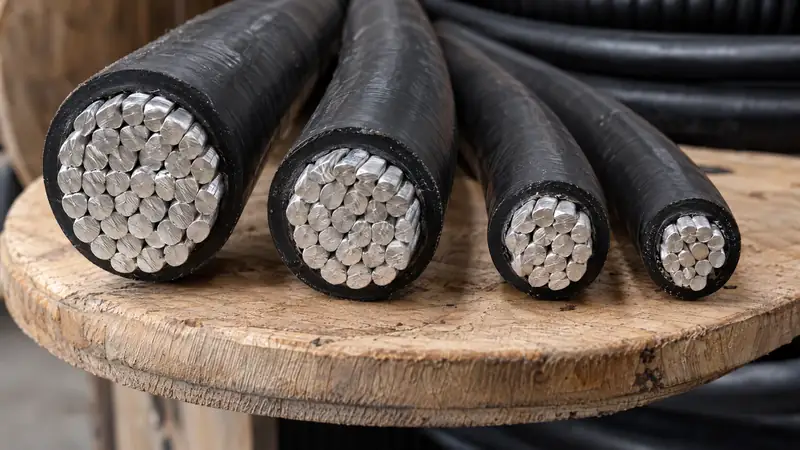
Ohio Wire Buyers buys reusable surplus aluminum feeders, service-entrance cable, underground distribution cable and overhead conductor from businesses anywhere in Ohio. As aluminum wire buyers, we purchase full and partial reels, coils and usable cut lengths for resale and reuse, not as scrap aluminum by the pound. Send photos and footage for a written offer before we arrange pickup at your jobsite, warehouse, plant or yard.
What do aluminum wire buyers need to identify?
The word aluminum identifies a metal, not a complete cable specification. A compact-stranded XHHW-2 feeder, gray SER assembly and bare steel-reinforced overhead conductor serve different applications. Size alone does not make them interchangeable, and an aluminum outer covering does not prove the conductors are aluminum.
We review AA-8000 series building wire, SER/SEU service-entrance cable, secondary and primary URD, aluminum-conductor MC feeders, AAC and ACSR. Keep each family separate on your footage list. If the lot also includes copper or control cable, identify those entries separately using the broader wire and cable categories we buy.
The most useful description combines manufacturer, conductor metal, insulation or cable type, size and remaining continuous length. Add the original part number when available; it can resolve details that a distant reel photo cannot show.
Which aluminum cable types and sizes can you sell?
These are verified catalog examples from Southwire and Priority Wire & Cable, not a ranking of sizes sold most often in Ohio. They illustrate how differently an aluminum lot can be built. Installation suitability must be checked against the actual product markings and project requirements.
| Aluminum product | Catalog size examples | Intended application or identifying feature |
|---|---|---|
| XHHW-2 single conductors | 4/0 AWG; 350, 500 and 750 kcmil | Insulated service and feeder conductors for permitted raceway or tray applications |
| SER service-entrance assembly | 2-2-2-4; 4/0-4/0-4/0-2/0 | Insulated phases and neutral with a separate bare grounding conductor |
| Secondary URD triplex | Ramapo: 2-2-2; Sweetbriar: 4/0-4/0-2/0 | Underground secondary distribution cable rated 600 volts |
| Primary concentric-neutral URD | 1/0 and 4/0 AWG; 500 and 750 kcmil | Shielded underground primary distribution cable; voltage and neutral design matter |
| Aluminum-conductor MC | 350, 500 and 750 kcmil examples | Insulated power conductors within a metal-clad assembly |
| Bare AAC and ACSR | AAC Poppy: 1/0 AWG; ACSR Sparrow: 2 AWG | Overhead conductor; ACSR includes steel reinforcement |
For single-conductor lots, photograph the full XHHW-2 wire markings, not just the size. Southwire identifies its referenced product as AA-8176 aluminum alloy with cross-linked polyethylene insulation. Do not assign that alloy or construction to an unmarked reel merely because it looks similar.
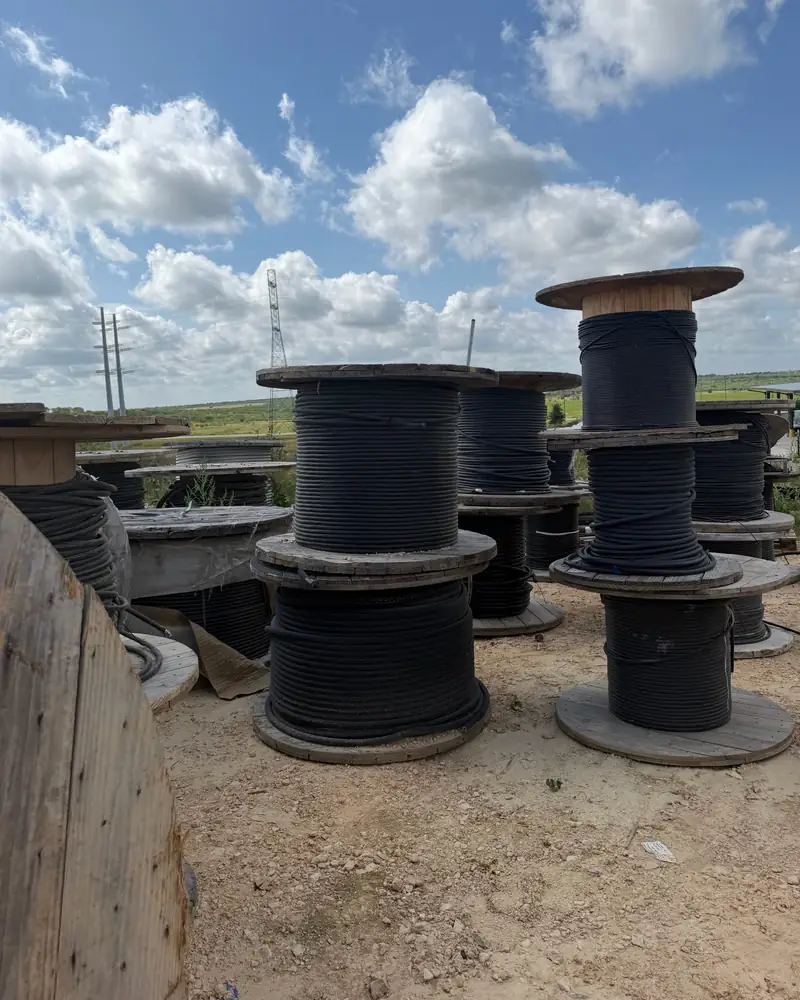
Is modern AA-8000 wire the same as old aluminum house wiring?
No. The earlier branch-circuit problems associated with AA-1350 aluminum involved conductor properties, connection compatibility and installation practices. The IAEI technical history describes AA-8000 alloys developed in the late 1960s, with listed production beginning in 1972, and explains their different creep and flexibility characteristics.
That history is not a reason to treat every aluminum conductor as defective, or every old conductor as reusable. Modern AA-8000 aluminum building wire must still have the correct identity, sound insulation and a suitable installation. Compact stranding also describes conductor geometry; it does not establish ampacity or prove compliance by itself.
For a surplus sale, preserve the alloy designation and manufacturer information. For an installation, qualified personnel must use connectors suitable for the conductor and follow the applicable instructions. A buyer's offer is not an engineering approval of a future feeder design.
Does aluminum MC armor mean aluminum conductors?
No. Southwire's copper-conductor Armorlite specification describes copper conductors inside aluminum interlocked armor. Its aluminum-conductor power MC specification describes AA-8000 conductors, XHHW-2 insulation, aluminum interlocked armor and an overall PVC jacket. Both constructions can present an aluminum outer metal layer.
When you describe surplus metal-clad cable, list conductor metal and armor material separately. Include conductor count, individual conductor size and grounding conductor details. For jacketed assemblies, show the jacket legend; for exposed armor, send the reel label and accessible identification tape.
Do not remove usable armor to expose the conductors for a sale. A clear photo of an already accessible cut end, backed by the correct product documentation, is more useful than a damaged assembly.
Why must SER, secondary URD and primary cable stay separate?
Service-entrance cable is not automatically underground cable. Southwire's SER specification expressly excludes underground installation, even in a raceway. Preserve the complete SER or SEU designation rather than describing every gray aluminum cable as a buried feeder.
Secondary URD triplex and quadruplex are different from shielded primary distribution cable. The Priority catalog distinguishes secondary cable rated 600 volts from primary URD product families rated 15, 25 and 35 kV. A primary lot needs its voltage rating, insulation construction and concentric-neutral configuration identified; a size-only inventory line is incomplete.
The URD cable selling guide covers those distinctions. Utility aluminum can also use a different alloy from building wire, so AA-8000 should not be assumed across the lot. For AAC and ACSR overhead conductor, record the code name and stranding as well as size.
What affects an offer beyond aluminum weight?
A reusable length has to fit a future application. Its insulation type, size, length, condition and documentation therefore matter alongside demand. A full tagged reel and an unidentified pile of short pieces are not equivalent inventories, even if their total metal weight matches.
Aluminum's cost and handling advantages can make it a value-engineering choice for feeders. A changed specification, canceled order or revised route can then leave an otherwise usable reel without a job. Utility projects can leave a different mix of overhead and underground products; describe the material itself rather than relying on the project label.
Keep original tags and avoid stripping insulation or cutting reels down before review. Report crushed armor, scraped insulation, damaged strands or uncertain storage history. Our surplus value versus scrap-price guide explains the distinction; if cable is not reusable, we say so and a recycler may be the right buyer.
What should you send for an aluminum cable offer?
Start with a whole-lot photo, then photograph each reel tag, readable jacket print and accessible cut ends. Pair every photo set with an inventory entry so a SER reel cannot be confused with a nearby URD reel. Keep existing end protection in place when possible, particularly on primary cable.
For each entry, send the following:
- The manufacturer, part number and conductor material, including the alloy designation if shown.
- The complete size string for assemblies, not just the largest conductor size.
- The insulation or cable type and marked voltage rating; include shield and neutral details for primary cable.
- The remaining continuous footage, or an estimate clearly labeled as an estimate, and whether the reel is full or partial.
- Known damage, previous use, storage concerns and whether the cable remains on its original reel.
Use our remaining-footage measuring guide when the tag only records the original quantity. Include your business details and proof of ownership, such as an invoice, purchase order, closeout paperwork or company letter. We verify ownership and keep a written purchase record.
How does pickup work for an Ohio aluminum lot?
We arrange pickup anywhere in Ohio and have no Ohio street address, office or yard. Material stays at your site for the arranged pickup. Tell us where it sits and describe loading access, available handling equipment and damaged reels. The Ohio service-area overview explains the statewide pickup model.
After review, we reply with questions or a written offer before pickup. Payment method and timing are confirmed in writing beforehand, and the count is checked against the written terms at pickup. See how selling surplus wire works for the full sequence.
To sell aluminum wire without losing its product identity, keep the tags and continuous lengths together. Request an offer for your aluminum cable with photos and footage, or call 951-403-5738 to discuss the lot.
Frequently asked questions
Can I sell a partial reel of aluminum feeder wire?
Yes, Ohio Wire Buyers buys reusable partial reels as well as full reels, boxed coils and cut lengths from businesses. Send the size, insulation type, conductor material and remaining footage or an estimate. Photograph the tag and accessible ends, and disclose any damaged section. Keep the remaining length intact until we have reviewed it rather than cutting it into shorter pieces.
Do you quote aluminum cable by the pound?
Ohio Wire Buyers buys reusable cable as product for resale and reuse, not as scrap metal by the pound. An offer depends on the cable's identity, usable footage, condition, documentation and demand. A recycler's metal-weight quote is a different transaction. If the material cannot be reused, we say so, and a scrap metal recycler may be the appropriate buyer.
Can you review aluminum wire without its original reel tag?
Send clear jacket-print photos, accessible cut-end photos and any invoice or specification sheet that belongs to the lot. A missing tag does not automatically establish that wire is unusable, but it leaves identification questions to resolve. Mark uncertain details as unknown rather than guessing the alloy, voltage rating or length. We may need additional information before providing a written offer.
Will you buy aluminum cable removed during decommissioning?
Used cable is considered only if it is still reusable. Explain the original application, removal history, remaining lengths and known damage, and include ownership or closeout paperwork. Only qualified personnel should disconnect or remove cable after it has been de-energized. Photos do not prove that a removed cable is suitable for another installation, especially when its insulation, shield or armor has been damaged.
Do I need to remove the steel core from ACSR before selling?
No. Keep reusable ACSR intact for review. Its steel reinforcement is part of the conductor design, not unwanted packaging to strip away. Send the manufacturer's designation, size, stranding information, footage and reel condition. Cutting or separating the strands destroys the original product configuration. If it is no longer reusable, a recycler can explain how it evaluates that material.
Sources and further reading
- IAEI: Aluminum Building Wire Installation and Terminations
- Southwire: SIMpull XHHW-2/RW90 Aluminum, Specification 10015
- Southwire: SER Aluminum Service Entrance, Specification 10041
- Priority Wire & Cable: Utility Wire and Cable Catalog
- Southwire: Aluminum-Conductor Jacketed MC, Specification 45313
- Southwire: Copper-Conductor Armorlite MC with Aluminum Armor