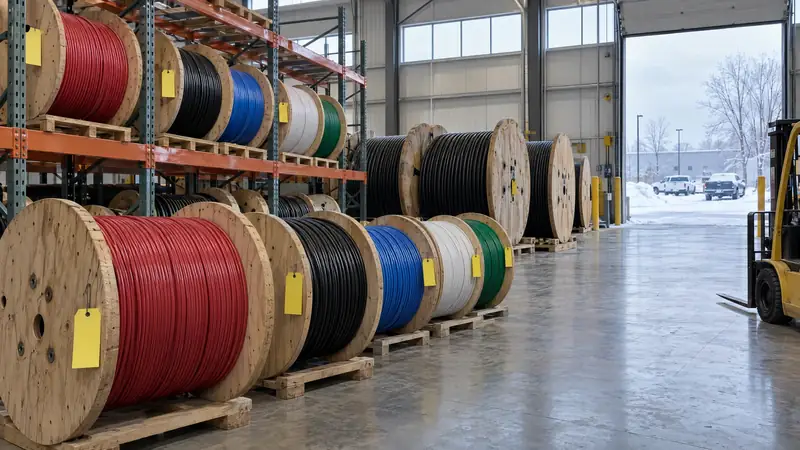
The wire and cable we buy includes reusable surplus building wire, feeder and power cable, control cable, flexible cord and specialty cable from Ohio businesses. Ohio Wire Buyers reviews unused full reels, partial reels, boxed coils and cut lengths, plus used cable only when it remains reusable, for resale as product rather than scrap by the pound.
Which wire and cable we buy fits your lot?
Start with the printed type designation, not the jacket color or the job it came from. Record the manufacturer, conductor material, size, voltage rating and remaining footage. A black jacket can cover very different constructions; "leftover feeder" is not enough to identify one.
Keep size separate from product family. AWG and kcmil describe conductor size, while THHN, XHHW-2 and TC identify different products. Our wire-size overview helps organize those entries. If several reels carry different markings, list them separately even when they look alike.
What do T, H, HH, W, X and N mean?
UL's general-wiring letter system provides useful clues, but it has exceptions. These meanings apply to building-wire designations, not every letter appearing anywhere in a cable legend.
| Marking | Meaning in general-wiring designations | What to record |
|---|---|---|
| T, as the first letter | Thermoplastic insulation | The complete type, such as THHN |
| H | Heat rating of 75°C | Any additional temperature markings |
| HH | Heat rating of 90°C | Whether the rating applies wet or dry |
| W | Moisture-resistant construction | The complete wet-location designation |
| X | Cross-linked polymer insulation | The full type and manufacturer |
| N | Nylon jacket | Other ratings printed beside the type |
For example, THHN/THWN-2 building wire combines thermoplastic insulation and a nylon covering. THHN alone identifies a dry-location rating; the additional THWN-2 designation establishes a wet-or-dry rating of 90°C. Do not shorten a dual-rated legend to just "THHN" in your inventory list.
XHHW-2 feeder wire uses cross-linked insulation and carries a 90°C wet-or-dry rating. Southwire's cited copper product uses cross-linked polyethylene, or XLPE. These temperature ratings identify insulation performance, not an automatic installed ampacity; terminations and conditions of use still govern.
Is it single-conductor wire or a cable assembly?
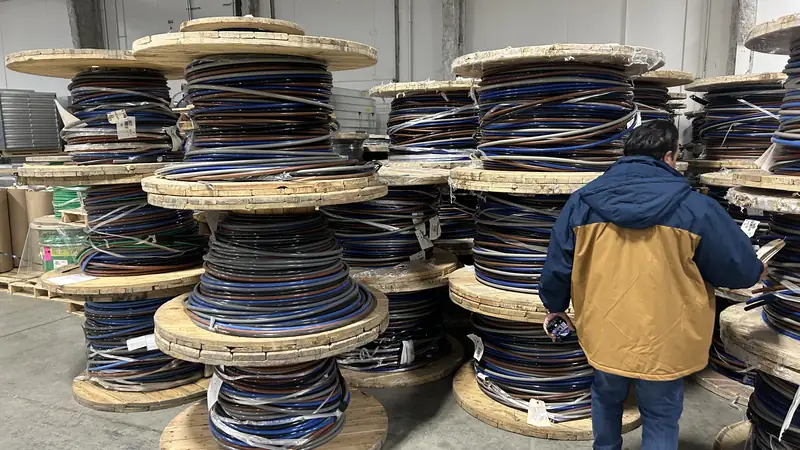
Single-conductor wire has one conductor, which may be solid or stranded. Several separate wires wound together on a parallel reel do not become a jacketed cable assembly. Photograph the reel arrangement and identify each wire.
A cable assembly groups conductors within a common covering or construction. NM-B nonmetallic-sheathed cable and metal-clad MC cable need their complete cable designation, conductor count and grounding details recorded. Metallic armor does not tell you whether the conductors themselves are copper or aluminum.
For industrial lots, distinguish TC and TC-ER tray cable from other jacketed products. With multiconductor control cable, include the conductor count and whether conductors are numbered or color-coded. Instrumentation pairs, shields and drain wires should be described separately rather than reduced to "control wire."
How do voltage ratings and UL standards help?
Do not identify voltage class by cable diameter. Southwire's cited THHN/THWN-2 product is rated 600 volts, while its cited XHHW-2 copper product offers 600- or 1,000-volt ratings. Read the actual legend rather than assigning a rating from the family name.
Medium-voltage power cable requires different details. Southwire's cited 15 kV MV-105 construction includes conductor and insulation shields, a copper tape shield and an outer jacket. Record the voltage, insulation level and shield construction shown on the tag.
The cited specifications reference UL 83 for thermoplastic-insulated wire, UL 44 for thermoset-insulated wire and UL 1072 for medium-voltage power cable. These are product standards, not interchangeable ratings. Preserve original certification labels: UL's application guide explains why jacket printing alone is not proof of certification coverage.
What about flexible and specialty products?
SOOW and other portable cords use a different letter system. In that system, OO indicates oil-resistant insulation and jacket; a final W indicates suitability for wet locations and sunlight resistance. Keep welding cable, DLO and heavy portable-power cable identified separately instead of describing every flexible product as welding lead.
For solar PV wire, send the full designation and voltage marking, not just "solar cable." Other families for review include USE-2/RHW-2, UF-B, SER/SEU, MC-HL/Teck, VFD cable, primary and secondary URD, overhead conductor, bare copper, aluminum building wire, machine-tool wire, data cable, fiber optic cable and fire-alarm cable. Each needs its own identification and condition review.
What makes surplus suitable for reuse?
Preserve continuous lengths, reel tags, boxes and protective coverings. Report cracked insulation, crushed armor, exposed conductors, splices or damaged reel flanges rather than hiding them in an overall photograph. For removed cable, disclose its service history and any available inspection or test records.
A readable legend does not establish that damaged cable is safe to reinstall. We review condition and usable length alongside product identity, packaging, documentation and demand. If material is not reusable, we say so; a scrap metal recycler may be the right buyer instead.
What should you send for an offer?
Send a whole-lot photo followed by a tag and jacket-print photo for each distinct product. Include existing accessible cut ends where safe; never open energized equipment or cut cable just to supply a photograph. For assemblies, show conductor count, shields and armor; for medium-voltage cable, show existing end protection and tag details.
Add a footage list, marking estimates as estimates. State whether lengths are continuous, whether reels are full or partial, and where the material sits. Include ownership records such as an invoice, purchase order, closeout paperwork or company letter.
Our selling process covers review questions, the written offer before pickup, and payment method and timing confirmed in writing before pickup. We arrange pickup anywhere in Ohio and check the count against the written terms.
Ready to identify your surplus lot? Request a written offer for your wire and cable, or call 951-403-5738 with the markings and footage you have available.
Frequently asked questions
Can I sell a mixed lot of copper and aluminum wire?
Yes. Ohio Wire Buyers reviews mixed lots of reusable surplus wire and cable from businesses. Separate the entries by conductor material, type, size and remaining footage rather than reporting only a total weight. Send whole-lot photos along with individual reel tags and jacket markings so we can identify the products without treating the lot as scrap metal.
Do you buy wire that was removed from service?
Used cable can be considered only if it remains reusable. Tell us where it was used, how it was removed and whether it has splices, damaged insulation or attached lugs. Include available condition records and proof of ownership. Removal and handling must be performed safely by qualified people; a photograph alone does not establish suitability for another installation.
Can I get an offer if the reel tag is missing?
Send clear jacket-print photos, available packaging information and any purchase records that identify the cable. Include cut-end photos if the ends are already accessible and safely de-energized. Mark uncertain details as unknown rather than guessing. Missing identification can limit reuse prospects, and we may need additional information before deciding whether to make a written offer.
Should I strip insulation before selling surplus wire?
No. We buy reusable wire as electrical product, so keep its insulation, jacket, armor and identification intact. Stripping changes the material into something different and can eliminate its usefulness as installed wiring. If the cable is already damaged beyond reuse, we will say so; a scrap metal recycler may then be the appropriate buyer.
Where can an Ohio business deliver surplus cable?
Ohio Wire Buyers has no Ohio street address, office or yard, and we do not accept deliveries. We arrange pickup at the seller's jobsite, warehouse, plant or yard anywhere in Ohio. Send the material details first. We provide a written offer before pickup, and payment method and timing are confirmed in writing before pickup is arranged.