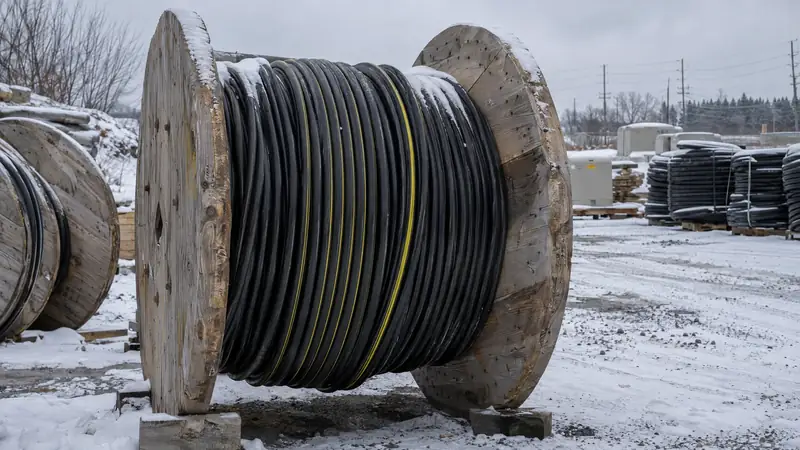
Ohio Wire Buyers buys reusable surplus underground residential distribution cable from businesses anywhere in Ohio, including primary concentric-neutral cable and secondary aluminum triplex or quadruplex. To sell URD cable, send reel tags, cable markings, condition photos and a footage list or estimate for review and a written offer before pickup. We buy usable cable as product for resale and reuse, not as scrap metal by the pound.
How do you sell URD cable without confusing primary and secondary?
Start by separating shielded primary cable from secondary cable assemblies. Both may be called URD in an inventory list, but their voltage ratings and construction are different. A description such as “black aluminum underground wire” is not enough to identify either product.
Southwire's primary catalog includes 15, 25 and 35 kV families. Its cited secondary triplex and quadruplex products are rated 600 volts. Keep those categories separate when preparing a lot list; other cable can be identified through the broader wire and cable types we buy.
| Identification point | Primary concentric-neutral URD | Secondary triplex or quadruplex |
|---|---|---|
| Voltage information | Record the marked kV class | Record the 600 V rating and conductor type |
| Cable arrangement | Insulated phase conductor with shielding and surrounding neutral wires | Insulated aluminum phase conductors cabled with an insulated neutral |
| Neutral detail | Full or fractional concentric-neutral designation | Separate neutral conductor size |
| Color clues in cited Southwire products | Black LLDPE jacket; red stripes may be specified or optional | Neutral identified by three yellow extruded stripes |
| Essential paperwork | Part number, insulation level and neutral construction | Code word, complete size combination and type markings |
Stripes are useful clues, not a substitute for the printed legend or specification.
What identifies reusable primary concentric-neutral cable?
Primary URD has more to identify than the aluminum conductor size. Southwire's cited TRXLPE designs include a conductor shield, tree-retardant cross-linked polyethylene insulation, an insulation shield, helically applied bare copper neutral wires and an overall jacket. LLDPE means linear low-density polyethylene, the jacket material in those specifications.
The cited full-neutral specification includes 1/0, 2/0 and 4/0 AWG aluminum conductors. The one-third-neutral specification includes larger sizes such as 750 and 1000 kcmil. These are manufacturer examples, not a promise that every size is made in every voltage and neutral combination.
Photograph the manufacturer name, conductor size, voltage, insulation wording and manufacture date wherever they appear. For a lot containing EPR insulation or other shield designs, use our medium-voltage cable selling information rather than labeling every primary reel TRXLPE.
Why do neutral fraction and insulation level matter?
“Full neutral” and “one-third neutral” identify different concentric-neutral constructions. They do not describe how much footage remains on a reel. Record the designation and, when supplied on the tag or specification, the neutral wire count and gauge.
Insulation level is a separate field. Southwire's cited full-neutral 35 kV product has a 100% insulation level, while its cited one-third-neutral product has a 133% level. Do not infer either field from the other: the primary catalog lists multiple combinations. Keep reels with different constructions on separate inventory lines even if their phase conductor sizes match.
Also avoid assuming every utility cable has a building-wiring listing. These primary specifications state UL 1072 listing as MV-90 when specified. Photograph the actual markings and use our reel-tag reading guide to organize the information without filling in missing ratings from memory.
What do Brenau, Ramapo and Sweetbriar mean?
Secondary code words identify particular conductor combinations within a manufacturer's catalog. Southwire's triplex specification describes two phase conductors and one neutral cabled together; its quadruplex specification describes three phase conductors and one neutral. Record each size, because the neutral may be smaller than the phases.
| Triplex code word in Southwire SPEC 83013 | Aluminum phase conductors | Aluminum neutral |
|---|---|---|
| Ramapo | Two 2 AWG conductors | 2 AWG |
| Brenau | Two 1/0 AWG conductors | 2 AWG |
| Sweetbriar | Two 4/0 AWG conductors | 2/0 AWG |
The cited secondary products use XLPE insulation and identify the neutral with three yellow extruded stripes. Southwire also describes sequential footage markers on these “YES” neutrals. Include a close photograph of that conductor, not just the outside of the assembly.
A code word alone does not document all listings or options. Read the USE-2 or other type markings; our USE-2 and RHW-2 identification page explains why the complete legend matters.
Can partial reels and cut lengths still be considered?
Yes, full reels, partial reels and cut lengths can be reviewed if the cable remains reusable. Keep each continuous length intact. Cutting an identifiable remainder into shorter pieces before review can remove its usefulness for a future run.
For secondary assemblies, report assembly footage rather than adding together the lengths of its individual conductors. For separately reeled primary conductors, list footage per reel and say whether their remaining lengths match. Note splices, repaired areas and anything that interrupts an otherwise continuous length.
If footage is uncertain, label it an estimate and explain the method. Our guide to measuring cable left on a reel can help. Identification, usable length, condition, packaging, documentation and demand affect an offer; metal weight alone does not establish surplus cable value versus scrap value.
How should surplus underground cable be protected?
Direct-burial suitability does not make an open cable end safe from water intrusion during storage. Southwire's handling guidance calls for airtight end seals and resealing after cable is cut. Photograph accessible cut ends, but do not remove sound seals just to show the conductor.
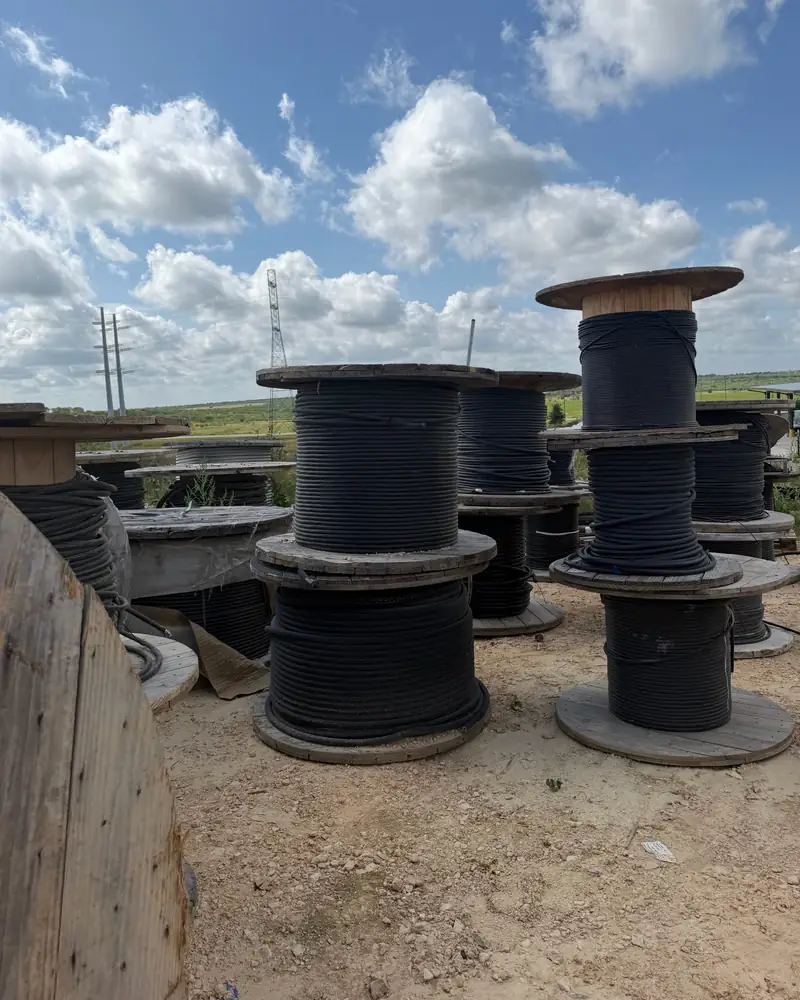
Keep tags attached, protect the cable from equipment contact and inspect damaged flanges before moving reels. The manufacturer recommends storing large reels with their flanges vertical rather than laying them flat. See our winter reel-storage guide for planning a stored lot.
Disclose missing caps, standing-water exposure, crushed insulation, jacket cuts or damaged neutral wires. Used primary cable needs its removal history documented; a clean-looking jacket does not establish electrical integrity. Work on connected distribution cable, including removal and testing, belongs to qualified, authorized personnel.
What should you send for a URD cable offer?
Use a separate inventory line for each construction, with a reel identifier that matches the photos. Utilities, co-ops, developers and underground contractors can submit surplus material they own; our utility and co-op surplus page addresses those sellers.
| Send this information | Detail specific to this cable |
|---|---|
| Whole-lot and reel photos | Show reel count, winding condition and damaged packaging |
| Primary tags and jacket print | Include voltage, conductor size, insulation level and neutral designation |
| Secondary markings | Include code word, phase sizes, neutral size and type rating |
| Ends and condition notes | Show accessible cut ends and existing caps; disclose exposure or removal history |
| Footage list | Distinguish measured footage from estimates and identify continuous lengths |
| Purchase or closeout records | Connect the cable description and reel identifiers to the seller |
Send available information first and mark unknown fields clearly. Ohio Wire Buyers reviews it and replies with questions or a written offer before pickup. The selling process explains the sequence without requiring you to guess missing specifications.
Ownership records and pickup at your Ohio location
A reel stored at a contractor's site may still belong to a utility or project owner. Confirm who can authorize the sale and supply proof of ownership, such as an invoice, purchase order, closeout paperwork or company letter. We verify the seller and keep a written purchase record; our Ohio seller-paperwork guide explains what to prepare.
Payment method and timing are confirmed in writing before pickup. We arrange pickup at your Ohio jobsite, warehouse, plant or yard and check the count against the written terms. Tell us about loading equipment and access restrictions. Ohio Wire Buyers has no Ohio street address, office, yard or drop-off. If the cable is not reusable, we say so; a scrap metal recycler may be the right buyer.
To have primary or secondary reels reviewed, request an offer for your surplus URD cable with the tags and footage, or call 951-403-5738.
Frequently asked questions
Can I sell URD cable if the reel tag is missing?
Send clear photos of the cable print, exposed ends and the whole reel, along with any purchase records. Missing tags do not automatically settle whether a reel is reusable, but they leave important identification gaps. For primary cable, neutral construction and insulation level may need confirmation from the manufacturer's part number or original order documents.
Does a yellow stripe mean underground cable can be installed inside a building?
No. A yellow stripe can identify the neutral on secondary URD, but it does not establish permitted installation locations. Check the actual conductor type markings and applicable installation requirements. Southwire's cited secondary products are USE-2 listed; do not assume an underground-service rating alone also qualifies the cable for indoor building wiring.
Will you buy cable removed from an underground distribution system?
Used cable is considered only if it remains reusable. Tell us why it was removed, whether it had a fault, how it was recovered and what condition records are available. Photos cannot establish the electrical integrity of primary insulation. Do not remove or test connected distribution cable for a sale; that work belongs to qualified, authorized personnel.
Is Sweetbriar the same size as Brenau?
Not in Southwire's cited triplex specification. Brenau has two 1/0 AWG aluminum phase conductors and a 2 AWG neutral. Sweetbriar has two 4/0 AWG phase conductors and a 2/0 AWG neutral. Send the manufacturer, code word and complete size combination rather than describing either reel simply as aluminum triplex.
Can Ohio Wire Buyers provide an offer before the reels are loaded?
Yes. Send the lot information and photos first. Ohio Wire Buyers reviews the material and replies with questions or a written offer before pickup. Payment method and timing are confirmed in writing before pickup, and the count is checked against the written terms. Pickup is arranged at the seller's Ohio location; there is no Ohio drop-off address.
Sources and further reading
- Southwire CableTechSupport: MV Primary product catalog
- Southwire SPEC 81241: 35kV aluminum TRXLPE full-neutral LLDPE cable
- Southwire SPEC 81252: 35kV aluminum TRXLPE one-third-neutral LLDPE cable
- Southwire SPEC 83013: Triplex 600 Volt USE-2 underground service entrance
- Southwire SPEC 83038: Quadruplex 600 Volt USE-2 underground service entrance
- Southwire: Guidelines for Wire & Cable Handling and Storage