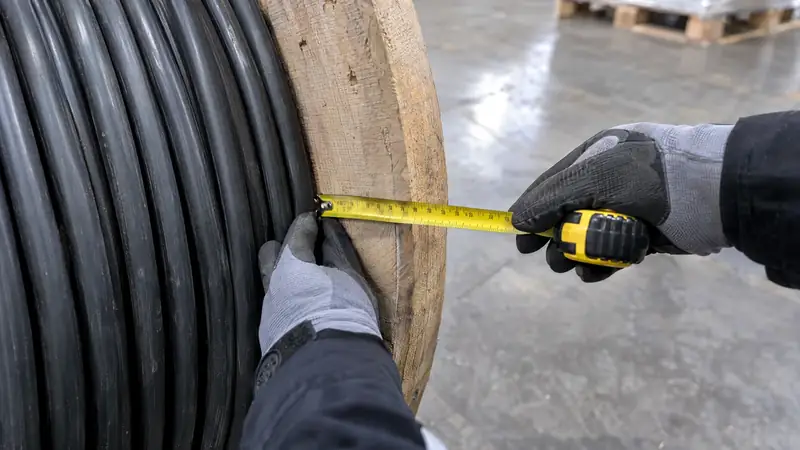
To learn how to measure wire left on a reel, start with sequential footage marks; if those are unavailable, use net cable weight, reel geometry or a suitable length counter. Ohio Wire Buyers accepts a footage list or estimate for reusable surplus electrical wire and cable from Ohio businesses, with the measuring method and uncertainty clearly identified.
How to measure wire left on a reel: choose your method
Choose the method that uses evidence you already have, rather than unwinding good cable just to produce a number. A factory tag may show the original shipment length, not what remains after jobsite pulls; our guide to reading reel tags explains what to preserve.
| Method | Information needed | Main limitation |
|---|---|---|
| Sequential marks | Verified length readings at both ends of one continuous piece | A buried end may be inaccessible |
| Net weight | Current gross weight, reel tare and matching cable weight per foot | Unknown tare or mixed constructions distort the result |
| Reel geometry | Barrel diameter, winding diameter, traverse and cable outside diameter | Loose or uneven winding makes it approximate |
| Length counter | Suitable measuring equipment and controlled payoff | Requires handling the entire length |
These methods complement the preparation advice in our wire selling guides. Keep reusable cable intact while documenting it.
How do sequential cable footage marks work?
Sequential numbers identify positions along the cable. Southwire's SIMpull Solutions brochure documents footage markers on certain THHN and XHHW-2 sizes, but do not assume every wire has them. Check the actual print and distinguish length marks from manufacturing dates, product codes and certification identifiers using our cable jacket print guide.
For a hypothetical continuous piece with end readings of 18,740 feet and 18,210 feet, the difference is 530 feet between the marks. Subtract the smaller reading from the larger regardless of the direction in which numbers run. If the readings are near, rather than exactly at, the physical ends, measure and add the unmarked tails.
Photograph each reading and record its unit. The exposed outer-end number alone cannot establish remaining footage unless you also have a reliable reading for the inner end, perhaps from an original receiving record. Never assume the inner end starts at zero or pull it loose from beneath the winding just to read it.
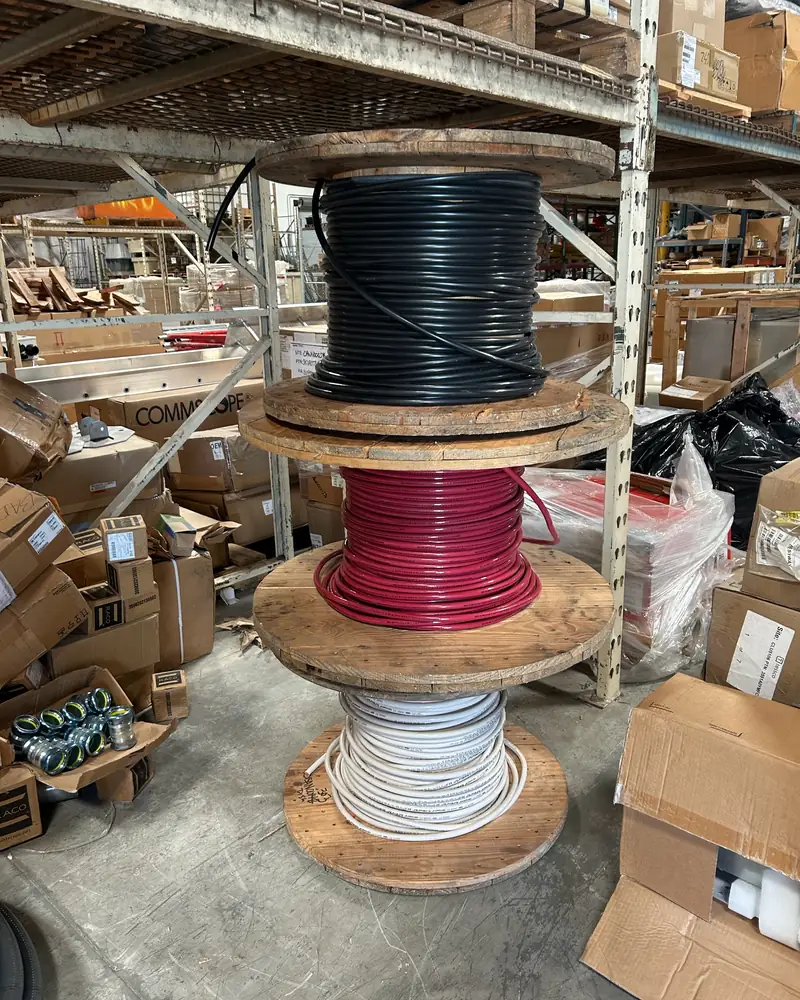
Can you calculate remaining footage from weight?
The weight method works when you know the cable construction and have a credible empty-reel weight, called tare. Use the current loaded weight, not the original shipping weight printed on an old label.
Estimated feet = (current gross pounds − tare pounds − other packaging pounds) ÷ cable pounds per foot.
Use the manufacturer's approximate finished-wire weight, including insulation and jacket. Southwire's SPEC 10000 sheet for stock 205088 lists 4/0 copper THHN/THWN-2 at approximately 719 pounds per 1,000 feet, or 0.719 pound per foot. Its copper-only weight is a different figure and is not the correct divisor for intact insulated wire.
In a hypothetical example, a loaded reel weighs 459.5 pounds, the documented reel tare is 100 pounds, and there is no additional packaging. The calculation is (459.5 − 100) ÷ 0.719 = 500 feet. Report that as an approximate length because the manufacturer's unit weight is approximate.
Match the sheet to the actual manufacturer, conductor material and construction; our wire weight-per-foot guide explains that distinction. Mud, wet wood, lagging and attached hardware can alter the result. A mixed reel cannot be divided by one cable's unit weight unless its contents are accounted for separately.
What is the reel geometry formula?
Quabbin Wire & Cable publishes an approximate reel-capacity formula: L = 0.262 × (H + B) × H × T ÷ d². All dimensions are in inches; the result, L, is in feet. For a partial reel, apply the formula to the space actually occupied by cable, not the maximum available flange space.
| Symbol | What to measure |
|---|---|
| B | Barrel or drum diameter beneath the cable |
| T | Traverse: inside winding width between the flanges |
| d | Outside diameter of the complete wire or cable, including its covering |
| D | Outside diameter across the current cable winding |
| H | Radial winding depth: (D − B) ÷ 2 |
| F | Flange diameter, used to distinguish reel size from winding size |
The same formula can be written L = 0.0655 × T × (D² − B²) ÷ d². Use consistent inch measurements rather than mixing inches and millimeters. Cable outside diameter is not the conductor's bare-metal diameter or its AWG designation.
Worked partial-reel example
Suppose a hypothetical reel has a 30-inch flange, a 10-inch barrel, a 14-inch traverse and a current winding diameter of 22 inches. The round cable's outside diameter is 0.50 inch. Winding depth is (22 − 10) ÷ 2 = 6 inches.
Then L = 0.262 × (6 + 10) × 6 × 14 ÷ 0.50² = 1,408.512 feet. List approximately 1,400 feet, geometry estimate, not a measured length with decimal precision.
The 30-inch flange does not replace the 22-inch winding diameter: doing so would count empty space as cable. This approach assumes reasonably even winding across the traverse. Crossed wraps, gaps, an uneven pile or nonround cable weaken the estimate; the reel sizes and weights guide helps separate reel dimensions from cable quantity.
When should you use a length counter?
A suitable counter measures cable passing through its measuring mechanism. Taymer's LR300 documentation, for example, provides footage and metric units, a reset function and programmable calibration. Select equipment compatible with the cable's outside diameter and follow its operating instructions; one counter's specifications do not describe every measuring device.
Confirm the units, check calibration against a known measured length, and reset before starting. Maintain controlled payoff and rewind so the cable does not slip through the mechanism or become damaged. A recorded counter reading is more useful when accompanied by the device identification and measurement date.
Do not improvise a heavy-reel setup or uncoil cable into traffic. If suitable handling equipment is unavailable, send an estimate instead. Preserving the condition of wire on partial reels matters more than obtaining unsupported precision.
How should you report uncertainty or conflicting results?
Write the method beside the footage: “from end marks,” “weight estimate” or “geometry estimate.” If weight and geometry disagree, review tare, cable identification, outside diameter and winding width before choosing a figure. Do not simply average conflicting results without understanding the difference.
Separate continuous pieces from total lot footage. A reel containing disconnected lengths is not equivalent to one unbroken run, even when the total is the same. Report damaged sections separately rather than quietly treating all footage as reusable.
What should you send for an offer on a partial reel?
Send a reel-by-reel list identifying manufacturer, wire type, size, copper or aluminum, color, continuous footage and measuring method. Include photographs of the whole reel, tag, readable jacket print and accessible cut ends. For a weight estimate, include gross weight, tare evidence and the specification used; for geometry, include every dimension and a clear side view.
Our offer photography guide helps organize those pictures. Provide ownership paperwork and the Ohio pickup location, plus loading access and available equipment. We review the information and reply with questions or a written offer before pickup; payment method and timing are confirmed in writing beforehand, and pickup count is checked against written terms. See how selling surplus wire works for the full process.
Ready to document your reels? Request an offer for reusable surplus wire or call 951-403-5738. Send the evidence you have and label what remains uncertain; there is no need to invent an exact footage number.
Frequently asked questions
Does the footage number on the jacket have to start at zero?
No. Sequential footage numbers can represent positions within a longer manufacturing run rather than a countdown for your reel. Use the difference between verified readings at opposite ends of the same continuous piece. Confirm that the numbers are length marks, check their units, and account for any unmarked tails between the readings and the physical ends.
How should I list footage on a reel with several wire colors?
List each conductor separately by color, size, type and continuous length. Do not describe the combined footage as though it were one piece. If the conductors were wound together and are believed to have equal lengths, say that explicitly and identify how the length was established. Report any shorter conductor or separated pull segment on its own line.
Can another empty wooden reel provide the tare weight?
It can provide a rough comparison, but it does not establish the tare of your loaded reel. Reels can differ in construction, hardware and moisture content even when their flange diameters match. Use the actual reel's documented tare when available, account for added packaging, and label the result as an estimate if the empty weight is uncertain.
Do I need exact footage before contacting Ohio Wire Buyers?
No. Send the footage you can establish or a clearly labeled estimate, along with reel tags, jacket print, cut ends and whole-lot photos. Explain the measuring method and anything that could affect the result. Ohio Wire Buyers reviews reusable surplus wire from Ohio businesses and replies with questions or a written offer before pickup; payment method and timing are confirmed in writing before pickup.