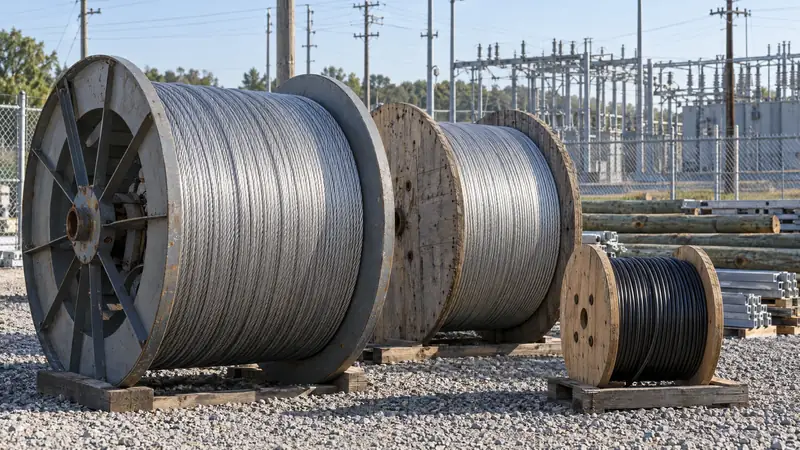
Ohio Wire Buyers buys reusable surplus ACSR, AAC, AAAC, ACSS and overhead service-drop cable from businesses anywhere in Ohio, including utilities, co-ops and line contractors. To sell ACSR conductor, send reel-tag photos, views of the conductor and remaining footage for review and a written offer before pickup. We buy usable material for resale and reuse, not scrap aluminum by the pound.
What do ACSR, AAC, AAAC and ACSS identify?
Bare aluminum strands can look similar while representing different products. ACSR means aluminum conductor, steel reinforced: hard-drawn aluminum wires surround a steel core. AAC means all aluminum conductor, with no steel core; Southwire's AAC specification identifies concentrically stranded aluminum wires and ASTM B231.
AAAC means all aluminum-alloy conductor. Southwire's AAAC-6201 uses an aluminum alloy for strength rather than a steel core. ACSS means aluminum conductor, steel supported; its aluminum is fully annealed, and the steel core carries most or all of the mechanical load. Do not group ACSS with ACSR simply because both have steel inside.
| Family | Construction identity | Detail needed for resale review |
|---|---|---|
| ACSR | Hard-drawn aluminum around a steel core; ASTM B232 | Aluminum size, aluminum/steel stranding and core designation |
| AAC | Stranded aluminum without steel; ASTM B231 | Size, strand count and stranding class |
| AAAC | Stranded aluminum alloy without steel | Alloy designation, code word and size |
| ACSS | Annealed aluminum around a supporting steel core; ASTM B856 | Full designation, including any core-strength suffix |
These are overhead product families, not interchangeable versions of insulated aluminum building wire. If your inventory includes several constructions, keep them separated within the broader wire and cable inventory we review.
Which code names and sizes should you record?
Bird and flower code words help identify bare conductor, but they should accompany the construction and size rather than replace them. The examples below come from Southwire's ACSR and AAC specification tables. For ACSR, aluminum/steel stranding records the number of wires in each material.
| Code word | Family | Listed conductor size | Listed stranding |
|---|---|---|---|
| Sparrow | ACSR | 2 AWG | 6 aluminum / 1 steel |
| Raven | ACSR | 1/0 AWG | 6 aluminum / 1 steel |
| Penguin | ACSR | 4/0 AWG | 6 aluminum / 1 steel |
| Linnet | ACSR | 336.4 kcmil | 26 aluminum / 7 steel |
| Drake | ACSR | 795 kcmil | 26 aluminum / 7 steel |
| Poppy | AAC | 1/0 AWG | 7 aluminum |
| Daisy | AAC | 266.8 kcmil | 7 aluminum |
| Tulip | AAC | 336.4 kcmil | 19 aluminum |
Southwire also lists Drake/ACSS, so “Drake” alone does not establish that a reel is ACSR. Its AAAC table includes city code words such as Akron and Canton; those names identify conductor, not where a seller or reel is located.
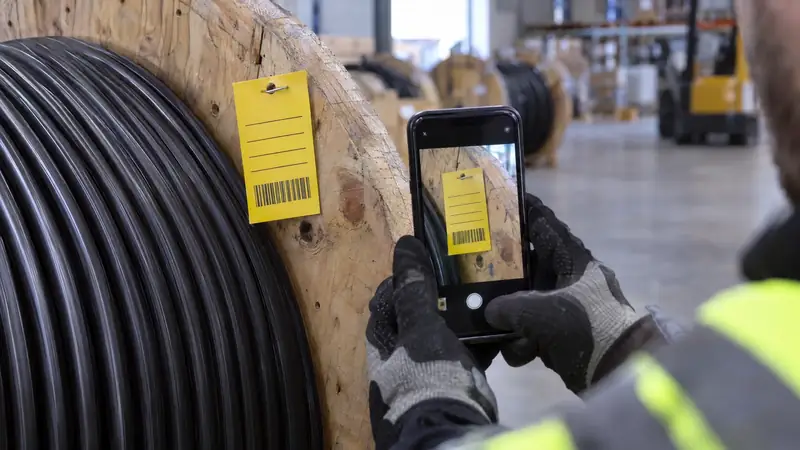
Copy the complete tag, including suffixes and stock numbers. Our guide to reading wire reel tags helps organize that information without guessing from diameter alone.
How is triplex service drop different from bare conductor?
Triplex service drop combines two insulated phase conductors with a neutral messenger. Quadruplex combines three insulated phase conductors with a neutral messenger. Southwire's service-drop catalog separates versions by messenger construction, including AAC, AAAC and ACSR, and lists reduced-neutral variants separately.
Do not assume every bundled aluminum cable is underground cable. Overhead service drop and underground distribution cable must be identified from their own tags and specifications. Record the phase size, neutral size, insulation material and messenger construction.
Names also vary by product family. Southwire's ACSR-neutral triplex specification lists Conch with 2 AWG phase conductors and Neritina with 1/0 AWG phases. Its ACSR-neutral quadruplex specification lists Palomino with 2 AWG phases and Appaloosa with 4/0 AWG phases. Photograph the full designation instead of assigning a cable type from a remembered animal name.
For insulated assemblies, include readable insulation markings and any cracking, cuts or flattened areas. Leave the assembly together; separating the messenger from the phase conductors changes what can be resold.
Can you sell ACSR conductor on partial reels?
Full factory reels and partial reels can be considered when the remaining conductor is reusable and identifiable. A long continuous remainder is different from a container of disconnected pieces. List each separate length rather than adding short pieces together and describing them as a continuous reel.
Bare conductor does not provide the same jacket-print clues as insulated cable. Start with original footage and documented issues or cuts, then explain whether the remainder is measured or estimated. Our remaining-footage guide explains ways to organize an estimate.
Never treat the reel's gross weight as conductor weight. The reel contributes its own weight, and ACSR includes both aluminum and steel. If you use a weight-based estimate, identify the exact construction, reel tare and manufacturer data used; uncertainty should remain visible in the lot list.
What condition problems affect reuse?
Photograph broken strands, tight kinks, flattened sections, loose strand bulges and corrosion rather than concealing them beneath the outer wrap. Tell us whether the material was unused, pulled but not installed, or removed from service. Prior installation and attached hardware require more explanation than a clean unused reel.
A dark surface alone does not establish that aluminum is scrap. Surface appearance and structural condition are different questions; photos should show both the discoloration and the surrounding strands. Do not grind, polish or straighten questionable areas just to improve the photograph.
Keep conductor off the ground and protect it from chemical exposure and handling damage. For removed material, have qualified personnel complete safe disconnection and removal before preparing it for sale. If it is no longer reusable, we say so; the difference between surplus value and scrap value explains why those buying decisions are separate.
Who owns the conductor and the steel reel?
Before offering utility or co-op surplus, confirm that the business authorizing the sale owns the material. Utility-furnished conductor left with a line contractor may not be that contractor's inventory. We verify the seller and proof of ownership and keep a written purchase record.
Reel ownership needs its own check. Southwire packages cable on steel and wooden reels and operates a reel-return program; a steel reel should not automatically be treated as disposable packaging. Check the purchasing terms, reel markings and any return obligation before including it in the sale.
Send reel serial numbers and state whether the reel must be returned or retained. Preserve factory identification when reviewing wire still on reels, and gather the relevant seller paperwork before material leaves the site.
What should you send for an overhead-conductor offer?
Prepare a reel-by-reel list with matching photos. For bare material, the reel tag and existing cut end are especially helpful because there may be no insulation legend to read. Do not cut a usable length solely to expose its core.
| Send this | Why it matters |
|---|---|
| Whole-lot and individual-reel photos | Connects each inventory entry to the actual reel |
| Complete tag and stock number | Distinguishes family, code word, size and suffixes |
| Existing cut-end and strand close-ups | Helps review the core and visible damage |
| Footage with its measurement basis | Separates confirmed lengths from estimates |
| Used-material history and ownership documents | Explains prior service and authority to sell |
| Reel dimensions, access and loading information | Helps plan pickup without assuming handling equipment |
We review the information and reply with questions or a written offer before pickup. Payment method and timing are confirmed in writing before pickup, and the count is checked against the written terms. The selling process covers those arrangements; Ohio Wire Buyers has no Ohio street address or drop-off yard.
Send your overhead-conductor inventory through the offer form, or call 951-403-5738. Keep the tags, continuous lengths and reel-return information intact so the review starts with an identifiable product rather than an unexplained aluminum lot.
Frequently asked questions
Can I sell an overhead conductor reel without its factory tag?
Send photos and any purchasing records you still have. A missing tag makes identification harder, especially when similar-looking conductors have different cores or alloy constructions. We may ask for the manufacturer's stock number, original invoice or a clear view of an existing cut end. An unidentified reel is not automatically accepted as reusable product.
Is an AAAC reel marked Akron connected to an Ohio pickup location?
Not necessarily. Akron appears as an AAAC conductor code word in Southwire's specification table; it identifies a conductor construction rather than the reel's location. Tell us separately where the material is stored. Ohio Wire Buyers arranges pickup anywhere in Ohio and has no Ohio street address or yard where sellers can deliver material.
Do I need to remove the steel core before selling ACSR?
No. Leave reusable ACSR intact because its aluminum strands and steel core together define the product. Separating them prevents resale as the original overhead conductor. Send the reel tag and existing cut-end photos instead. If the material is damaged beyond reuse, we will say so, and a scrap metal recycler may be the appropriate buyer.
Will utility surplus require proof of ownership?
Yes. We verify the seller and proof of ownership and keep a written purchase record. Useful documents include an invoice, purchase order, closeout paperwork or company letter. A contractor's possession of a utility reel does not by itself establish authority to sell it. Confirm who owns both the conductor and any returnable reel before requesting an offer.