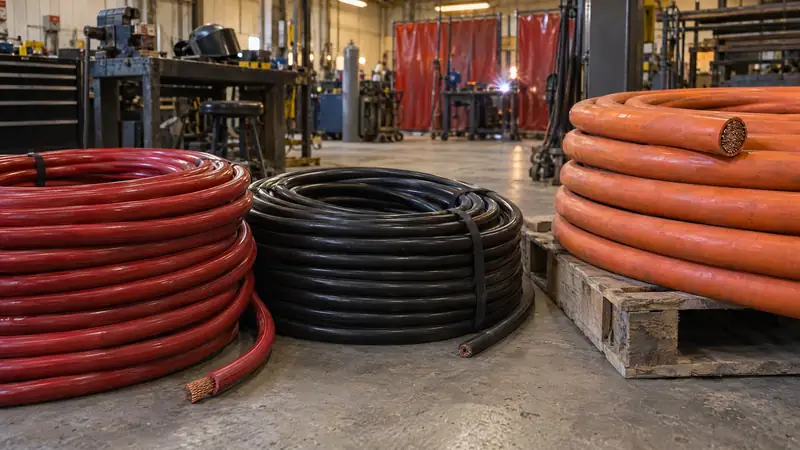
Ohio Wire Buyers buys reusable surplus 1/0 and 2/0 electrical wire and cable from businesses anywhere in Ohio, including feeder wire, aluminum primary cable and flexible welding or battery leads. To sell 1/0 wire or a mixed lot of these sizes, send product photos and a footage list for review and a written offer before pickup. We buy usable product for resale and reuse, not scrap metal by the pound.
How do you sell 1/0 wire without losing its identity?
Start with the complete marking, not just the conductor size. A reel of copper THHN, aluminum primary cable and flexible DLO can all carry an aught-size designation while being very different products. Copy 1/0 or 2/0 exactly; do not shorten either to 1 or 2.
Keep the reel tag attached and photograph the jacket legend. Record conductor material, insulation designation, manufacturer and color alongside the size. Our overview of wire sizes we buy helps organize adjacent sizes without mixing them into one entry.
For building wire, distinguish THHN/THWN-2 copper feeders from material marked XHHW-2. Preserve bare copper grounding wire as a separate inventory entry rather than combining it with insulated conductors.
What are the copper and aluminum ampacities?
The following values are from NEC Table 310.16, 2023 edition, reproduced in HELUKABEL's technical document. They apply to insulated conductors with not more than three current-carrying conductors in raceway, cable or earth, with a base ambient temperature of 30°C.
| Size | Copper, 60°C | Copper, 75°C | Copper, 90°C | Aluminum, 60°C | Aluminum, 75°C | Aluminum, 90°C |
|---|---|---|---|---|---|---|
| 1/0 AWG | 125 A | 150 A | 170 A | 100 A | 120 A | 135 A |
| 2/0 AWG | 145 A | 175 A | 195 A | 115 A | 135 A | 150 A |
Terminations and conditions of use govern the actual rating. Insulation temperature rating alone does not authorize use of the highest column; ambient-temperature corrections and conductor-count adjustments may apply. These are reference values, not a circuit-design recommendation or a welding-lead duty-cycle chart.
Do not apply this table to the shielded primary URD example below. Its medium-voltage construction requires an appropriate engineering evaluation. For an offer, the actual product legend is more useful than describing a reel only by an assumed amperage.
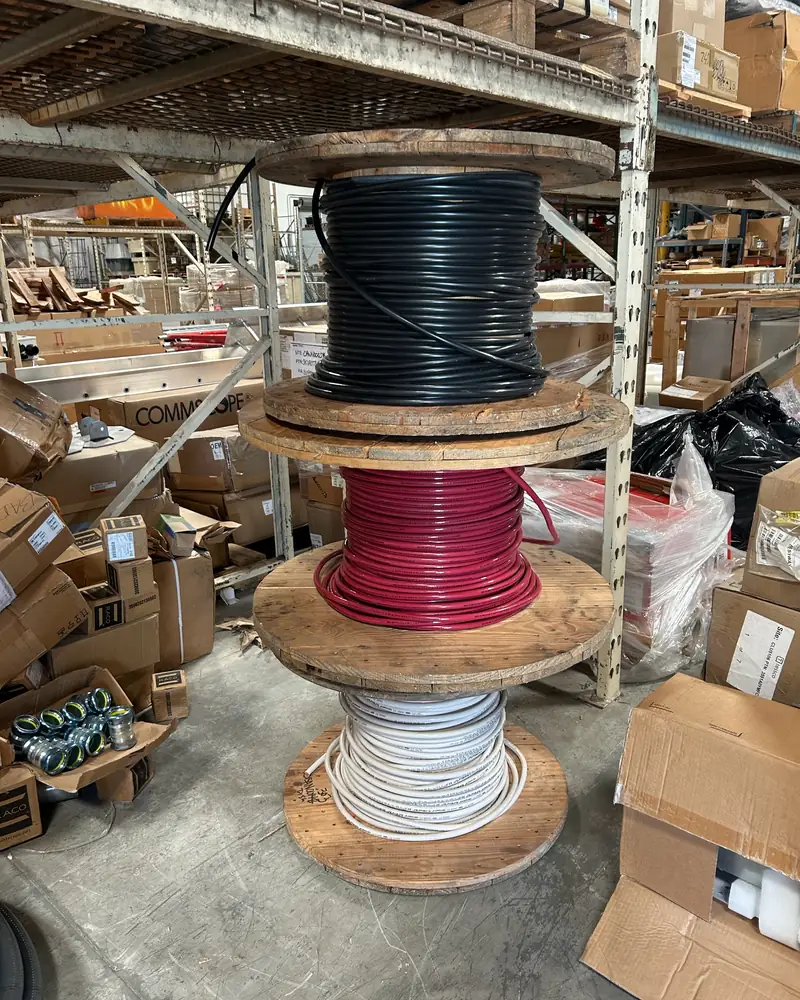
How much do THHN reels weigh, and what put-ups exist?
Southwire's specifications distinguish copper content from the weight of the complete insulated wire. That distinction matters when a seller uses a scale to estimate footage: insulation contributes weight, and the empty reel contributes additional tare weight.
| Copper THHN size | Approximate copper weight per 1,000 ft | Approximate insulated-wire weight per 1,000 ft | Examples of listed THHN reel put-ups | Uses to identify in the lot |
|---|---|---|---|---|
| 1/0 AWG | 326 lb | 374 lb | 500, 1,000 and 2,500 ft | Service and feeder conductors; keep grounding wire separately identified |
| 2/0 AWG | 410 lb | 464 lb | 500, 1,000 and 2,500 ft | Service and feeder conductors; distinguish flexible welding or battery leads |
Weights are approximate and attributed to Southwire's corresponding copper SIMpull THHN/THWN-2 product specifications. They exclude the reel and are not weights for welding cable, DLO or aluminum cable. The put-ups are manufacturer-listed examples, not a statement about every brand or current availability.
An opened factory reel may contain much less than its original label states. Use remaining footage, not original packaging length, in your inventory list.
What identifies 1/0 aluminum primary URD?
The words “1/0 aluminum” are not enough to identify primary distribution cable. Southwire's verified example is a 15 kV product with tree-retardant cross-linked polyethylene insulation, a 100% insulation level, a full concentric neutral of copper wires and a polyethylene outer jacket. Its construction differs substantially from an individual aluminum building-wire conductor.
For surplus primary URD cable, send the complete tag and an existing accessible cut-end photo showing the layers. Include the voltage class, insulation level and neutral configuration exactly as marked. Do not identify a reel solely by jacket stripes or a utility stock number without supporting documentation.
Keep factory end seals or caps intact. Disclose missing seals, exposed ends and outdoor storage history. Do not cut open a sealed end just to make a better photo; existing product records may resolve the identification without disturbing the cable.
Are 2/0 welding cable and DLO interchangeable?
No. Matching size and flexibility do not establish matching listings or applications. Southwire's Super Excelene specification identifies 2/0 welding cable intended for welding leads and also describes battery-lead applications. Its construction uses rope-stranded bare copper, while Southwire's DLO overview describes a flexible tinned-copper conductor with insulation and an outer jacket.
List 2/0 welding cable separately from DLO power cable. For DLO, record any RHH/RHW-2 designation and voltage marking; for welding cable, preserve the actual manufacturer legend rather than assuming every flexible lead has the same rating.
Lugged lengths need close-ups of both terminations and the jacket near each lug. Fine-stranded cable requires suitable connectors, so an attached lug is not proof that a lead is ready for another installation. Explain whether the pieces are unused leftovers or removed from service.
Which partial reels and cut lengths are worth reviewing?
Continuous, identifiable footage is the starting point. A partial reel with a readable legend gives us more useful information than the same wire chopped into transport-sized pieces. Keep colors and types separate, and disclose whether a reel contains one continuous piece or several unrelated lengths.
For cut lengths, list each piece individually rather than adding everything into one total. Mark splices, pulling damage, crushed insulation, heat exposure or corrosion in the notes. Used cable is considered only if it remains reusable; photos cannot erase a known service or damage history.
If footage is uncertain, say “estimated” and explain the method. Our guide to measuring wire remaining on a reel covers the evidence to gather. Do not strip insulation or unwind heavy cable simply to improve an estimate before review.
What should you send for a 1/0 or 2/0 offer?
Assign each reel or coil a lot identifier that matches its photos and inventory entry. For these sizes, separating flexible leads from feeder wire and primary cable is especially important. Send a whole-lot view first, followed by the details below.
| Material in your lot | Information to send |
|---|---|
| THHN or XHHW-2 reels | Size, copper or aluminum identification, color, tag, jacket print and remaining continuous footage |
| Primary aluminum cable | Voltage class, insulation level, neutral configuration, reel identification and end-seal condition |
| Welding, battery or DLO lengths | Full legend, individual lengths, lug photos, jacket condition and unused or removed-from-service status |
| Bare grounding conductor | Conductor identification, packaging, individual footage and visible condition |
Include proof of ownership, such as an invoice, purchase order, closeout paperwork or company letter. If tag abbreviations are unclear, the wire reel tag guide explains which fields to photograph. Send uncertainty with the lot description rather than presenting a guess as a confirmed specification.
How does pickup work for an Ohio lot?
Ohio Wire Buyers reviews the material and replies with questions or a written offer before pickup. Payment method and timing are confirmed in writing before pickup, and we verify the seller and ownership documentation while keeping a written purchase record. The selling process explains these steps.
We arrange pickup at your Ohio jobsite, warehouse, plant or yard. We have no Ohio street address and do not accept drop-offs. Describe access, loading equipment and damaged reel flanges before arrangements are made. At pickup, the count is checked against the written terms; if material is not reusable, we say so.
To have your surplus reviewed, request an offer for your identified wire lot with tags, jacket photos and footage, or call 951-403-5738. Keep the cable intact while we review what you have.
Frequently asked questions
Is 1/0 wire the same size as 1 AWG?
No. Manufacturer specifications list 1 AWG and 1/0 AWG as separate conductor sizes. Copy the slash and zero exactly when making your inventory list, and photograph the size marking rather than relying on appearance. A handwritten label that says only 1 can lead to the wrong product identification. Keep 2 AWG and 2/0 AWG separate for the same reason.
Do you buy 2/0 battery cables with lugs attached?
Ohio Wire Buyers reviews reusable cable lengths with lugs attached. Send the jacket legend, length of each piece, cut-end or exposed-conductor photos where safely accessible, and close-ups of both terminations. Explain whether the cable is unused or removed from service. Attached lugs do not establish cable condition or suitability for another installation, so leave them intact while the lot is reviewed.
Can I sell a mixed lot of copper and aluminum feeder wire?
Yes, you can submit a mixed lot for review, but list copper and aluminum separately. Within each material, separate the size, insulation type, color and continuous length. Photograph the corresponding reel tag for each entry. Identifiable reusable product can be evaluated more accurately than a combined weight or a description such as assorted heavy wire.
Will an original reel label prove how much wire remains?
Not by itself if the reel has been opened or used. The label describes the original put-up, not necessarily the remaining footage. Send the label along with available jacket footage marks, pull records or a clearly labeled estimate. Tell us whether the reel contains one continuous piece or separate lengths, and do not unwind it solely to obtain a photo.
Do you pay for 1/0 copper wire by the pound?
Ohio Wire Buyers buys reusable surplus wire as product for resale and reuse, not as scrap metal by the pound. Type, conductor material, continuous footage, condition and identification matter to the review. Manufacturer weights can help explain a lot, but they are not a purchase-price schedule. If the material is not reusable, we say so; a scrap metal recycler may be the appropriate buyer.
Sources and further reading
- HELUKABEL allowable ampacity tables — NFPA 70, NEC 2023
- Southwire 1/0 copper SIMpull THHN/THWN-2 — weights and packaging
- Southwire 2/0 copper SIMpull THHN/THWN-2 — weights and packaging
- Southwire 1/0 aluminum 15 kV TRXLPE full-neutral primary cable
- Southwire Diesel Locomotive Cable Overview
- Southwire Royal Super Excelene welding cable — SPEC 70300