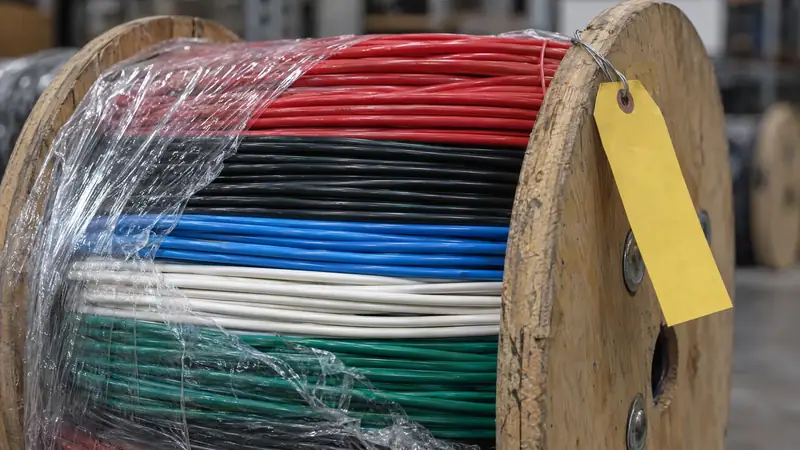
Ohio Wire Buyers buys reusable surplus 10 and 8 AWG electrical wire and cable from businesses anywhere in Ohio, including full reels, partial reels, boxed coils and cut lengths. To sell 10 AWG wire or leftover 8 gauge cable, send identification photos and remaining footage for review and a written offer before pickup. We buy it as product for resale and reuse, not as scrap metal by the pound.
What identifies a usable 10 or 8 gauge lot?
Start with the insulation or jacket print, not the apparent thickness. Record the AWG size, copper or aluminum conductor, insulation designation, manufacturer and any voltage or temperature markings. A thick jacket does not mean a larger conductor, and a multiconductor cable cannot be identified reliably from its outside diameter alone.
For loose building wire, distinguish solid from stranded construction and separate colors. For cable, record the conductor count and grounding arrangement as well. Our overview of wire sizes we buy helps place these gauges alongside other surplus, but the tag and print identify the actual product.
What are the ampacity, weight and packaging differences?
The ampacities below are from NEC Table 310.16, 2023 edition, as reproduced in HELUKABEL's allowable ampacity tables. They apply to the table's conditions: not more than three current-carrying conductors in raceway, cable or earth, with a 30°C ambient reference. Terminations and conditions of use govern the actual rating.
| Size | Copper amps, 60/75/90°C | Aluminum or copper-clad aluminum amps, 60/75/90°C | Approx. copper THHN net weight, lb/1,000 ft | Example factory reel put-ups | Application examples, subject to design |
|---|---|---|---|---|---|
| 10 AWG | 30 / 35 / 40 | 25 / 30 / 35 | 38, stranded | 2,500 ft | Appliance branch circuits; separately rated PV wire |
| 8 AWG | 40 / 50 / 55 | 35 / 40 / 45 | 62, stranded | 500, 1,000, 2,500 or 5,000 ft | Feeder conductors; three-conductor tray cable |
Weights and THHN reel put-ups are from the Encore copper THHN specification. These approximate net weights include insulation and nylon, but exclude the reel; they are not bare-copper metal weights. Packaging examples are not an acceptance minimum or proof of how much remains on an opened reel.
The aluminum columns identify table values, not a promise that copper and aluminum are interchangeable. Confirm the conductor material from documentation and the cut end rather than the insulation color.
Which wire families should you keep separate?
THHN/THWN-2 building wire: These are individual insulated conductors. Encore's specification describes copper conductors with PVC insulation and a nylon covering, rated for 600-volt applications. Keep surplus THHN and THWN-2 wire organized by size, color and solid or stranded construction; do not combine unlike products on an unmarked reel.
NM-B cable: Identify 10/2, 10/3 and 8/3 with ground as complete cable assemblies, not loose THHN. Southwire lists these configurations and states that NM-B is for dry locations with ampacity limited to the 60°C conductor rating. Its NM-B specification also says the internal conductors are not separately listed as THHN and must not be installed apart from the complete cable.
Cerrowire lists electric dryers and larger air-conditioning equipment among application examples for 10/3 NM-B. That explains why appliance-job leftovers deserve careful identification; it does not make every leftover suitable for another appliance. Keep reusable NM-B coils intact and read the jacket rather than relying on color.
PV wire: A solar-project coil needs its own rating information. Southwire's photovoltaic specification lists both sizes in a 2,000-volt copper product with XLPE insulation and a 90°C wet-or-dry rating. Photograph the actual print when submitting surplus solar PV wire; do not assume ordinary black THHN is the same product.
Tray and grounding material: Southwire lists an 8 AWG, three-conductor TC-ER cable with a separate grounding conductor. For multiconductor tray cable, document the assembly, not merely the largest conductor. Keep any bare copper surplus in a separate inventory line instead of grouping all copper by weight.
Why isn't the ampacity column a breaker recommendation?
An insulation marking does not select the circuit rating. NEC overcurrent-protection rules generally limit 10 AWG copper to 30 amps unless another applicable Code provision permits otherwise. A higher table value is not blanket permission to increase the breaker.
NM-B has its own ampacity limitation, while ambient heat and conductor grouping can require adjustments. Equipment terminals also matter. These distinctions help describe resale inventory accurately; a qualified electrician must determine suitability for the next installation.
What makes partial reels and cut lengths easier to resell?
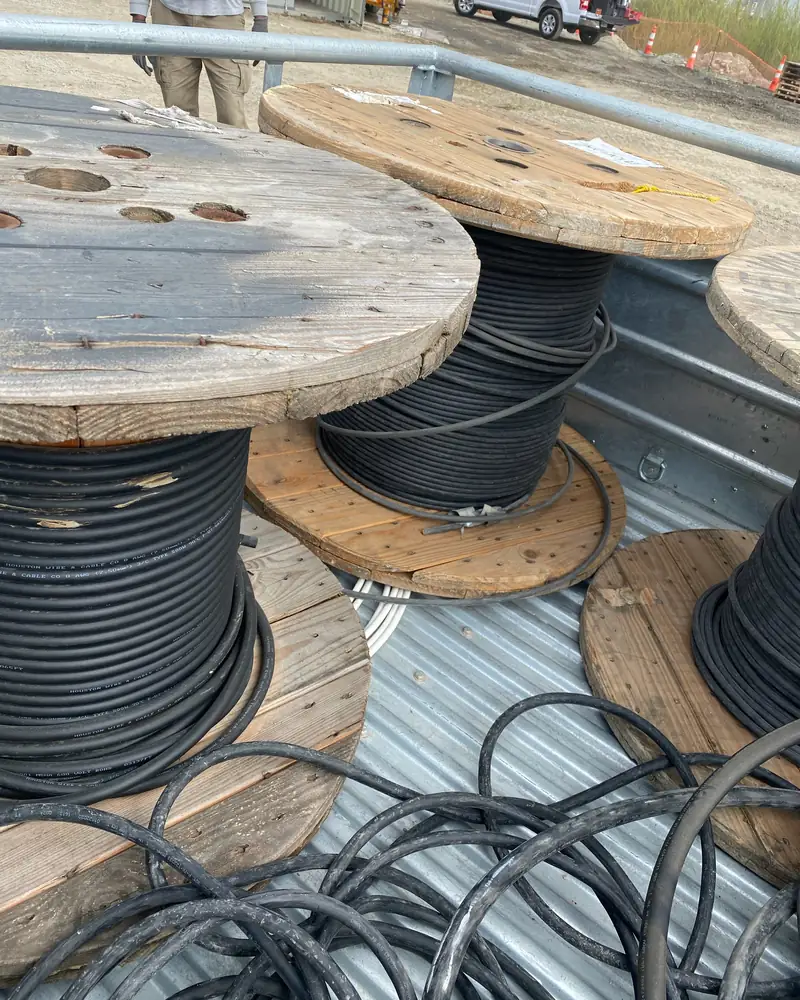
Preserve continuous runs and original identification. A labeled reel of uniform wire is easier to review than a bin of loose ends whose types cannot be distinguished. Keep coils secured without crushing the insulation, and disclose splices, exposed copper, scraped nylon, flattened cable or damaged reel flanges.
For appliance-work leftovers, distinguish a continuous cable run from separate pieces that merely add up to the same total footage. For tray cable, describe jacket damage and the condition of the grounding conductor. Used material is considered only if it remains reusable; tell us its service and storage history rather than calling removed cable new.
Unknown footage does not justify cutting the material down. Label an estimate as an estimate and explain whether it comes from withdrawal records, measurements or another method. Our guide to measuring wire left on a reel covers ways to establish a better quantity without guessing from the flange label.
How do you sell 10 AWG wire and 8 AWG leftovers?
Prepare a lot list with a separate line for each product and continuous length. If the material came from HVAC, water-heater, dryer or solar work, include that context, but let the markings establish what the wire actually is. The following details make this size group easier to review.
| Send this detail | Why it matters for the offer |
|---|---|
| Whole-lot photo plus each reel or coil label | Distinguishes factory packages from partial or re-reeled inventory |
| Readable print showing gauge, type and conductor material | Separates similar-looking THHN, PV wire and cable assemblies |
| Cut-end photo for multiconductor cable | Shows conductor count and grounding arrangement |
| Remaining footage for each continuous piece | Avoids treating unrelated short pieces as one usable run |
| Condition notes and ownership paperwork | Discloses damage and supports seller verification |
Include the pickup location and loading access. Do not strip sound insulation to demonstrate copper content; that changes the product being offered. If the wire is not reusable, we say so, and a scrap metal recycler may be the right buyer. See the surplus-versus-scrap comparison before deciding to cut or strip a lot.
What happens before pickup in Ohio?
We review the photos and footage, then reply with questions or a written offer before pickup. Payment method and timing are confirmed in writing before pickup. We verify the seller and proof of ownership, keep a written purchase record, arrange pickup at the seller's jobsite, warehouse, plant or yard, and check the count against the written terms.
The selling process explains these steps. Ohio Wire Buyers has no Ohio street address, office, yard or drop-off, so do not transport the material to an assumed local location.
Ready to clear identified reels or coils? Request an offer for your 10 and 8 AWG surplus, or call 951-403-5738 to discuss what photos and footage to send.
Frequently asked questions
Can I sell an opened carton of 10 gauge wire?
Yes. Ohio Wire Buyers reviews opened cartons and partial coils when the wire remains reusable. Keep the original label and distinguish the carton quantity from the footage actually left in each package. Photograph each coil, the insulation print and any damage, then send your footage estimate with the rest of the lot. Acceptance depends on the material and condition.
Is 8 AWG tray cable valued like loose 8 gauge THHN?
No. A tray cable is a complete assembly with multiple conductors, a jacket and a specified grounding arrangement. Loose THHN is single-conductor building wire. We review each as its own reusable product, considering identification, remaining length and condition. Keep tray cable intact rather than stripping it into separate conductors or presenting its weight as if it were a THHN reel.
Will you review mixed colors of 10 and 8 AWG wire together?
Yes. You can submit mixed colors in one surplus lot, but list each gauge, wire type, color and continuous length separately. Matching colors do not prove matching insulation ratings or conductor material. Photos of the print and tags help us distinguish otherwise similar coils and avoid treating several unrelated products as one interchangeable item.
Does a 90°C marking mean I can use a larger breaker?
Not by itself. The insulation temperature rating is only part of conductor selection. Termination limits, installation conditions, cable-specific rules and overcurrent-protection requirements also apply. The 2023 NEC Table 310.16 values shown here help identify surplus material; they are not approval for a particular circuit. A qualified electrician must evaluate the actual installation.
Can you collect surplus wire where my business stores it?
Yes. We arrange pickup at the seller's Ohio jobsite, warehouse, plant or yard. Ohio Wire Buyers has no Ohio street address, office, yard or drop-off. Send material details first. The written offer comes before pickup, and payment method and timing are confirmed in writing before pickup as well.
Sources and further reading
- HELUKABEL allowable ampacity tables, NFPA 70: NEC 2023
- Encore Wire copper THHN product sheet: construction, approximate net weights and packaging
- Southwire SPEC 10028: copper Type NM-B cable
- Southwire SPEC 45411: copper photovoltaic wire
- Southwire SPEC 45251: three-conductor copper TC-ER power cable
- Cerrowire applications charts