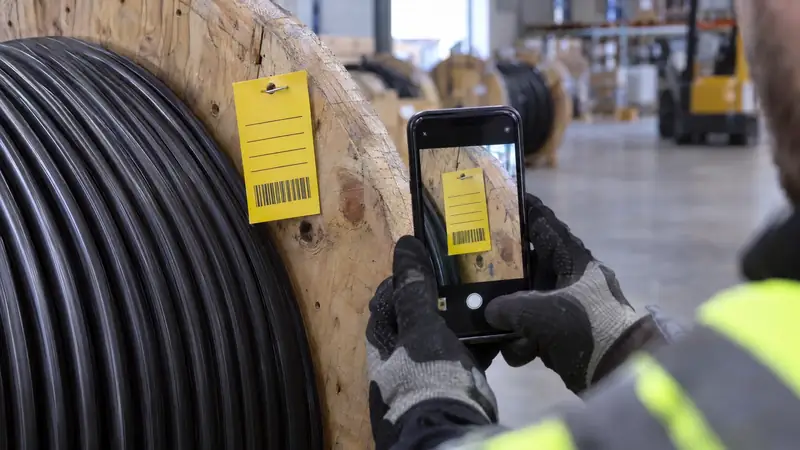
To understand how to read a wire reel tag, identify the manufacturer and product number, then check the wire type, conductor size, material, ratings and original footage against the cable itself. Ohio Wire Buyers uses those details, jacket photos and remaining-length information to review reusable surplus electrical wire and cable from businesses anywhere in Ohio.
How to read a wire reel tag in the right order
Start with the written product description, not the largest number or barcode. Record the manufacturer and catalog or stock number exactly, preserving suffixes and leading zeros. Then read the size, conductor material, type designation, color and length unit.
Next, compare the tag with the wire wound on that reel. A factory label can remain on a flange after cable has been transferred or partly used. The tag identifies the original package; it does not automatically prove the identity or quantity of its current contents. Our wire selling guides cover the separate checks needed before offering a surplus lot.
What do the fields on a wire reel label mean?
Field names and placement vary. Southwire's reel packaging document lists the manufacturer, product description, footage, gross/tare/net weights, stock number, operator and manufacturing date. Other information may appear in the description, on an additional label or in the jacket legend rather than in its own box.
| Field to look for | What to record | What it helps establish |
|---|---|---|
| Manufacturer | Printed company or brand name | Whose catalog to consult |
| Catalog, stock or product number | Complete identifier, including suffixes | Exact product and package lookup |
| Wire or cable type | THHN/THWN-2, XHHW-2, TC or other printed designation | Product family and marked uses |
| Size | AWG or kcmil value exactly as printed | Conductor cross-sectional size |
| Conductor material | Copper, CU, aluminum, AL or another designation | Metal, not armor material |
| Conductor count | Written count and any ground designation | Cable construction |
| Voltage | Value and unit as marked | Voltage rating, not ampacity |
| Length | Quantity and feet or meters | Labeled package length |
| Reel, serial or lot identifier | Each separately named identifier | Traceability and matching records |
| Date | Date plus its field heading | Manufacture or another documented event |
| Weight | Gross, tare and net fields with units | Package versus product weight |
| Listing or certification mark | Complete mark and accompanying text | Certification identification |
| Color | Written color or color code | Insulation or jacket variant |
If a field is absent, mark it unknown. Do not fill the gap by assuming every black cable has the same construction.
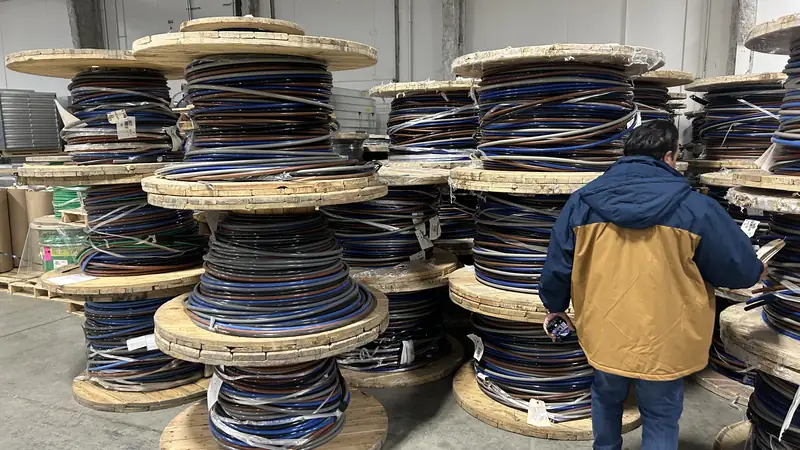
How do you check type, size and conductor material?
Copy the entire type string. For example, THHN/THWN-2 identifies more than THHN alone. Southwire's copper specification gives THHN a dry-location temperature rating of 90°C and THWN-2 a wet-or-dry rating of 90°C, with a separate limitation for oil exposure. Its voltage rating is 600 volts. Those ratings do not establish the allowable current for an installation.
A description such as “500 kcmil copper THHN/THWN-2” identifies size, metal and wire type. It does not tell you the remaining length or prove an unopened package. See our THHN and THWN-2 surplus guide for that product family.
Preserve the slash in an AWG size rather than rewriting it from memory. Use the AWG and kcmil size explanation when interpreting the size field. For metal-clad cable, aluminum armor does not establish aluminum conductors; check the conductor description separately.
Does printed footage equal what is left?
Not on a partial reel. Factory footage describes the supplied package, while a handwritten balance may reflect an estimate or a later cut. Keep both entries in your inventory and identify which one describes the material being offered.
Check for sequential jacket markings, but establish how that manufacturer's system works before treating an exposed number as the balance. Encore's SmartCount system, for applicable master reels, starts with the total and counts down along the wire. That is a manufacturer-specific feature, not a rule for every cable.
Record visible length marks and any cutting history. If the inner end is inaccessible, do not unwind a heavy reel solely to locate it for a photo. Our guide to measuring wire left on a reel explains how to document an estimate without presenting it as verified footage.
What do weights, dates and reel numbers tell you?
Gross weight includes the package; tare is the empty packaging weight; net is the product weight. A net cable weight includes insulation and other cable components, not just copper or aluminum. Original shipping weights also stop representing the current load after material is removed.
Distinguish weight units and headings before using them for handling plans. A reel model designation is not necessarily a unique serial number, and neither is a conductor size. Send every identifier with its heading; the reel sizes and weights guide addresses packaging and loading information.
Read dates the same way: preserve whether the heading says manufacture, shipment or something else. Southwire's storage guidance says its products have no defined shelf life when properly stored and undamaged. A date alone neither condemns older wire nor clears it for reuse.
Why don't manufacturers' labels look the same?
Manufacturers separate product, packaging and traceability information differently. Southwire's listed reel fields include weights and manufacturing date. Encore also provides identification on the cable itself: its SmartColorID labels for MC and AC products identify details such as gauge, conductor count, cable type and inner-conductor colors.
These supplementary labels are not substitutes for photographing the reel's original identification. They are useful cross-checks, especially for surplus MC cable whose conductors are hidden by armor. Do not cut armor simply to confirm information already available on a readable label.
Certification deserves its own check. The UL Solutions application guide identifies the complete mark on the coil, reel, flange or box as the evidence of its certification coverage. Letters or symbols printed on the cable are supplemental, not equivalent evidence on their own.
What if the tag is missing or disagrees with the jacket?
Photograph the disagreement and describe it plainly. Do not rename the wire based on whichever label seems easier to sell. A distributor sticker, old flange tag and current jacket legend may represent different stages of handling.
Use our cable jacket print guide to capture the repeating legend. Add purchase records or a manufacturer specification tied to the product number where available. If neither the tag nor the wire can establish identity, report it as unidentified rather than guessing a rating or conductor size.
What should you photograph for an offer?
Photograph the whole reel first, then the complete tag and a focused close-up of its smallest readable fields. Avoid glare, fingers over numbers and crops that remove units. Give that reel a seller-assigned inventory name and use it for every related photo and list entry.
Include jacket print, an existing exposed cut end and the whole lot. Do not remove sealed end caps just for identification. Send original footage separately from estimated footage remaining, plus notes on splices, re-reeling, storage and visible damage. Our wire offer photo checklist helps organize mixed lots.
Include seller identification and available proof of ownership. Ohio Wire Buyers reviews the material and replies with questions or a written offer before pickup. Payment method and timing are confirmed in writing before pickup; see how selling surplus wire works. We buy reusable product for resale and reuse, not scrap metal by the pound.
Send your matched tag photos and footage list through the surplus wire offer form, or call 951-403-5738. Tell us where the material sits in Ohio so we can review the lot and arrange pickup under the written terms.
Frequently asked questions
Can I sell surplus wire without its original reel label?
You can send it for review, but a missing label leaves more identification work. Photograph the jacket print, the whole reel and any existing exposed end, then include purchase or closeout records if available. Ohio Wire Buyers may ask for more information before deciding whether the material is reusable and making a written offer.
Should I peel off an old label before photographing the reel?
Leave the original label attached and photograph it in place. Removing it can damage the printing or separate the product identity from the reel. If a newer inventory sticker covers part of it, send photos showing both labels and explain what each represents rather than discarding the older identification.
Does a barcode identify the exact cable construction?
A barcode is useful only with the information or system behind it. Send a clear photograph of the barcode and the readable product number beside it, along with the written cable description. Do not substitute a scanned number for photographs of wire type, size, conductor material and jacket print.
Is a manufacturing date on a wire reel an expiration date?
Not by itself. Southwire states that its wire and cable products do not have a defined shelf life when appropriately stored and undamaged. That statement is not a guarantee for every surplus reel or manufacturer. Storage history, physical condition, product identification and intended application still need review before reuse.