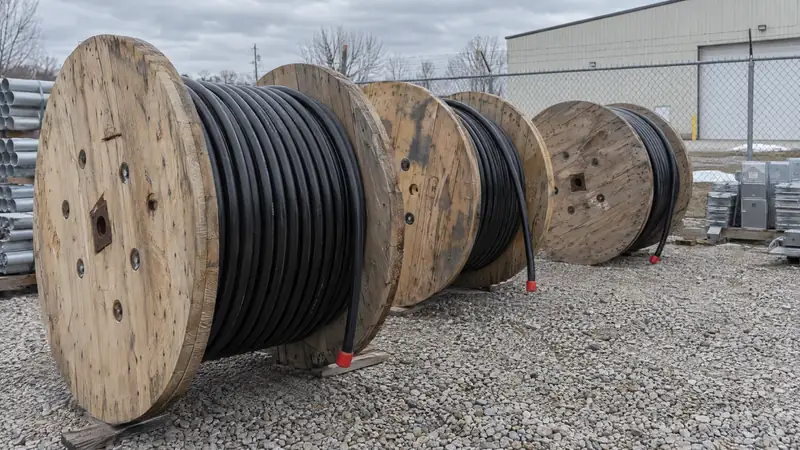
Ohio Wire Buyers buys reusable surplus USE-2, RHH and RHW-2 copper or aluminum wire from businesses anywhere in Ohio, including full reels, partial reels and usable cut lengths. To sell USE-2 wire, send photos of the complete insulation print, reel tags and conductor ends with a footage list or estimate; we review the lot and provide a written offer before arranging pickup. These conductors belong among the wire and cable types we buy, but their individual ratings need to remain identifiable.
How do you sell USE-2 wire without losing its product value?
Leave the insulation intact and preserve each continuous length. A tagged partial reel can be evaluated for another installation; the same conductor chopped into short pieces or stripped loses that product identity. Do not cut it down just to make a pile easier to move.
Describe the lot by manufacturer, conductor metal, size, printed ratings and footage rather than simply calling it underground wire. Separate unused leftovers from previously installed material. Tell us if a reel was rewound or contains multiple pieces, because a single reel does not necessarily hold one uninterrupted length.
An offer depends on usable product, condition and demand, not a promise that every underground conductor has a resale market. Our surplus-versus-scrap guide explains the distinction when damaged insulation or unusable lengths change the appropriate buyer.
What do USE-2, RHH and RHW-2 mean?
Triple-rated wire carries different designations on the same conductor, not three separate insulation layers. Southwire's copper product uses cross-linked polyethylene, also called XLPE or XLP. Encore offers a triple-rated aluminum version as well.
| Marking | What it identifies | What to check when selling |
|---|---|---|
| USE-2 | Underground service-entrance cable rated for 90°C wet or dry use | Complete designation, voltage and service-cable listing |
| RHH | Thermoset-insulated conductor with a 90°C dry-location rating | Confirm the separate wet-location designation if present |
| RHW-2 | Thermoset-insulated, moisture-resistant conductor rated 90°C wet or dry | Preserve the suffix; RHW is not the same designation |
| XLPE or XLP | Cross-linked polyethylene insulation construction | Match the manufacturer and product number to its sheet |
UL's coding guide identifies R as thermoset insulation, HH as the higher heat designation and W as moisture resistance. The suffix -2 identifies evaluation for 90°C wet and dry use. The R does not prove that a particular reel has a separate rubber jacket.
Southwire lists UL 44 for thermoset-insulated wire and UL 854 for service-entrance cable. Keep these distinctions when sorting alongside XHHW-2 feeder wire; similar black insulation does not establish the same listings.
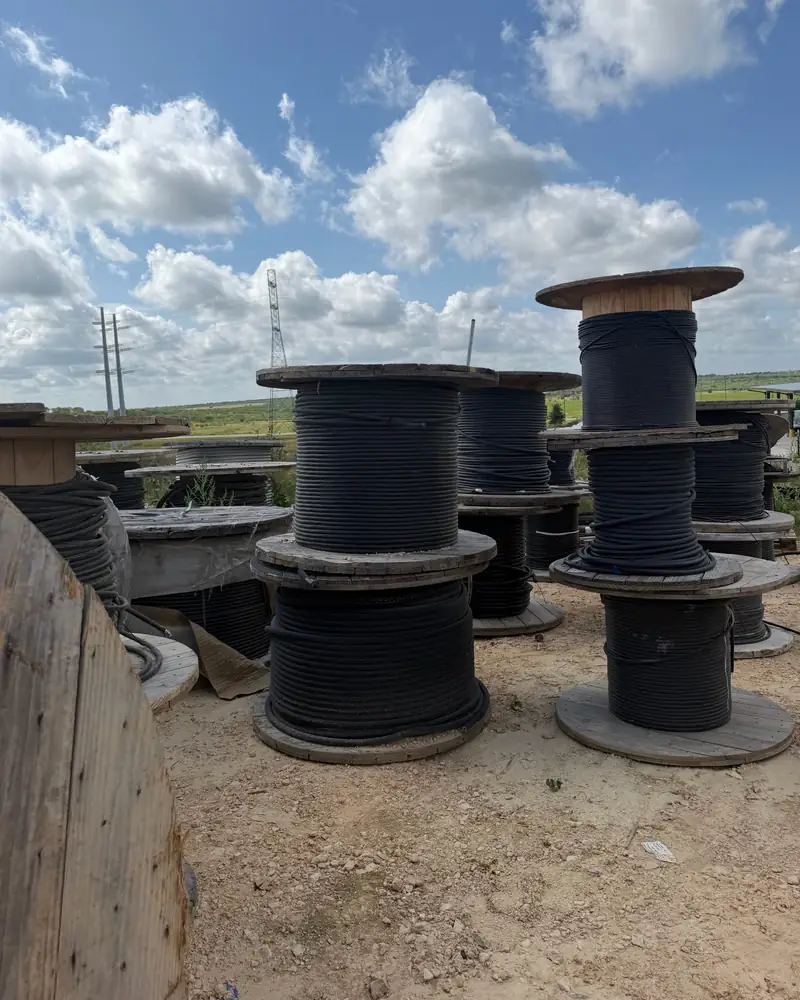
Is your reel 600 V, 1,000 V or 2,000 V?
Read the voltage attached to each type designation. Southwire SPEC 10010 identifies its copper product as 600 V USE-2 or 1,000 V RHH/RHW-2. Its SPEC 45502 distinguishes 2,000 V RHH/RHW-2 from 600 V USE-2 and limits the described direct-burial application to 600 V.
That distinction matters when someone labels a lot simply as “2 kV underground wire.” A higher RHH/RHW-2 rating does not raise the USE-2 rating. Photograph enough of the repeating legend to capture both entries, even if that requires separate overlapping photos.
UL 854 covers below-ground USE and USE-2 service cables and does not require a cable flame test for USE-only cable. Do not market an underground-only product as interchangeable general building wire. Preserve any additional RHH/RHW-2 markings so its separate suitability can be checked. Our cable-print reading guide helps organize those details without guessing.
What makes copper and aluminum lots different?
Southwire's referenced copper family includes solid and stranded constructions. Encore's referenced aluminum product uses Aluminum Alloy 8000 Series conductors and lists sizes from 8 AWG through 1000 kcmil. Those are manufacturer product ranges, not a requirement that your entire lot match one catalog.
Record the size exactly as printed. A copper conductor and an aluminum conductor with the same size designation are not equivalent products simply because both say RHW-2. Keep separate lot entries for conductor metal, size, color and ratings so the next buyer can match a specification.
Photograph an existing exposed end without stripping usable wire just for the picture. When the metal is uncertain, the reel tag and manufacturer's sheet are better evidence than a distant view of the cut face. Related aluminum building wire should remain separately identified, even if it shares storage space with this lot.
Why does USE-2 show up in solar surplus?
USE-2 has a history in outdoor solar-panel interconnections, including grounded photovoltaic systems. KrisTech's comparison explains that dedicated PV wire later displaced much of that use. A solar-project origin therefore helps explain the inventory, but it does not establish its current installation permissions.
Look for an actual PV designation before calling the material photovoltaic wire. UL 4703 is the product standard for PV wire; a USE-2 marking alone does not establish that listing. Some products carry several ratings, so retain the complete legend rather than choosing whichever description sounds most marketable.
Keep surplus solar PV wire separate from USE-only material on the offer list. We need the product's documented identity, not just the project name or the color of its insulation.
How do partial reels and removed cable affect an offer?
For a partial reel, report the remaining continuous length, not the footage originally shipped. Keep the original tag, but label its quantity as original if wire has already been pulled. If you cannot measure what remains, clearly identify your footage as an estimate.
Do not unwind a heavy reel merely to count turns for an inquiry. Send visible footage markings, reel details and any purchase or closeout records first. Our remaining-footage guide explains the information useful for assessing a partial reel.
Removed cable needs a different description from unused surplus. Disclose splices, scraping, crushed sections, tight kinks, damaged ends and known chemical or heat exposure. A direct-burial rating is not proof that cable survived excavation or removal without damage. Photos cannot establish electrical serviceability; used cable is considered only when still reusable, with removal handled by qualified people after de-energization.
What should you send for a USE-2/RHW-2 offer?
Make each reel or coil traceable to its photos. A simple lot identifier lets us match a tag to the correct insulation print and footage entry instead of assuming every black reel contains the same product.
| Send this item | Detail specific to this wire |
|---|---|
| Complete lot photo | Show separate reels, coils and cut lengths, including mixed material |
| Reel tag | Capture manufacturer, product number, conductor metal, size and original footage |
| Insulation legend | Include USE-2, RHH, RHW-2, voltage entries and any PV or sunlight-resistance marking |
| Existing cut ends | Show conductor construction and visible end condition |
| Footage list | Distinguish continuous lengths, estimates, original quantities and spliced pieces |
| Condition and records | State unused or removed, storage history, known damage and proof of ownership |
Send the information even if some tags are missing; explain what remains unknown. Avoid supplying an assumed voltage or a size inferred only from outside diameter. We verify the seller and ownership using an invoice, purchase order, closeout paperwork or company letter and keep a written purchase record.
Keeping the lot ready for Ohio pickup
Keep loose ends secured and protect insulation from sharp reel hardware and handling damage. Do not cover the only readable legend with tape or paint. Photograph damaged flanges and tell us whether the reel can be moved safely, rather than rewinding it solely to make it look better.
Ohio Wire Buyers arranges pickup at the seller's Ohio jobsite, warehouse, plant or yard; there is no Ohio office, yard or drop-off address. Describe access and available loading equipment when sending the lot details. We review the information and reply with questions or a written offer, confirm payment method and timing in writing before pickup, and check the count against the written terms. The selling process explains those steps.
Ready to offer your reusable underground service or RHW-2 surplus? Send your wire details for an offer or call 951-403-5738 with the insulation markings and remaining footage handy.
Frequently asked questions
Do you buy aluminum USE-2 wire as well as copper?
Yes. Ohio Wire Buyers reviews reusable surplus copper and aluminum wire from businesses anywhere in Ohio. Keep the two conductor metals separate on your footage list, even when the insulation looks alike. Send the manufacturer tag and insulation legend so we can identify the aluminum alloy, wire size, ratings and remaining length before making an offer.
Can I offer wire marked RHW-2 without a USE-2 marking?
Yes. Send its actual markings rather than adding a rating you cannot find. RHW-2 surplus can be reviewed as reusable product, but the marking alone does not establish a USE-2 service-entrance listing. The manufacturer's product sheet and reel tag help us distinguish that lot from direct-burial underground service wire.
Is the offer based only on the weight of the copper?
No. We buy reusable wire as product for resale and reuse, not as scrap metal by the pound. Conductor metal matters, but so do the exact ratings, size, continuous footage, condition and documentation. If the wire is not reusable, we say so; a scrap metal recycler may then be the appropriate buyer.
Does the 90°C marking tell me which breaker to use?
No. That marking describes the conductor insulation's temperature rating, not a standalone breaker selection. Termination temperature limits and conditions of use govern the actual circuit rating. Have the qualified person responsible for the installation determine conductor ampacity and overcurrent protection under the applicable code rather than treating the printed temperature as an installation instruction.
Will you consider wire removed from an underground installation?
Only if it is still reusable. Tell us where it was used, how it was removed, whether it contains splices and what condition the insulation and conductor ends are in. Photos support an initial review but do not prove electrical suitability. Keep removal records and ownership documentation with the lot, and disclose any known damage or exposure.