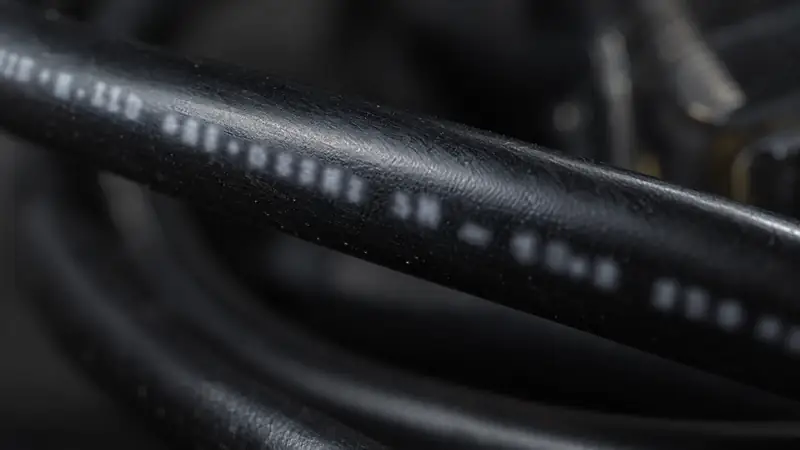
Here is how to read cable jacket print: separate the manufacturer's name, conductor size and material, cable type, electrical ratings, and tracking codes. Ohio Wire Buyers uses those details, together with footage and condition photos, to review reusable surplus electrical wire and cable from businesses anywhere in Ohio. A readable legend identifies the product; it does not prove that a used length remains fit for reuse.
How to read cable jacket print without losing a detail
Find a complete repeating legend on an accessible, de-energized length. Take overlapping photographs if the wording wraps around the cable or stretches beyond the camera frame. Keep punctuation and suffixes: THWN and THWN-2 are not the same designation, and a slash can separate ratings rather than conductor sizes.
Transcribe what is visible before interpreting it. Match that transcription to the reel tag, then locate the manufacturer's specification for the product. If the tag and jacket disagree, report the discrepancy rather than choosing the description that sounds more valuable; our wire selling guides cover the other identification and preparation steps.
Which markings identify size, material and construction?
The manufacturer name tells you where to begin the specification lookup. A catalog number can narrow the search further, while a distributor's name may require supporting paperwork. The reel's wooden flange may have been reused, so the cable itself and its attached product label deserve closer attention.
| Marking | What to record | What not to assume |
|---|---|---|
| AWG or kcmil | Exact size, including an /0 designation | Outside jacket diameter is not conductor size |
| CU or AL | Copper or aluminum conductor designation | Metallic armor identifies the conductor metal |
| CDRS or C | Number of conductors indicated | A grounding conductor is necessarily included in that count |
| Ground or GW field | Separate ground count and size, if shown | Every conductor has the same size |
| THHN/THWN-2 CDRS | Ratings of conductors inside an assembly | The whole assembly is simply loose building wire |
| Product or catalog number | Complete number and any suffix | A tracking code is a catalog number |
Keep AWG and kcmil in the transcription instead of writing only a bare number. Our AWG and kcmil explanation helps organize that information. Photograph an existing cut end to show conductor count, shields and grounds, but do not strip sound cable merely to investigate its metal.
What do THHN, THWN-2 and XHHW-2 mean?
For these building-wire designations, T identifies thermoplastic insulation, HH indicates high heat resistance, W indicates water resistance, and N identifies a nylon covering. X in XHHW-2 identifies cross-linked polyethylene insulation. The complete designation matters more than any isolated letter.
THHN is rated for dry locations at a conductor temperature up to 90°C; THWN-2 adds a wet-location rating up to 90°C. XHHW-2 also carries a 90°C wet/dry rating but uses a different insulation system. Record all printed designations when separating THHN/THWN-2 building wire from XHHW-2 feeder wire.
These are conductor temperature ratings, not permission to operate any terminal or circuit at that temperature. The voltage marking likewise identifies a cable rating, not its previous operating voltage. Terminations, installation conditions and applicable code requirements govern actual use; do not turn a jacket temperature into an ampacity claim.
What do sunlight resistant, direct burial, CT and ER tell you?
Read environmental and installation markings independently. Sunlight resistance concerns ultraviolet exposure of the outer covering. It does not establish direct-burial suitability, and a wet-location rating alone is not permission to bury cable without a raceway.
| Printed wording | Meaning for identification |
|---|---|
| SUNLIGHT RESISTANT, SUN. RES. or SR | Identifies a sunlight-resistance evaluation where required or permitted for that product |
| DIRECT BURIAL or DIR BUR | Identifies direct-burial suitability for the marked product |
| FOR CT USE or FOR CABLE TRAY USE | Identifies evaluation for cable-tray use |
| TC | Identifies power and control tray cable |
| TC-ER | Adds an exposed-run designation, subject to installation requirements |
Do not apply these abbreviations as a universal decoder for every cable family. UL's guide explains that some suitability comes from the type designation rather than optional surface wording. For example, Southwire's four-conductor TC-ER specification lists sunlight resistance and direct burial separately; preserve those distinctions when describing surplus tray cable.
Does a UL or CSA marking prove everything about the cable?
No. The UL Wire and Cable Application Guide says the complete certification label on the reel, coil, flange or box identifies UL coverage. A UL symbol printed on the cable is supplemental information, not a substitute for that label. Keep original packaging and photograph it.
UL surface symbols accompanied by C indicate Canadian certification; C together with US indicates both Canadian and U.S. certification. CSA marks similarly identify certification against applicable standards, with market coverage determined by the specific mark. Neither organization’s symbol establishes the present condition of a removed cable.
A UL file reference beginning with E can assist a lookup when combined with the manufacturer and other markings. Do not confuse that reference with a product number or manufacture date. Our reel-tag reading guide explains how package information complements the surface legend.
Two worked examples of a cable print legend
These simplified examples are invented for explanation, not copied factory legends or installation approvals. Actual wording and sequence vary by manufacturer.
Single-conductor example: EXAMPLE MAKER | 8 AWG | CU | THHN/THWN-2 | 600 V
This describes copper building wire sized 8 AWG with both printed type ratings and a 600-volt rating. It does not state remaining footage, conductor condition or package certification. Preserve any additional markings outside this shortened example.
Assembly example: EXAMPLE MAKER | 600 KCMIL | CU | 4 CDRS | TC-ER | THHN/THWN-2 CDRS | GROUND 1 x 2 AWG | 600 V | SUN RES | DIR BUR
Here the main conductors are 600 kcmil copper, while the ground is separately identified as 2 AWG. The assembly is TC-ER; THHN/THWN-2 describes its inner conductors. Its sunlight and burial markings describe separate capabilities, not the number of cores.
Are footage marks and date codes the same thing?
Sequential length markings change along the cable; production codes track manufacture. The Prysmian/General Cable catalog shows both sequential footage and manufacturer-specific date formats. Do not assign a universal month/year meaning to an unfamiliar code.
For a hypothetical continuous length with end markings of 004180 FT and 003760 FT, the difference is 420 feet. That calculation requires matching units and a continuous sequence without a reset or splice. One visible number alone is not automatically the footage remaining; use our partial-reel measurement guide when the inner end is inaccessible.
What jacket details should you send for an offer?
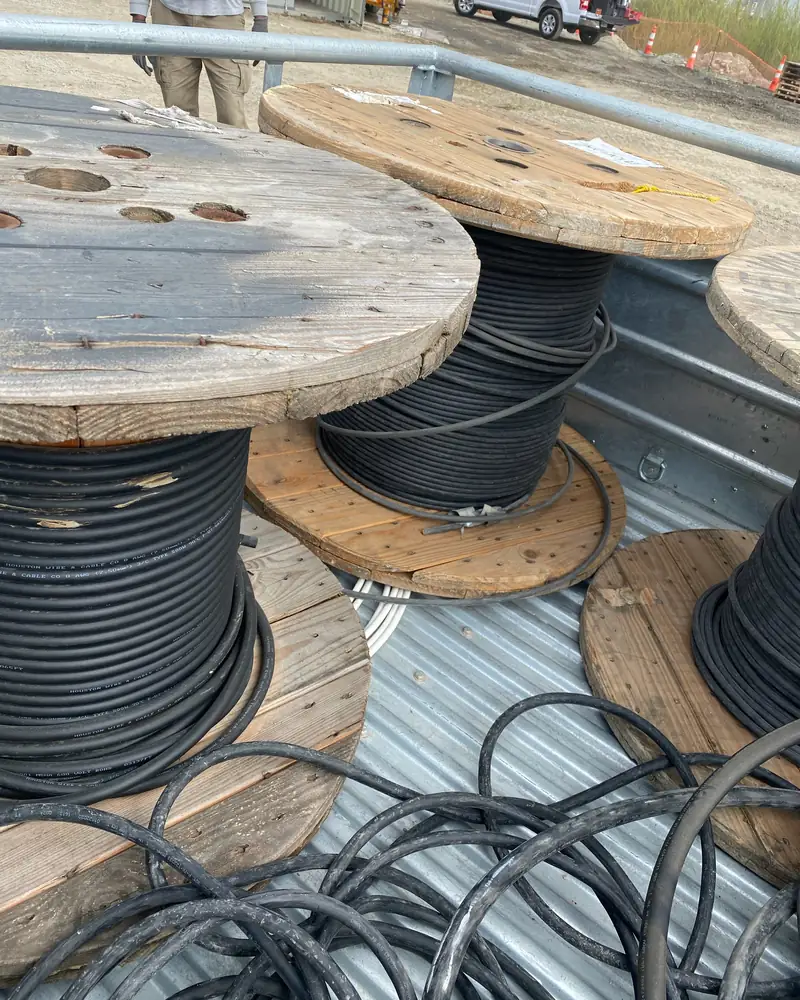
Send the whole lot, complete legends, original reel labels and existing cut ends. Pair each reel's photos with its footage or clearly labeled estimate. Note unreadable sections, tag mismatches, storage damage, missing end seals and whether the cable is unused or removed from service; the offer-photo guide helps keep those views organized.
Include your business details and proof of ownership. Ohio Wire Buyers reviews the information and replies with questions or a written offer before pickup; payment method and timing are confirmed in writing before pickup. We arrange pickup anywhere in Ohio and check the count against the written terms. Material that is not reusable may belong with a scrap recycler instead.
Send your markings and footage through the surplus-wire offer form, or call 951-403-5738 to discuss a lot with uncertain identification.
Frequently asked questions
Can I identify cable from its jacket color alone?
No. Jacket color can help organize a lot, but it does not establish conductor material, size, voltage or installation suitability. Different cable families can have similar colors. Read the print legend and compare it with the reel tag and manufacturer specification. For an offer, include a whole-reel photo and a close-up of the actual markings rather than describing the material only as black cable.
Does an E-number identify the exact cable model?
An E-number is a UL file reference, not necessarily a unique catalog number for one cable construction. Preserve it along with the manufacturer name, type designation and product number. Those details support a certification lookup, but the surface reference does not replace the complete UL label on the original reel or package. A buyer still needs size, footage and condition information.
Is AWM wire automatically suitable as building wire?
No. Appliance wiring material is generally evaluated as component wiring for equipment, rather than unrestricted field installation. Some products carry both AWM and a separate building-wire type designation. Record every rating shown instead of treating AWM as interchangeable with THHN or another NEC wire type. Installation suitability depends on the applicable listing, equipment requirements and conditions of use.
Should I cut off a cable sample to show the print?
Keep the continuous length intact when possible. Photograph the exposed jacket and an existing cut end instead of cutting a new sample or stripping insulation. If the legend is difficult to read, send overlapping close-ups and the reel tag. Ohio Wire Buyers can review what you have and ask for additional identifying information without assuming the cable must be cut first.
Can I sell surplus cable when the jacket legend is incomplete?
Send the readable portions, reel tag, purchase documents and footage estimate, and clearly identify any unknown details. Missing markings do not by themselves prove that cable is scrap, but uncertain identity makes reuse harder to evaluate. Ohio Wire Buyers reviews reusable surplus as product, not metal by the pound, and will say so if the material is not reusable.
Sources and further reading
- UL Solutions Wire and Cable Application Guide
- Southwire SIMpull THHN/THWN-2 Copper specification
- Southwire Type TC-ER four-conductor power cable, SPEC 45257
- Service Wire: THHN vs. XHHW-2 and insulation acronyms
- CSA Group Marks and Labels for North America
- Prysmian/General Cable Industrial Automation Catalog: print legends and tracking codes