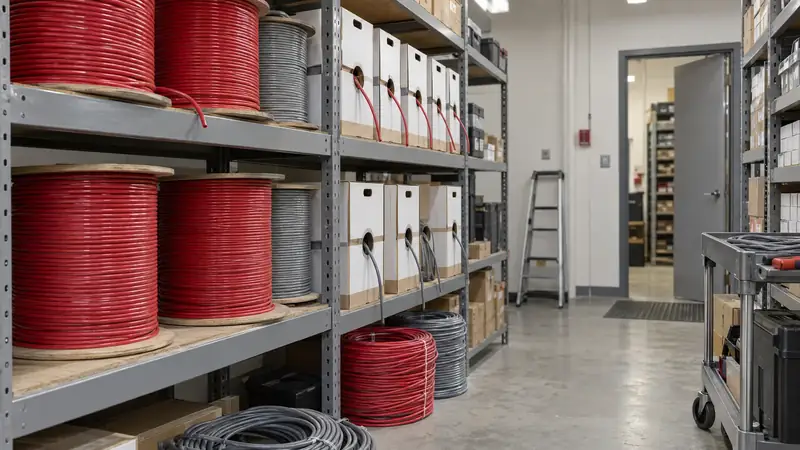
Ohio Wire Buyers buys reusable surplus fire alarm and low-voltage cable from businesses anywhere in Ohio, including unused boxes, full and partial reels, coils and usable cut lengths. To sell fire alarm cable, send package labels, jacket-print photos and remaining footage for review and a written offer before pickup. We buy cable as product for resale and reuse, not as scrap metal by the pound.
What fire alarm and low-voltage stock can you sell?
Send identifiable FPL, FPLR and FPLP cable, shielded or unshielded alarm cable, armored fire alarm assemblies and documented circuit-integrity cable. Security, access-control and thermostat wire can be included in the same submission, but list each construction separately. These belong within the broader range of wire and cable we buy.
A low-voltage contractor or integrator may have unopened project stock alongside partly used pull boxes. Keep that distinction visible: factory packaging helps establish identity, while remaining footage determines what usable product is actually available. For contractor project leftovers, keep job records with the lot rather than combining unmarked remnants into a single pile.
Do not strip jackets or cut long runs down for easier handling. A continuous, identified length gives the next user information that loose pieces of copper cannot provide.
What do FPL, FPLR and FPLP mean?
These are power-limited fire alarm cable designations associated with NEC Article 760. The suffix describes the cable's installation category, not its conductor gauge or whether it has a shield. Belden's fire alarm bulletin distinguishes the categories as follows.
| Jacket designation | Cable category | Why it matters when selling surplus |
|---|---|---|
| FPL | General-purpose power-limited fire alarm | Do not describe it as riser or plenum cable without an additional applicable rating |
| FPLR | Power-limited fire alarm riser | Identify separately from general-purpose stock intended for different wiring paths |
| FPLP | Power-limited fire alarm plenum | Preserve the designation for projects specifying cable for environmental air spaces |
An FPLR jacket is not evidence of an FPLP listing. Likewise, a red jacket alone proves none of these ratings; Belden notes that fire alarm jacket colors can vary. Use the guide to reading cable jacket print when the carton label is missing or conflicts with handwritten inventory notes.
Why do gauge, conductor count and shielding matter?
Belden catalogs fire alarm constructions in 18, 16 and 14 AWG, among other sizes, with shielded and unshielded versions. Record conductor count as well as gauge. An 18 AWG pair and a multiconductor cable of that gauge are different products, even when their jackets look alike.
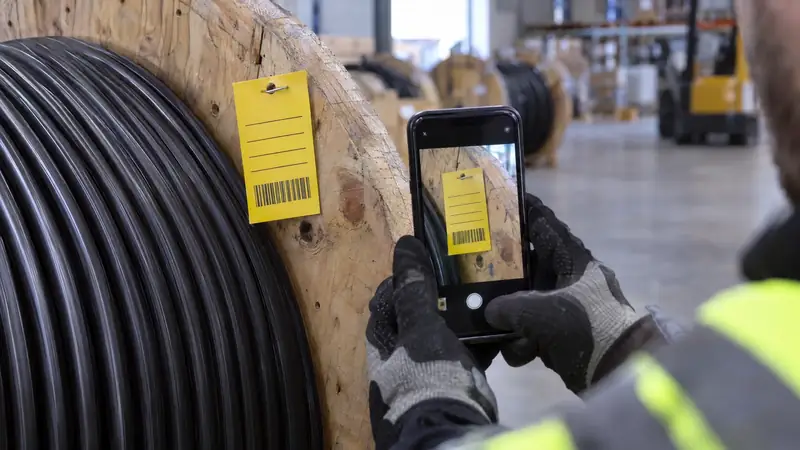
Photograph an existing exposed end to show solid or stranded conductors, foil shielding and any drain wire. Do not cut a sealed factory package merely to create that photograph. If shielding is uncertain, say so instead of guessing from the jacket diameter.
System requirements also matter. Belden explains that conductor resistance affects voltage drop and that capacitance is relevant to addressable-system cable selection. The exact manufacturer part number therefore helps distinguish ordinary alarm cable from a specialized low-capacitance construction. Keep industrial shielded instrumentation pairs separate rather than assuming that all small-gauge shielded cable is interchangeable.
Is two-hour CI cable the same as plenum cable?
No. A plenum designation addresses flame and smoke performance for that installation category. Circuit integrity concerns continued circuit operation during specified fire exposure. Ordinary FPLP cable should not be advertised as two-hour cable merely because it is fire alarm material.
As a specific manufacturer example, Radix lists DuraLife dual-rated CIC/CI cable with a two-hour UL 2196 fire-resistive rating and FPLR/FPLR-CI markings. Preserve the complete legend, product number and accompanying documentation. Do not shorten the inventory description to “red fire cable.”
UL's circuit-integrity guidance distinguishes system listings from CI-suffixed cable and ties performance to the applicable installation requirements. Send the listed system identification and installation instructions if available. A purchase review does not establish that a future installation satisfies a survivability requirement; that needs product-specific verification by the responsible designer or installer.
What identifies armored fire alarm cable?
Record the cable rating beneath the armor as well as its exterior identification. Southwire's Red Alert MC-FPL composite specification describes red aluminum interlocked armor, not a universal red stripe shared by every manufacturer's product. If your assembly has a red stripe instead, photograph it and retain its own label rather than assigning a brand from appearance.
Composite assemblies can contain different conductor sizes and shield configurations inside the same armor. Southwire's specification includes constructions combining 14 AWG and 16 AWG circuits. Photograph the tag and an already exposed end so those circuits are not overlooked.
For surplus metal-clad cable, describe flattened armor, separated interlocks, damaged ends and any outer jacket. Keep armored assemblies separate from ordinary jacketed alarm cable; the product identity and handling requirements are different.
How should security and thermostat wire be listed?
List security and access-control cable by the actual markings, such as CL2 or CL3 and any riser or plenum suffix. Include conductor count, solid or stranded construction and shielding. Avoid treating a security cable designation as automatic proof of suitability for every fire alarm application.
Thermostat wire needs its own entry. Southwire's CL2/CMH thermostat product, for example, uses solid copper conductors and is offered as a 500-foot spool in a carton. Record the actual construction on your package rather than describing everything as “thermostat wire.”
Keep Cat6 and other category data cable in separate rows, too. For access-control composite cable, preserve the label describing each internal cable group. A mixed low-voltage lot is easier to review when distinct products remain traceable to their packaging.
What should you send to fire alarm cable buyers?
Start with a whole-lot photograph, then provide the details that separate similar-looking cartons and reels. Southwire's packaging bulletin lists enclosed 1,000-foot fire alarm put-ups; that original quantity does not establish what remains after pulling. Mark each opened package as partial and use the remaining-footage guide when an estimate needs explanation.
| Send this detail | What it establishes |
|---|---|
| Box label and manufacturer part number | Original product identity and factory put-up |
| Clear jacket legend | Gauge, conductor count, rating and special markings |
| Existing exposed-end photo | Shield, drain wire and conductor construction |
| Footage for each continuous length | Usable inventory rather than a combined scrap quantity |
| CI documentation or armored assembly label | Specialized construction that needs separate review |
| Condition notes and ownership paperwork | Known damage, storage history and authority to sell |
Identify splices and separate cut lengths instead of adding them together as though they form one run. Use an invoice, purchase order, closeout record or company letter as proof of ownership. We verify the seller and keep a written purchase record.
How do you sell fire alarm cable in Ohio?
An offer depends on identification, continuous footage, condition, packaging, documentation and demand for that construction. Dry, legible packaging is helpful, but it does not erase hidden damage or make an unknown cable reusable. Disclose crushed cartons, jacket cuts, contamination and removal history before pickup is discussed.
If cable is not reusable, we say so; the surplus-versus-scrap guide explains why a scrap recycler may then fit better. For a usable lot, we review your information and reply with questions or a written offer. Payment method and timing are confirmed in writing before pickup, and the count is checked against the written terms; see how selling surplus wire works.
Ohio Wire Buyers arranges pickup at your Ohio jobsite, warehouse, plant or yard and does not accept deliveries at an Ohio facility. Send your labeled inventory through the cable offer form, or call 951-403-5738 to discuss the lot.
Frequently asked questions
Can I sell opened boxes of fire alarm cable?
Yes. Ohio Wire Buyers reviews opened boxes and partial reels when the remaining cable is reusable. Keep the original label, identify the rating and conductor construction, and provide remaining footage or an honest estimate. An opened carton should not be listed at its original factory length unless that amount is still present.
Does red cable automatically qualify as fire alarm cable?
No. Red is a common jacket color, not a substitute for the printed cable designation. Photograph the jacket legend and package label so the manufacturer, part number and rating can be checked. Fire alarm products also come in other colors, and visually similar cable can have different shielding or environmental ratings.
Do you buy cable removed from an old alarm installation?
Used cable is considered only if it remains reusable. Describe its removal history, continuous lengths and any jacket or conductor damage. Do not disconnect an operating life-safety system to prepare a sale; have qualified personnel handle removal. A photo review or purchase is not a certification that cable is suitable for a future installation.
Should I strip low-voltage cable before requesting an offer?
No. Leave reusable cable intact, including its jacket, shielding and printed identification. Ohio Wire Buyers purchases usable product for resale and reuse, not scrap metal by the pound. If the material cannot be reused, we say so, and a scrap metal recycler may be the appropriate buyer instead.
Is there an Ohio location where I can drop off surplus cable?
No. Ohio Wire Buyers has no Ohio street address, office or yard and does not accept deliveries. We arrange pickup at an Ohio business's jobsite, warehouse, plant or yard after reviewing the material. A written offer and written confirmation of payment method and timing come before pickup arrangements are completed.
Sources and further reading
- Belden Fire Alarm Cables product bulletin
- Radix DuraLife Dual-Rated CIC/CI Cables
- UL Solutions: Fire Resistive Cables and Circuit Integrity Systems
- Southwire Red Alert Type MC-FPL Fire Alarm Composite specifications
- Southwire CL2/CMH thermostat cable, 500-foot carton
- Southwire fire alarm cable packaging bulletin