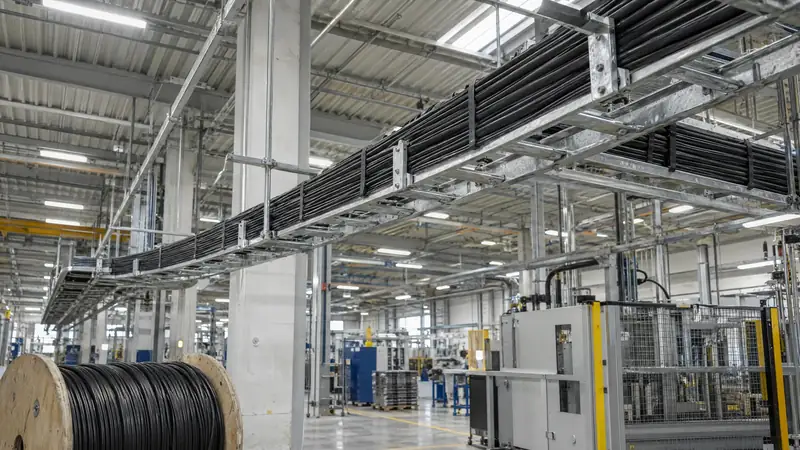
Ohio Wire Buyers buys reusable surplus Type TC and TC-ER tray cable from businesses anywhere in Ohio, including full reels, partial reels and usable cut lengths. To sell tray cable, send photos of the jacket print, reel tags, existing cut ends and whole lot, plus a footage list or estimate. We review the material for resale and reuse, not as scrap metal by the pound, and provide a written offer before pickup.
What should you identify before you sell tray cable?
Type TC is a factory-assembled cable with multiple insulated conductors under a nonmetallic jacket, with or without an equipment grounding conductor. UL 1277 covers electrical power and control tray cables. A cable found in a ladder tray is not necessarily Type TC; read the actual type designation before describing it to a buyer.
Two constructions worth distinguishing are PVC-insulated conductors with a nylon covering, such as THHN/THWN-2, and cross-linked polyethylene insulation, commonly identified as XHHW-2. Both can appear inside a black PVC outer jacket. Southwire's cited power and control specifications illustrate these differences, but black jacket color alone cannot identify the insulation or rating.
| Item to read | What it tells a buyer | What not to assume |
|---|---|---|
| TC or TC-ER | Cable type and exposed-run designation | Every jacketed industrial cable is TC-ER |
| THHN/THWN, THWN-2 or XHHW-2 | Insulated conductor type | Similar-looking reels have identical wet ratings |
| Printed voltage | Voltage rating of that assembly | Every tray cable has the same rating |
| SUN RES and direct-burial wording | Additional evaluated uses | TC-ER automatically includes both properties |
Our wire and cable buying overview covers related families. For a faded legend, use the cable jacket identification guide rather than guessing from appearance.
Does TC-ER mean the cable can run anywhere without conduit?
No. ER means exposed run, not unrestricted installation. Southwire explains that TC-ER meets additional crush and impact requirements and can connect a tray to equipment under specified conditions. The applicable installation rules still govern support, protection against physical damage, grounding and the setting in which the cable is used.
For a surplus sale, the practical point is to preserve the exact marking. Do not upgrade an ordinary TC reel to TC-ER in your inventory list because it was previously installed outside a tray. A future installer must select cable suitable for the new installation.
Sunlight resistance and direct-burial suitability are separate identification questions. The UL wire and cable application guide explains their markings. Photograph these words alongside the type designation; an outdoor storage history does not establish either rating.
How do conductor count, ground size and insulation affect resale?
A description such as 3/C + G indicates three insulated conductors plus a grounding conductor. Record both the phase conductor size and the ground size. A green insulated ground and a bare ground may serve the same general purpose, but the assembly's actual construction must match what a future purchaser needs.
The following examples come from Southwire SPEC 45251, a 600 V THHN/THWN-2 power tray cable family. They are identification examples, not specifications for every manufacturer's product.
| Phase conductor size | Insulated conductor count | Ground listed by Southwire |
|---|---|---|
| 8 AWG | 3 | One 10 AWG insulated green ground |
| 250 kcmil | 3 | One 4 AWG bare copper ground |
| 750 kcmil | 3 | One 1 AWG bare copper ground |
Smaller multiconductor assemblies can be control cable rather than a simple motor-feed construction. Southwire's XHHW-2 control family includes 14 AWG constructions with differing conductor counts. Keep those separate from power reels, and include numbered or colored conductor identification when offering surplus control cable.
Temperature ratings also depend on the identified product. The cited current THHN/THWN-2 power specification permits normal operation at 90°C in wet or dry locations; do not transfer that rating to older THHN/THWN cable without checking its own documentation. Temperature markings are not a substitute for an installation-specific ampacity determination.
Is ordinary power tray cable the same as VFD cable?
Not automatically. An unshielded motor-feed assembly may be Type TC-ER without having the construction required by a variable frequency drive system. The drive manufacturer's requirements and the exact cable specification matter more than a seller's handwritten description of “motor cable.”
For example, Southwire's cited VFD family uses XLPE insulation, a copper tape shield and three symmetrical grounding conductors. That differs from an ordinary power assembly with a single ground. Photograph any visible shield at an existing cut end, but do not peel back sound jacket merely to look for one.
If the part number identifies a drive-specific product, include its data sheet and offer it as VFD cable surplus. If the reel only establishes TC-ER power cable, describe it that way. Accurate identification is more useful than assigning an unsupported specialty label.
Which partial reels and removed lengths remain reusable?
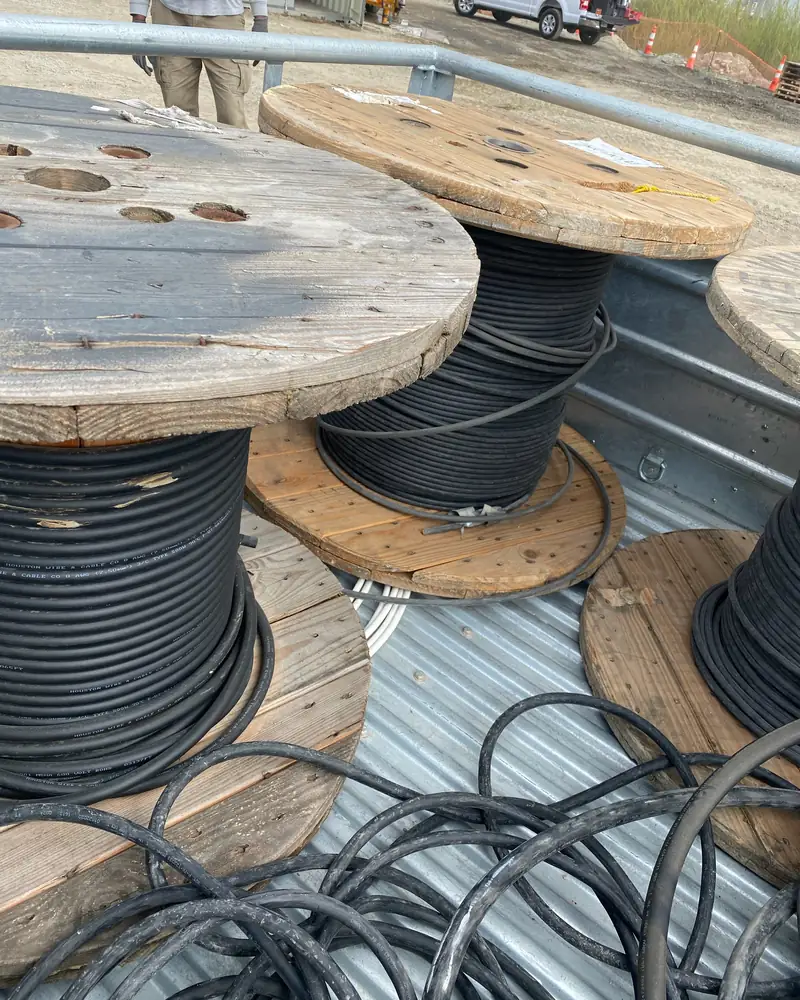
Continuous usable footage, identifiable construction and sound condition are the important starting points. A partial factory reel can be worth reviewing even after its original project ends. An intact tag helps, but its original quantity does not prove the amount remaining.
List each separate cut length individually. Several short pieces are not interchangeable with a continuous run of the same total footage. Photograph accessible sequential footage marks, note how you obtained the estimate, and consult our remaining reel footage guide if the quantity is uncertain.
Disclose jacket splits, flattened sections, sharp kinks, contamination, exposed conductors and repairs. Used cable is considered only if still reusable; removal history and any available inspection records help explain what happened to it. Photos support an initial review but do not establish electrical fitness by themselves.
Do not cut or strip an intact assembly to prepare it for sale. Our surplus-versus-scrap guide explains the distinction. If damage prevents reuse, we say so, and a scrap metal recycler may be the appropriate buyer.
What should you send for a tray-cable offer?
Start with a whole-lot photo, then give each reel or coil a simple identifier that also appears in your footage list. Keep power cable, control assemblies and shielded drive cable on separate lines. For each item, send:
- A reel-tag photo showing the manufacturer, part number, conductor size and count.
- Clear jacket-print photos covering TC or TC-ER, voltage, conductor type and environmental markings.
- Existing cut-end photos showing the conductor arrangement, ground and any shield.
- Remaining footage or an explicitly labeled estimate, with each continuous piece listed separately.
- Condition and storage notes, including damage, prior installation or missing tags.
The reel-tag reading guide helps distinguish a product code from an order number. If the tag conflicts with the jacket, send both rather than choosing whichever seems more favorable. Include the manufacturer's specification when available, especially for unusual ground arrangements or shields.
For plant surplus inventory, note whether the lot consists of unused maintenance stock, project leftovers or removed cable. Manufacturing and water-treatment facilities can offer motor-feed or control assemblies, but the facility's industry does not identify the cable. The printed specification does.
How does pickup work across Ohio?
Ohio Wire Buyers arranges pickup at your Ohio jobsite, warehouse, plant or yard; there is no Ohio street address, office, yard or drop-off. Describe access restrictions, loading equipment and reel condition before arrangements are made. Do not move a damaged reel simply to get a better photo.
We verify the seller and ownership through an invoice, purchase order, closeout paperwork or company letter, and retain a written purchase record. Gather that material using the seller paperwork guide. After review, we reply with questions or a written offer; payment method and timing are confirmed in writing before pickup, and the count is checked against the written terms when collected. The selling process overview explains those steps.
To sell tray cable without losing its identity to a scrap bin, request a written offer with your reel photos and footage list, or call 951-403-5738.
Frequently asked questions
Can I sell unopened factory reels and leftover motor-feed cable together?
Yes. Ohio Wire Buyers reviews mixed lots of reusable surplus tray cable from businesses. List factory reels separately from partial reels and removed lengths, even when the jacket markings match. Include the manufacturer's part number, conductor size and count, grounding arrangement, condition and footage for each item. That lets us review the lot without treating every reel as the same product.
Should I strip the jacket before contacting tray cable buyers?
No. Keep reusable cable intact and send photos of the existing cut ends instead. The jacket protects the assembly and carries identification needed for resale. Stripping, chopping or separating the conductors changes the product you are offering. If the cable is already damaged or stripped, describe that honestly; a scrap metal recycler may be the more appropriate buyer.
Does 3/C tray cable always include a grounding conductor?
Do not assume it does. A listing may describe the insulated conductor count separately from an equipment grounding conductor. Look for an explicit ground designation on the reel tag or manufacturer specification, and photograph an existing cut end. Give the ground size and whether it is bare or insulated when known. A shield or drain wire should not be counted as an equipment ground.
Does sunlight-resistant tray cable have a guaranteed storage life?
The sunlight-resistant marking identifies an evaluated property of the jacket, not a guarantee that stored cable remains reusable indefinitely. Ohio Wire Buyers reviews the cable's actual condition and storage history. Photograph cracking, abrasion, crushed sections, damaged flanges and exposed ends. Do not assume that an outdoor-use marking makes a deteriorated reel suitable for another installation.
Can I request an offer when the remaining footage is unknown?
Yes. Send an estimate clearly identified as an estimate, together with whole-reel photos and any accessible footage markings. Keep separate pieces separate in your list rather than adding them into one apparent continuous length. Ohio Wire Buyers may ask follow-up questions before making a written offer. The count and other purchase terms are checked against the written agreement at pickup.
Sources and further reading
- Southwire SPEC 45251: THHN/THWN-2 three-conductor TC-ER power cable
- Southwire SPEC 45052: XHHW-2 XLPE-insulated TC-ER control cable
- UL Solutions Wire and Cable Application Guide
- Southwire application note: Tray Cable Type TC
- Southwire SPEC 45451: XLPE VFD cable with symmetrical grounds and copper tape shield