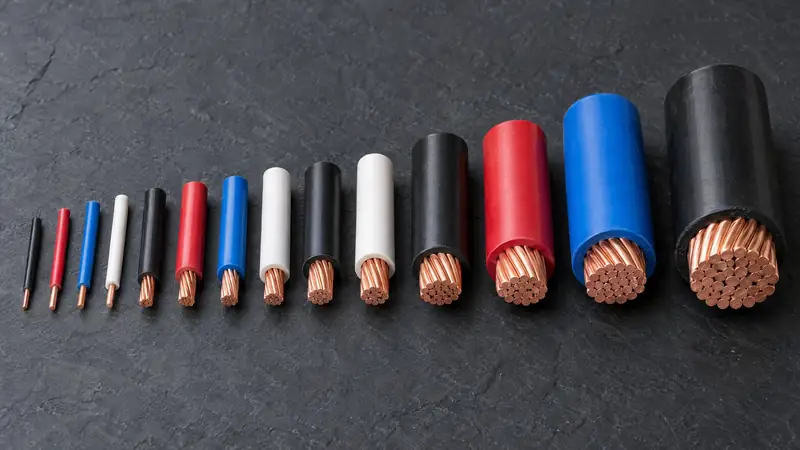
AWG and kcmil explained simply: AWG is a gauge scale whose smaller numbers indicate larger conductors, while kcmil states conductor area directly in thousands of circular mils. Neither designation measures the outside diameter of insulated cable. Ohio Wire Buyers buys reusable surplus electrical wire and cable from businesses anywhere in Ohio, and accurate size identification helps us evaluate the material as product for resale and reuse.
AWG and kcmil explained: which way is bigger?
AWG means American Wire Gauge. Within numbered AWG sizes, a lower number means a larger metal cross-section: 8 AWG is larger than 10 AWG, which is larger than 12 AWG. In kcmil sizes, the direction reverses: 500 kcmil is larger than 250 kcmil.
AWG is a logarithmic scale, not a sequence of equal diameter increments. The NIST copper wire handbook describes it as a geometric progression: each step toward a larger conductor changes diameter by the same ratio. Moving three gauge numbers toward a larger wire approximately doubles the metal area; moving six approximately doubles the solid-wire diameter.
These are dimensional relationships, not automatic increases in allowable current. Keep installation decisions separate from inventory identification; our wire selling guides focus on documenting the material you have.
How do you read the sizes after 1 AWG?
After 1 AWG, the larger sizes are 1/0, 2/0, 3/0 and 4/0. Electricians commonly say one-aught, two-aught, three-aught and four-aught. The equivalent written forms are 0, 00, 000 and 0000.
The slash is not a fraction. A tag marked 4/0 identifies four-aught conductor, not 4 AWG and not a count of conductors. Preserve that slash when transcribing an inventory list, because dropping it changes the product identity.
For a useful comparison, 4/0 has a nominal area of 211,600 circular mils, or 211.6 kcmil. It is therefore smaller than 250 kcmil, not interchangeable with it. Keep 3/0 and 4/0 surplus wire listed under its original gauge designation rather than rounding it to a nearby feeder size.
What does kcmil mean, and is MCM different?
A mil is one thousandth of an inch. A circular mil is the area of a circle with a diameter of one mil. It is an area unit, unlike the linear mil used to describe insulation thickness.
For a solid round wire, area in circular mils equals its diameter in mils squared. The prefix in kcmil means thousand, so 500 kcmil means 500,000 circular mils. Doubling kcmil doubles nominal metal area, not diameter.
MCM is the older notation for the same unit. Cerrowire explains that its first M represents the Roman numeral for thousand; kcmil uses the kilo prefix instead. A reel marked 500 MCM and one marked 500 kcmil have the same nominal conductor size, but you must still compare material and insulation type. See our page on selling 500 MCM wire for the other details that distinguish those reels.
What are the diameters and areas of common wire sizes?
The table combines NIST nominal solid-wire dimensions with Southwire's approximate metric areas. For kcmil rows, the diameter is calculated from circular-mil area. Every diameter below is solid-equivalent bare diameter, not the measured width of a stranded bundle or finished insulated cable.
| Conductor size | Solid-equivalent bare diameter, inches | Approximate nominal metal area, mm² |
|---|---|---|
| 12 AWG | 0.0808 | 3.31 |
| 10 AWG | 0.1019 | 5.26 |
| 8 AWG | 0.1285 | 8.37 |
| 6 AWG | 0.1620 | 13.3 |
| 4 AWG | 0.2043 | 21.2 |
| 2 AWG | 0.2576 | 33.6 |
| 1/0 AWG | 0.3249 | 53.5 |
| 2/0 AWG | 0.3648 | 67.4 |
| 3/0 AWG | 0.4096 | 85.0 |
| 4/0 AWG | 0.4600 | 107 |
| 250 kcmil | 0.5000 | 127 |
| 350 kcmil | 0.5916 | 177 |
| 500 kcmil | 0.7071 | 253 |
| 750 kcmil | 0.8660 | 380 |
| 1000 kcmil | 1.0000 | 507 |
Use this chart to understand scale, not to identify a reel by measuring across its insulation. Our overview of wire sizes we buy connects size groups with their individual surplus pages.
Can you substitute the nearest metric wire size?
A numerical area conversion is not proof that two finished wire products are equivalent. Southwire distinguishes nominal AWG/kcmil area in square millimeters from the nearest metric sizes used in product standards. Those nearest-size relationships are not blanket substitution instructions.
For example, Southwire lists 500 kcmil at approximately 253 mm², while its separate closest-size table pairs 240 mm² with 500 kcmil. Those statements serve different purposes. A reel actually marked 240 mm² should stay identified that way on your footage list.
Also retain the conductor material. Copper and aluminum of the same nominal gauge do not automatically have the same allowable current or termination requirements. Our copper versus aluminum wire guide explains why the material belongs beside the size, not in a note that can become separated from the reel.
Why can same-size conductors look different?
Stranded conductor size concerns the combined metal cross-section of its strands. Spaces between strands contribute to bundle diameter without adding metal area. Compressed or compact construction changes how the strands fit together, while insulation, jackets and shields add more outside thickness.
Southwire's listed 500 kcmil SIMpull THHN/THWN-2 copper construction illustrates the distinction. Its published diameter over conductor is 0.789 inches, and its approximate finished outside diameter is 0.931 inches. Neither is the 0.7071-inch solid-equivalent diameter in the chart above.
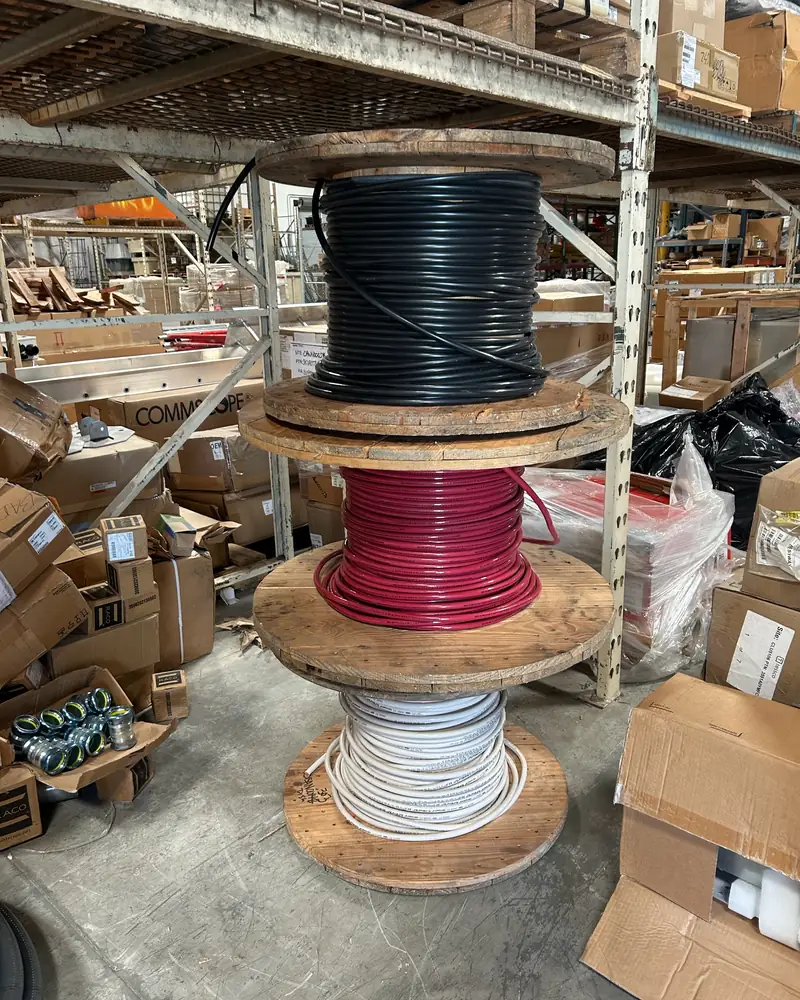
Do not infer gauge from how heavily a reel is wound, or assume that thicker-looking cable contains more copper. Compare the complete cable jacket print with the manufacturer specification for that product. A size chart alone cannot establish ampacity; terminations and conditions of use govern the actual rating.
How should you sort surplus wire by size?
Keep each size separate, then distinguish copper from aluminum and record the insulation designation. A lot labeled only “large black wire” leaves important questions unanswered. A lot labeled “500 kcmil copper THHN/THWN-2, partial reel” establishes much more of the product's identity before anyone discusses footage.
Read both the wire marking and the reel label. If they disagree, report the disagreement rather than choosing whichever looks easier to sell; a reel may have been reused or relabeled. Our wire reel tag guide explains which label fields to preserve.
Keep useful continuous lengths intact. We review full reels, partial reels, boxed coils and cut lengths as reusable product, not scrap metal by the pound. Size helps identify a lot, but usable footage, condition and documentation still affect the offer.
What size information should you send for an offer?
Photograph the complete size marking with its unit visible, the adjacent wire-type print, the reel tag, accessible cut ends and the whole lot. Take cut-end photos only of safely de-energized, removed material. Do not cut or strip usable wire just to create a sample.
Send a line for each distinct product showing size, conductor material, insulation type, color, reel or coil count and remaining footage. State whether footage comes from records, markings or an estimate. If footage is uncertain, our guide to measuring wire left on a reel helps separate evidence from guesswork.
Include proof of ownership and the Ohio pickup location. Ohio Wire Buyers reviews the information and replies with questions or a written offer before pickup; payment method and timing are confirmed in writing before pickup. We arrange pickup at your jobsite, warehouse, plant or yard and check the count against the written terms. The selling process explains those steps.
Send your size list and photos to request an offer for reusable surplus wire, or call 951-403-5738. If the material is not reusable, we will say so; a scrap metal recycler may be the appropriate buyer instead.
Frequently asked questions
Is 4/0 wire the same size as 4 AWG?
No. The slash and zero change the meaning: 4/0 is four-aught, also written 0000, while 4 AWG is a smaller gauge. Their nominal metal areas are approximately 107 mm² and 21.2 mm² respectively. Photograph the complete size marking rather than shortening either designation to a handwritten number without its unit.
Does 500 MCM mean 500 millimeters?
No. MCM is an older designation for thousands of circular mils, so 500 MCM means the same conductor area as 500 kcmil. It is not a diameter in millimeters. Its nominal metal cross-sectional area is approximately 253 mm²; the finished cable diameter depends on stranding, insulation and any additional jacket or shield.
Can I determine wire gauge from its insulation color?
Do not use insulation color as proof of conductor size. For surplus single-conductor wire, record the size printed on the insulation or jacket and compare it with the reel tag and purchase paperwork. If those records disagree or the printing is unreadable, send photographs and describe the uncertainty instead of assigning a gauge from appearance.
Will a wire size chart tell me what my surplus reel is worth?
No. A size chart identifies nominal conductor dimensions, not resale value. Ohio Wire Buyers reviews wire type, copper or aluminum construction, usable footage, condition and documentation as well as size. Send photos and a footage list or estimate so the material can be evaluated as reusable product rather than assumed to have a value based only on conductor area.