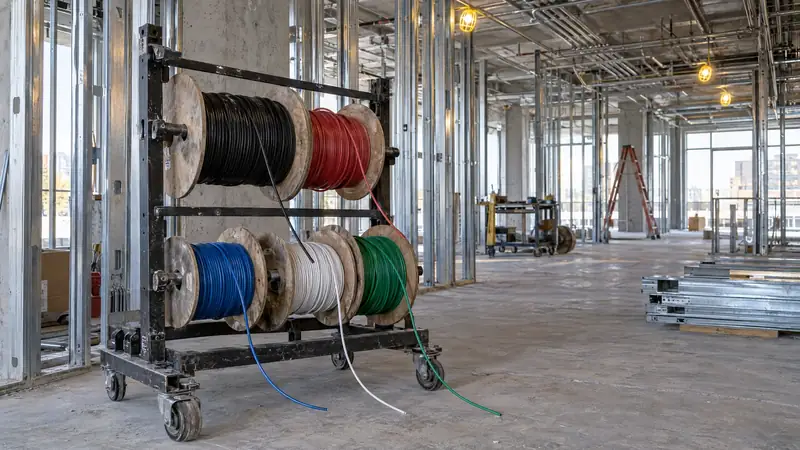
A project closeout wire checklist should identify every leftover reel or coil, establish who owns it, preserve its condition and assign a return, transfer, sale or recycling decision. Ohio Wire Buyers buys reusable surplus electrical wire and cable from Ohio businesses, with a written offer before pickup and payment method and timing confirmed in writing before pickup.
Project closeout wire checklist: who owns each action?
Assign a responsible person and a due date to each task before the storage cage or laydown area is cleared. A reel marked “left over” is not yet released for disposal: it may belong to the owner, be needed for punch-list work or await a supplier decision.
Use this checklist as a working handoff between the foreman, project manager and purchasing staff. The suggested responsibilities can be adjusted to your company.
| Closeout task | Suggested lead | Evidence to retain |
|---|---|---|
| Walk storage areas and count packages | Foreman | Lot list and overview photos |
| Reserve punch-list and owner-required spares | Project manager | Written hold instructions |
| Confirm material ownership | Project manager | Purchase and contract records |
| Check supplier return eligibility | Purchasing | Written approval and deadline |
| Identify remaining wire and footage | Foreman | Tag photos and measurement notes |
| Protect and stage released material | Site logistics lead | Condition and access notes |
| Approve disposition and reconcile removal | Authorized company representative | Transfer record or purchase terms |
Keep related instructions with the lot list; the wire selling guides cover individual preparation tasks in more detail.
What should the leftover inventory record contain?
Create an entry for each reel, boxed coil or separate continuous length. Record the manufacturer, product or catalog number, cable type, conductor size, conductor metal, color and conductor count where applicable. Copy these details from the label and jacket rather than identifying cable by appearance alone.
Include package condition, storage location and whether the material is unused, pulled but not installed, or previously in service. Keep those categories separate. A factory-wrapped reel and cable removed from equipment need different review even if the jacket legends match.
Give every package a unique lot reference and include that reference in its photographs. Do not combine separate cut lengths into a single footage entry; the buyer needs to know the usable length of each piece. The reel tag reading guide helps you capture identifying fields without discarding the original label.
How do you label partial reels without overstating footage?
Keep the factory tag, but add a separate closeout label showing what remains and how that quantity was established. An original put-up length describes what shipped, not necessarily what is left after installation. Mark quantities as measured, calculated from records, estimated or unknown.
Where readable footage marks are available, photograph them and record the readings used. Do not unwind heavy cable merely to reach a hidden end for an initial inquiry. A documented estimate is more useful than an unsupported exact figure; follow the guide to measuring wire left on a reel before choosing a method.
Record each remaining conductor length separately on a parallel reel. A pull may leave unequal lengths, and a general “partial reel” description hides that difference. Date your quantity note and identify the person who prepared it so later pulls can be reconciled.
Protect the cable before the laydown area closes
Keep labels attached, preserve protective wrapping and secure loose ends without damaging the jacket. Follow the cable manufacturer's instructions for resealing exposed ends; an improvised cover is not proof that a cable has remained dry.
Southwire's handling and storage guidance recommends indoor storage for building wire and resealing cable ends after cutting. A wet-location rating does not replace the manufacturer's storage instructions. Keep material away from standing water, solvents and physical damage while disposition is pending.
Do not strip insulation, chop usable lengths or move intact coils into a mixed scrap bin to save space. Flag crushed flanges, split jackets, corrosion or evidence of water exposure for review. For material awaiting collection during cold weather, use the Ohio winter reel storage guide and confirm product-specific handling precautions before moving it.
Should this lot be returned, transferred, sold or scrapped?
Check returns first when the original supplier may still accept the product. Record the purchase date, applicable deadline, approval requirements, expected deductions and return freight. Ask specifically about opened reels, cut-to-order material and special orders rather than assuming they qualify.
Graybar's website terms, for example, specify returns within 90 days of purchase and require unused, undamaged, saleable product in original packaging. Those are website terms, not a universal rule for every distributor or negotiated account. Confirm the terms governing your purchase and do not treat project completion as the start of the return period.
Transfer material only when a receiving project or warehouse accepts the identified product and quantity. Record the receiving location and responsible person instead of leaving a vague “keep for later” note.
Consider sale for released, reusable material without a practical return or transfer destination. Separate non-reusable material for a recycler; the surplus-versus-scrap guide explains why usable cable should be assessed as product before destruction.
Which documents release the material for sale?
Match the lot to invoices, purchase orders or other company records. Check whether contract requirements reserve spare material for the owner and whether an authorized representative has approved the sale. Payment for an installation does not, by itself, settle every ownership question about leftovers.
Ohio Wire Buyers verifies the seller and proof of ownership, which may include an invoice, purchase order, closeout paperwork or company letter, and keeps a written purchase record. The Ohio wire seller paperwork guide explains what to assemble.
Keep internal approval, buyer correspondence and the final removed-package count together. If authority to sell is unresolved, hold the affected material out of the offered lot until the company clarifies it.
What should you send for a closeout offer?
Send the inventory list with the job reference, seller's company name and material location. Identify which entries are available for sale and which remain on hold. Include the site-clearance deadline as a scheduling constraint, not as an assumed pickup commitment.
Photograph the whole lot, then each package's reference label, factory tag, readable jacket print and accessible cut ends. Add close views of defects and damaged packaging. Use the wire offer photo guide to make small print readable and connect each photograph to its inventory entry.
State the footage basis, storage history and any missing identification. Include lifting-equipment availability, access restrictions and whether the material must leave an active jobsite or has moved to a warehouse. Ohio Wire Buyers reviews the information and replies with questions or a written offer before pickup.
How do you schedule pickup before site turnover?
Provide a site contact, permitted collection hours and gate or dock instructions. Report reel dimensions and available weight information without guessing an equipment rating. Confirm who will load and which equipment is suitable for the actual packages.
Shawflex's handling guide warns against forklift contact with the cable and calls for reels to be supported correctly at their flanges. Loading should follow the manufacturer's guidance and your site's procedures, not a hurried closeout improvisation.
Ohio Wire Buyers arranges pickup anywhere in Ohio and checks the count against the written terms. Confirm payment method and timing in writing before pickup; the selling process explains the sequence. Retain a removal record and reconcile it against the closeout list so held spares do not leave with the sale lot.
When the released material is documented and protected, request an offer for your closeout wire or call 951-403-5738. Send the lot list and photos before cutting usable cable or clearing the storage area.
Frequently asked questions
Can wire from several completed projects be offered together?
Yes. Ohio Wire Buyers can review a combined lot of reusable surplus from an Ohio business. Keep the original project references and ownership records, and list each reel or coil separately. Combining the offer should not mean mixing unidentified lengths or losing the paperwork that connects material to its seller.
Should we remove factory wrapping to take closeout photos?
Leave protective packaging intact where possible. Photograph the full package, its label and any accessible jacket print or cut end without damaging the wrapping or end seal. If identification is hidden, describe what is inaccessible and ask what additional information is needed before opening the package.
Does an unopened reel automatically qualify for a distributor return?
No. Packaging condition is only part of the decision. Your distributor's applicable terms, purchase date, product classification and approval requirements also matter. Ask the supplier to confirm eligibility and the expected credit in writing, including any deductions or return freight, before assigning that reel to the return list.
Will Ohio Wire Buyers buy every item on our closeout list?
Not necessarily. Ohio Wire Buyers buys reusable surplus electrical wire and cable as product for resale and reuse, not scrap metal by the pound. Send identification, footage information and condition photos for review. If material is not reusable, we say so; a scrap metal recycler may be the appropriate buyer.
Can we deliver leftover wire directly to Ohio Wire Buyers?
No. Ohio Wire Buyers has no Ohio street address, office or yard and does not accept seller deliveries. We arrange pickup at the seller's jobsite, warehouse, plant or yard anywhere in Ohio after review and written terms. Provide the location, site restrictions and loading information when submitting the lot for an offer.