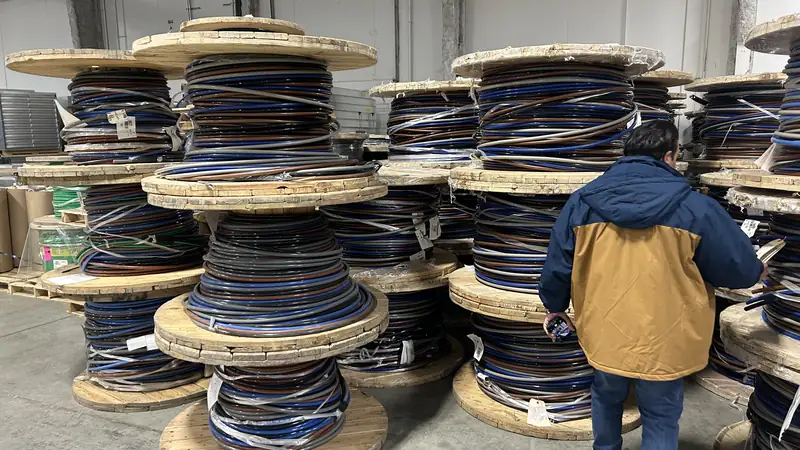
Electrical wire color codes identify intended conductor roles: black/red/blue commonly marks US 120/208 V phases, while brown/orange/yellow commonly marks 277/480 V phases. Those phase combinations are conventions, not a universal NEC color assignment; Ohio Wire Buyers evaluates reusable surplus using the reel tag, insulation markings, footage and condition as well as color.
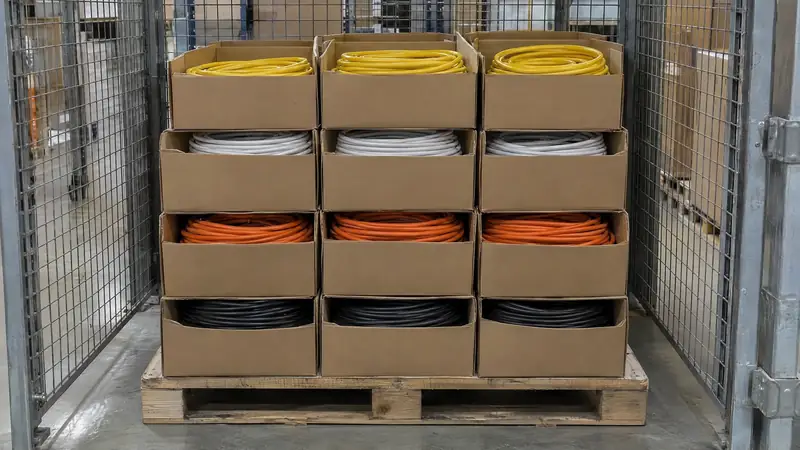
Electrical wire color codes: the common US chart
The chart below describes common three-phase AC practices. It is not a wiring instruction or proof that an installed conductor belongs to the system shown.
| Conductor role | Common 120/208 V convention | Common 277/480 V convention | Meaning of the color |
|---|---|---|---|
| Phase A | Black | Brown | Customary phase identification |
| Phase B | Red | Orange | Customary phase identification; orange also has a high-leg use |
| Phase C | Blue | Yellow | Customary phase identification |
| Grounded conductor, usually neutral | White | Gray | NEC grounded-conductor identification applies |
| Equipment grounding conductor | Green, green/yellow or bare | Green, green/yellow or bare | NEC equipment-grounding identification applies |
White on the lower-voltage system and gray on the higher-voltage system helps distinguish neutrals, but that particular allocation is not universal. Use the project's electrical specifications and posted identification scheme rather than assuming every facility follows this chart.
For surplus THHN/THWN-2 building wire, record the factory color as part of the product description. Do not label a loose blue reel as “208-volt wire” merely because blue appears in that convention.
Which colors does the NEC actually require?
The National Electrical Code has identification requirements for grounded conductors and equipment grounding conductors. NFPA's grounding and bonding reference explains white, gray and specified white or gray stripe identification under Section 200.6, and green or green with yellow stripes for covered or insulated equipment grounding conductors under Section 250.119. Equipment grounding conductors can also be bare.
Grounded and grounding are different terms. A neutral is a circuit conductor; an equipment grounding conductor provides a ground-fault current path and connects normally non-current-carrying metal parts. Treating them as interchangeable because both relate to grounding is a serious mistake.
The statement “the NEC only specifies neutral and ground colors” also needs a qualification. Section 110.15 addresses high-leg marking on certain delta-connected systems, requiring orange or other effective identification. Thus, orange can signify a high leg rather than the customary phase B of a 277/480 V system.
Black/red/blue and brown/orange/yellow are widely recognized phase conventions. They do not replace the applicable code, project requirements or verification of the actual installation.
Can you identify voltage or condition from color alone?
No. Factory color does not tell you the conductor metal, insulation type, voltage rating, remaining footage or suitability for another installation. Black XHHW-2 feeder wire and black THHN can look similar at a glance while having different product identities.
Start with the printed cable legend. Match it to the reel tag, then inspect the visible jacket and accessible ends for damage. Field-applied tape and sleeves should be recorded separately from factory insulation color; do not describe black wire with white tape as factory-white product.
For installed or decommissioned material, color is never an absence-of-voltage test. OSHA's electrical work-practice standard requires qualified-person testing to verify a de-energized condition, including possible backfeed or induced voltage. Have qualified personnel isolate and remove cable under the applicable procedures before preparing it for sale.
What do NM-B outer jacket colors tell you?
An NM-B outer jacket is a separate identification layer from the insulation on its individual conductors. Jacket colors help distinguish product constructions, but manufacturer schemes and older inventory can differ. They do not replace the printed gauge and conductor count.
The following combinations come from Cerrowire's current CerroMax NM-B specifications, not a universal NEC jacket-color mandate.
| CerroMax outer jacket | Manufacturer's cable designation | What to record |
|---|---|---|
| White | 14/2 AWG | Gauge and two insulated circuit conductors |
| Light blue | 14/3 AWG | Gauge and three insulated circuit conductors |
| Yellow | 12/2 AWG | Gauge and two insulated circuit conductors |
| Purple | 12/3 AWG | Gauge and three insulated circuit conductors |
| Orange | 10/2 AWG | Gauge and two insulated circuit conductors |
| Pink | 10/3 AWG | Gauge and three insulated circuit conductors |
| Black | 4, 6 or 8 AWG | Read the printing to distinguish size and construction |
The slash count describes insulated circuit conductors, not the equipment grounding conductor supplied with these constructions. When listing surplus NM-B coils, include the complete printed designation and grounding information. A yellow coil and a purple coil should not be combined into one inventory line just because both contain the same gauge copper.
Why do multiconductor cables use stripes or numbers?
A control cable may contain more conductors than a simple power-circuit color chart can distinguish. Southwire's conductor-identification reference describes base colors with tracers, single-color insulation with printed color designations, and sequentially numbered conductors.
These methods identify individual conductors within an assembly. They are not automatically a declaration that every internal color follows the common building-wire phase chart. The specified identification method matters when matching replacement cable to a drawing or purchasing specification.
For multiconductor control cable, photograph both the base insulation colors and any tracer stripes or numbers. For power tray cable, preserve the outer jacket legend and manufacturer part number as well. An outside photograph of a black reel cannot establish its internal conductor identification.
How does color affect surplus resale?
Color affects whether a reusable reel fits another buyer's specified installation. Familiar phase, neutral and grounding colors can simplify that match, but color alone does not establish a premium or how quickly a lot will sell. An unusual color is not automatically scrap.
Preserve continuous lengths and original identification. Do not cut a mixed-color lot into short pieces merely to create uniform bundles, and do not remove tags while rearranging reels. List each color separately even when the manufacturer, size and insulation type match.
Distinguish genuine discoloration or jacket damage from a harmless difference in the manufacturer's color shade. Send clear photos rather than repainting, retaping or otherwise changing the material to make it look uniform. Our reuse-versus-scrap guide explains why a documented usable product is evaluated differently from recoverable metal.
What should you send for an offer on colored wire?
Use a separate inventory line for each reel, coil or continuous cut length. Include manufacturer, printed type, conductor size, copper or aluminum, factory color, footage or estimate, and whether it is unused or previously installed. Mark unknown information as unknown rather than filling gaps from the color chart.
Photograph the whole lot, each reel tag, readable jacket print and accessible cut ends. Add close-ups of tracer stripes, conductor numbers and field-applied identification. For boxed NM-B, show the package label and jacket designation; for partial reels, distinguish original tag footage from your estimate of what remains.
Our wire photography guide and reel-tag guide help organize those details. Ohio Wire Buyers verifies the seller and proof of ownership, reviews the material, and replies with questions or a written offer before pickup. Payment method and timing are confirmed in writing before pickup; we arrange pickup anywhere in Ohio and check the count against the written terms.
Ohio Wire Buyers buys reusable surplus as product for resale and reuse, not scrap metal by the pound. Send your color-by-color inventory through the offer form, or call 951-403-5738. For more help identifying the lot before submitting it, use our wire selling guides.
Frequently asked questions
What does a blue electrical wire mean?
Blue commonly identifies a phase conductor in a US 120/208 V three-phase installation. That convention does not establish voltage, phase rotation or whether the wire is energized. Blue can also appear in other wiring systems, and a light-blue NM-B outer jacket identifies certain cable constructions rather than a phase. Read the markings and have a qualified person verify an installed circuit.
Are white and gray wire both neutral colors?
White and gray are recognized identification colors for grounded conductors, which are often neutrals. A project may use white for one voltage system and gray for another, so they are not automatically interchangeable within an existing installation. For a surplus offer, list the actual factory color and photograph any stripes or field markings rather than describing every grounded conductor simply as neutral wire.
Does an orange wire always mean 480 volts?
No. Orange commonly appears in the brown/orange/yellow convention for 277/480 V wiring, but it also identifies the high leg of certain delta systems. The NEC high-leg rule allows orange or other effective identification. An orange NM-B jacket can instead indicate a cable size. These different uses are why color must be interpreted with the cable markings and the system documentation.
Is purple NM-B different from older yellow cable?
Cerrowire identifies its 12/3 CerroMax NM-B with a purple jacket and its 12/2 with yellow. Those products have the same nominal conductor gauge but different insulated conductor counts. Older inventory and other manufacturers may use different jacket schemes. Read the printed designation on each coil; a changed jacket color alone does not establish a changed insulation rating or make older cable unusable.
Will Ohio Wire Buyers review mixed-color partial reels?
Yes. Ohio Wire Buyers reviews full reels, partial reels, boxed coils and cut lengths of reusable surplus electrical wire and cable from Ohio businesses. Keep each reel or continuous length separate and provide its factory color, type, size and footage or estimate. Mixed colors are not automatically a problem, but clear tags and a lot list make it easier to identify exactly what is available.
Sources and further reading
- NFPA Grounding and Bonding: Using the Tables in Article 250, hosted by the City of Salinas
- Brady: Wiring Color Codes and Three-Phase AC Conventions
- Cerrowire: CerroMax NM-B Product Specifications and Jacket Colors
- Southwire: Common Conductor Identification for Multiconductor Cables
- EC&M: NEC High-Leg Identification Requirements, by Mike Holt
- OSHA 1910.333: Selection and Use of Electrical Work Practices