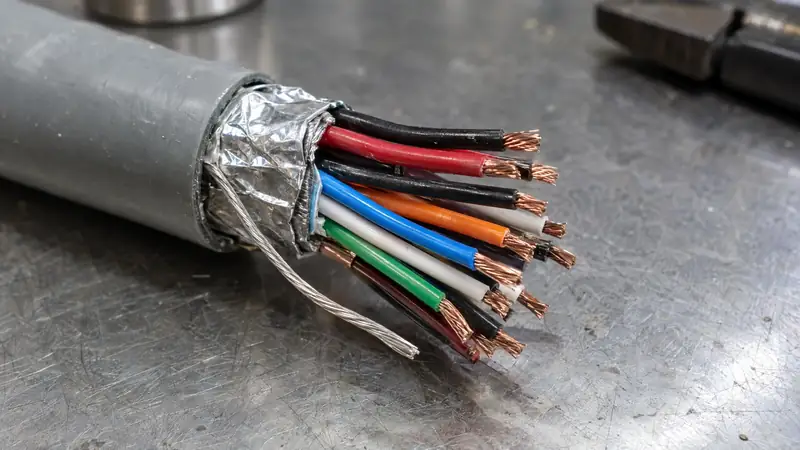
Ohio Wire Buyers buys reusable surplus multiconductor control cable from businesses anywhere in Ohio, including full reels, partial reels and usable cut lengths. To sell control cable, send the conductor size and count, jacket markings, color code, shield details and footage with photos; we review the material and provide a written offer before pickup when we can make an offer.
What identifies a multiconductor control-cable lot?
Control cable brings several insulated conductors together under an overall jacket for control circuits and automation applications. Its resale identity is the complete construction, not simply the copper gauge. A reel marked with a conductor size still needs a conductor count, manufacturer or part number, insulation description and cable rating.
Southwire's SPEC 45051 provides concrete examples of how much variety sits within this family:
| Conductor size | Examples listed in SPEC 45051 | Construction details to retain |
|---|---|---|
| 14 AWG | 2, 12, 19 and 37 conductors | Stranded bare copper, PVC-nylon insulation, PVC jacket |
| 12 AWG | 2, 7, 19 and 37 conductors | Same gauge does not mean the same conductor count |
| 10 AWG | 2, 7, 12 and 19 conductors | Match the count and product number to the reel |
These are examples from the Southwire control-cable specification, not an acceptance limit. Keep this material separate from other wire and cable families we buy, even when the outer jackets look alike.
Why do E-2, K-2 and numbered conductors matter?
ICEA Method 1 uses colored insulation with tracer stripes. Table E-2 starts with black, red, blue, orange, yellow and brown conductors; its standard sequence does not include white or green. Service Wire's conductor color-code chart labels this table E-2 and also uses the familiar K2 name.
Southwire's identification guide distinguishes that arrangement from Method 4, which uses a single insulation color with sequential printed conductor numbers. A handwritten number on a terminal sleeve is not proof that the underlying cable has factory-numbered conductors. Photograph the actual insulation and any printed identifiers at an already exposed end.
For resale, these details determine whether the cable matches the next user's drawings and specification. Do not combine color-coded and numbered reels under one lot description. Our wire color-code guide explains the broader identification issues; neither a color sequence nor a surplus listing authorizes a particular installation.
Are TC-ER and PLTC the same rating?
No. Type TC identifies power and control tray cable; TC-ER identifies constructions listed for exposed runs under applicable installation requirements. PLTC identifies power-limited tray cable. Belden describes PLTC applications as power-limited industrial control and energy-management circuits, among other uses. It is not a synonym for every industrial control cable.
Southwire's SPEC 45051 describes a 600-volt family and states that constructions with three or more conductors are listed for exposed runs. That qualification matters: do not assume every count in a product family carries every advertised listing. Read the exact jacket legend and match the manufacturer specification to the construction on your reel.
The overlap with TC and TC-ER tray cable is real, but it does not make all cable interchangeable. Photograph the complete voltage and listing information rather than writing only “control wire.” Permitted use depends on the actual product, circuit and installation conditions.
What should you report about shields and jackets?
Shielded and unshielded cable should be separate inventory entries. State whether the shield surrounds the whole conductor bundle or individual pairs or groups, and show any drain wire at the existing cut end. Belden lists unshielded, overall-shielded, and individually plus overall-shielded PLTC constructions. Shield layout is part of the product identity, not just an extra metal layer to weigh.
If the core contains twisted pairs or triads, compare it with instrumentation cable before classifying the lot. Likewise, a shielded jacket alone does not establish that a reel is VFD cable.
Jacket compounds also differ. PVC means polyvinyl chloride; CPE means chlorinated polyethylene. Southwire's shielded substation product uses flame-retardant cross-linked polyethylene insulation and a CPE jacket, while Belden also offers low-smoke, zero-halogen material options. Do not infer PVC, CPE or LSZH from jacket color, and do not assume those materials carry identical ratings.
Can partial reels and cut lengths remain reusable?
Yes, when the cable remains reusable and its identity and usable length can be established. Keep each continuous piece separate on your footage list. Several short cuts cannot be represented as a single uninterrupted run, even when their combined footage matches a longer reel.
Photograph any footage marks and record whether the length comes from a verified measurement, inventory record or estimate. Use our guide to measuring cable left on a reel when the original factory footage no longer reflects what remains. Do not unwind a heavy reel merely to improve a photo.
Report jacket cuts, crushed sections, exposed conductors, damaged shields, splices or contamination. Preserve tags and protect exposed ends while awaiting review. If the cable is not reusable, we say so; a scrap metal recycler may be the appropriate buyer.
How should plant and utility sellers separate surplus?
For a motor-control or PLC-panel project, keep the cable schedule with the corresponding reel. Distinguish multiconductor field cable from loose machine-tool and panel wire. A canceled panel build can leave both materials, but they require different descriptions.
For utility control-cable surplus, retain the utility specification, purchase records and any manufacturer's construction sheet that came with the material. Identify removed cable as used rather than unused stock. Have qualified personnel handle disconnection and removal; do not cut installed cable just to create an offer sample.
What should you send to sell control cable?
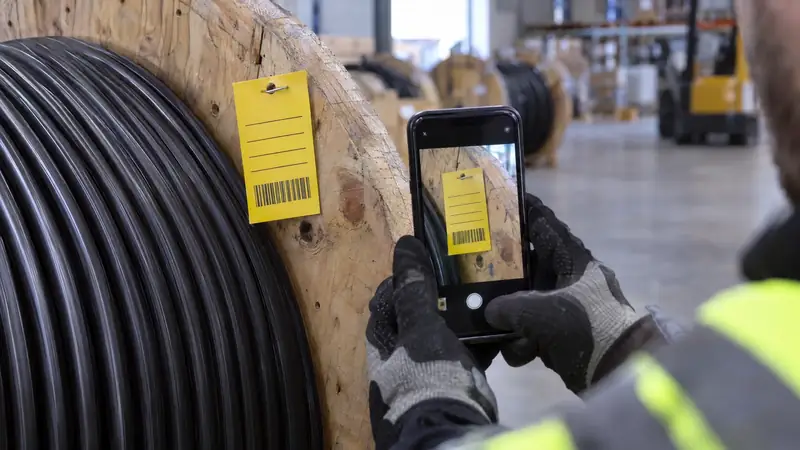
Start with a whole-lot photo, then give each reel or coil a distinct identifier. Pair that identifier with its tag photo, jacket legend, existing cut-end photo and footage entry. This prevents similar black-jacketed reels from being quoted as though they were the same construction.
| Send with your request | Why it matters for control cable |
|---|---|
| Reel tag and manufacturer part number | Connects the lot to a specific construction sheet |
| Gauge and insulated conductor count | Distinguishes otherwise similar-looking cable |
| Color/tracer or factory-numbering photo | Shows the conductor-identification system |
| Shield and drain-wire details | Separates overall shields from individually shielded groups |
| Complete jacket legend | Records voltage, listings and printed use markings |
| Continuous footage and condition notes | Separates reusable runs from short cuts or damaged sections |
Include proof of ownership such as an invoice, purchase order, closeout paperwork or company letter. Mark uncertain details as unknown. We verify the seller and ownership and keep a written purchase record.
What happens before Ohio pickup?
Ohio Wire Buyers reviews your information and replies with questions or a written offer. Payment method and timing are confirmed in writing before pickup. We arrange pickup at your Ohio jobsite, warehouse, plant or yard and check the count against the written terms; we do not maintain Ohio premises or accept seller deliveries.
The selling process covers the transaction details. When your lot is ready, request an offer for your control-cable surplus or call 951-403-5738 with the reel information available.
Frequently asked questions
Can I sell control cable left over from a canceled project?
Yes. Ohio Wire Buyers buys reusable surplus control cable from businesses, including unused project leftovers. Keep the original reel labels and any purchase or closeout records. Send photos and a footage list showing each construction separately. We review the material and reply with questions or a written offer before arranging pickup.
Do you buy control cable that has already been installed?
Used cable is considered only if it remains reusable. Tell us where it was used, how it was removed, whether it contains splices, and what damage or contamination is present. Have qualified personnel handle disconnection and removal. Photos alone do not establish suitability for reuse, and non-reusable material may belong with a scrap recycler.
Is a control-cable offer based on copper weight?
We buy reusable cable as a product for resale and reuse, not as scrap metal by the pound. Conductor size and count help identify the construction, but footage, shielding, color code, ratings, condition and documentation also matter. A heavier cable is not automatically a better resale match or a higher-value offer.
Can you review a reel if its factory label is missing?
Send clear photos of the jacket legend, the existing cut end and the whole reel. Include purchase records or the manufacturer's part number if available. Mark any uncertain conductor count or footage as unknown rather than guessing. We may need more information before identifying the cable or making a written offer.
Sources and further reading
- Southwire SPEC 45051: PVC-nylon insulated control cable with PVC jacket
- Southwire: Common conductor identification for multiconductor cables
- Service Wire: Common color codes, including E-2/K2 and Method 4
- Belden: Control cable constructions and material options
- Belden: Type PLTC cable applications and shielding options
- Southwire: FR-XLPE insulated, CPE-jacketed shielded substation control cable