Ohio Wire Buyers buys reusable surplus instrumentation cable from businesses anywhere in Ohio, including full reels, partial reels and usable cut lengths. To sell instrumentation cable, send its jacket markings, reel tags, footage and condition photos for review and a written offer before pickup. We buy cable as product for resale and reuse, not as scrap metal by the pound.
What do PLTC and ITC markings tell a buyer?
PLTC means power-limited tray cable; ITC means instrumentation tray cable. Shawflex's 300 V instrumentation specification identifies PLTC under UL 13 and ITC under UL 2250. A cable may carry both designations, but the complete jacket legend and manufacturer specification establish what that particular product is.
Do not infer voltage rating from the signal it carried. Instrumentation products include 300 V PLTC/ITC constructions and different 600 V constructions, such as the armored cable discussed below. A low-voltage signal application does not make their listings interchangeable. Likewise, direct-burial or exposed-run suitability needs product-specific confirmation, not an assumption based on a black jacket.
Photograph enough of the legend to capture the manufacturer, product designation, conductor size and ratings. Our guide to reading cable jacket print helps organize that information. Keep unrelated material separate when inventorying the broader wire and cable types we buy.
How do pairs, triads and shields change the product?
A pair groups two insulated conductors; a triad groups three. The group count matters as much as gauge: a reel of pairs is not equivalent to the same number of triads. Shawflex lists both 16 AWG and 18 AWG constructions, with separate product numbers for the different group counts.
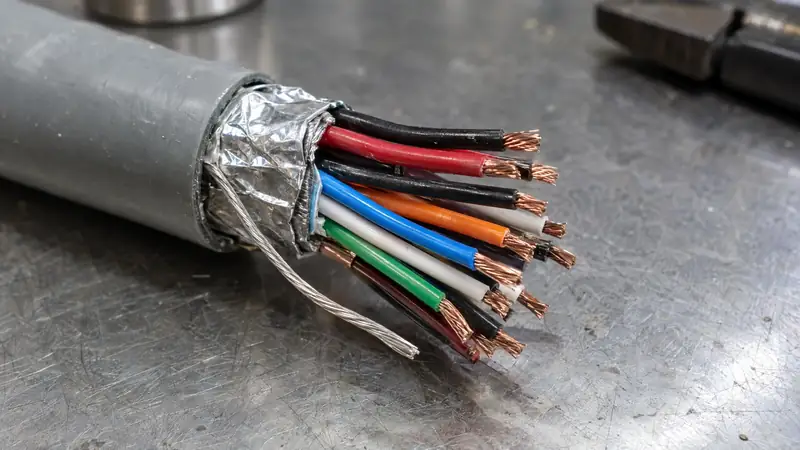
Overall shielding, often abbreviated OS, surrounds the assembled conductor groups. Individual and overall shielding, written IS/OS or ISOS, adds shields around the individual pairs or triads as well. Shawflex describes foil shields with tinned copper drain wires; these wires provide a connection to the shield and should not be counted as additional insulated signal conductors.
| Verified manufacturer example | Conductor grouping | Shield construction | Rated voltage and identity |
|---|---|---|---|
| Belden 32P1808 | 18 AWG, eight pairs | Individual and overall foil shields | 300 V, PLTC/ITC/CMG |
| Belden 3027A | 18 AWG, two triads | Overall foil shield | 300 V, PLTC/ITC/CMG |
| Shawflex PLTC/ITC product family | 16 AWG and 18 AWG pairs or triads | ISOS standard; OS optional | 300 V, PLTC/ITC |
These are identification examples, not a promise that every similar-looking reel matches. Preserve the product number on Belden surplus cable, and list ungrouped multiconductor control cable separately. A cut-end photo should show the conductor groups and foil without dismantling otherwise usable footage.
Why is thermocouple extension wire a separate item?
Thermocouple extension wire connects a matching thermocouple to its measuring instrument. Its conductors have thermoelectric characteristics matched to the sensor type; ordinary copper signal cable is not a substitute. Separate this material by its printed type and grade, even if the reels look like other small-gauge instrumentation cable.
The following American color conventions come from TC Measurement and Control's ANSI MC96.1 reference. They describe extension-grade identification, not a universal jacket-color rule for every industrial assembly.
| Extension designation | Positive conductor | Negative conductor | Typical extension-grade outer color |
|---|---|---|---|
| JX | White | Red | Black |
| KX | Yellow | Red | Yellow |
| TX | Blue | Red | Blue |
| EX | Purple | Red | Purple |
Imported products may follow a different color system, and some insulation uses tracers rather than solid colors. For these types, thermocouple-grade wire typically has a brown outer covering instead of the extension-grade color. Send the manufacturer number, type, grade and insulation description; color alone is insufficient to identify a resale item.
What is different about armored instrumentation cable?
Armored instrumentation cable adds mechanical protection around its signal-cable core. Southwire's SPEC 43702 ARMOR-X construction is a 600 V MC-HL product with shielded pairs, an overall shield, an inner PVC jacket, continuously welded corrugated aluminum armor and an outer PVC jacket. That identity is different from unarmored PLTC/ITC.
For an offer, photograph both the jacket legend and any already-exposed armor at an end. Flag crushed sections, sharp bends, splits or visible corrosion rather than describing the reel simply as armored. Do not peel away protection to expose the core for a photograph.
List this material with its complete designation, not merely as industrial tray cable. Our page on MC-HL and jacketed armored cable covers the related family. Neither an armor description nor a purchase offer establishes suitability for a particular hazardous-location installation.
What makes a signal-cable lot reusable?
Reusable cable needs an identifiable construction and footage that remains useful as cable. Keep continuous lengths intact, retain the original tags, and secure loose ends without crushing the jacket. Separately identify short offcuts, spliced sections and material with uncertain service history.
A clean-looking outer jacket does not establish the condition of every insulated conductor or shield inside it. Tell us about moisture exposure, chemical contact, heat damage or difficult removal. For installed cable, have qualified personnel handle de-energization and removal; do not disturb active instrument circuits to prepare a sale.
Exact product identity, usable length, condition, documentation and demand affect the offer. If the cable is not reusable, we say so; a scrap metal recycler may be the appropriate buyer. The surplus-versus-scrap comparison explains that distinction without treating copper weight as the resale price.
What should you send for an instrumentation cable offer?
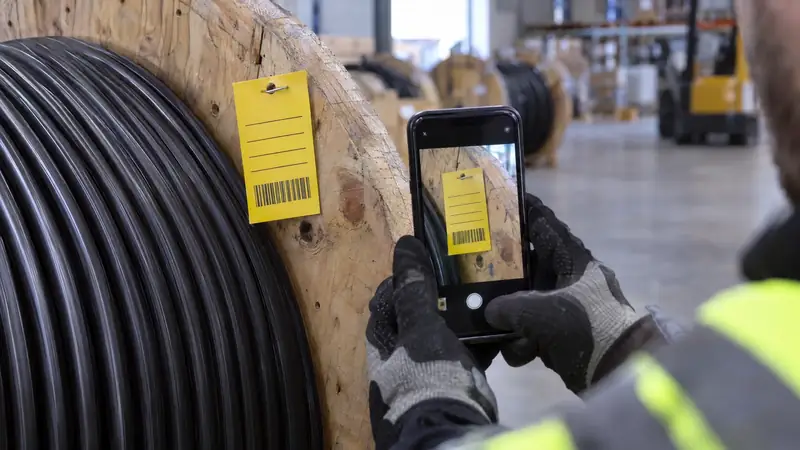
Send a whole-lot photograph and assign each reel or coil a matching entry on your footage list. Include close-ups of its tag, readable jacket print and accessible cut ends. For shielded material, show any visible drain wires and group identifiers; for thermocouple extension wire, include the type and grade markings.
| Information to send | Why it matters for this cable |
|---|---|
| Manufacturer and exact product number | Allows construction to be checked against the correct specification |
| AWG and pair or triad count | Distinguishes signal groups from total conductors |
| OS or IS/OS identification | Establishes the shield arrangement rather than guessing from the jacket |
| Voltage and complete listing marks | Separates PLTC/ITC from differently rated constructions |
| Continuous footage per reel or coil | Shows usable lengths, not just a combined lot total |
| Condition and storage history | Flags jacket, insulation, shield or armor concerns |
Mark footage as an estimate when it is not measured. Include proof of ownership, such as an invoice, purchase order, closeout paperwork or company letter. For plant surplus inventory, connect each tag photo to the matching inventory entry rather than sending an unlabeled folder of similar reels.
How do you sell instrumentation cable from an Ohio facility?
If your Ohio refinery, chemical plant, power-generation facility or water-treatment operation has surplus cable, identify unused stock separately from removed lengths. State whether the material is at a storeroom, loading dock or operating-site laydown area, and describe access restrictions and available loading equipment.
Ohio Wire Buyers reviews the details and replies with questions or a written offer before pickup. Payment method and timing are confirmed in writing before pickup; we verify the seller and ownership, keep a written purchase record, and check the count against the written terms when collecting the lot. See how the selling process works for the full sequence.
To have your instrumentation surplus reviewed, request a written cable offer with photos and footage, or call 951-403-5738. We arrange pickup at your jobsite, warehouse, plant or yard anywhere in Ohio.
Frequently asked questions
Can I sell partial reels of shielded instrumentation cable?
Yes, Ohio Wire Buyers reviews reusable partial reels as well as full reels and cut lengths. Keep the jacket print and reel tag available, identify the pair or triad count, and provide remaining footage or an honest estimate. Do not split a continuous length into shorter pieces just to make the reel easier to move.
Is instrumentation cable priced by its copper weight?
Ohio Wire Buyers buys reusable cable as product for resale and reuse, not as scrap metal by the pound. An offer depends on the exact construction, usable footage, condition, documentation and demand. Shields, drain wires and thermocouple alloys can make a cable materially different from another reel with a similar outside diameter.
Can I drop off cable at an Ohio Wire Buyers yard?
No. Ohio Wire Buyers has no Ohio street address, office or yard. We arrange pickup at the seller's jobsite, warehouse, plant or yard anywhere in Ohio. Send the material details first; the written offer and payment method and timing are confirmed before pickup is arranged.
Will you review instrumentation cable with a missing reel label?
Send clear photos of the jacket legend and any remaining product number, along with footage and condition details. A missing tag does not automatically identify cable as scrap, but it makes verification harder. If the construction or rating cannot be established, we may need more information before determining whether it is reusable and making an offer.
Should I combine thermocouple extension wire with copper signal cable?
You can submit both in the same surplus lot, but list them separately. Thermocouple extension wire must match the sensor type and is not interchangeable with ordinary copper instrumentation cable. Include its type designation, extension-grade marking, conductor colors, insulation material and product number so each item can be reviewed on its own.