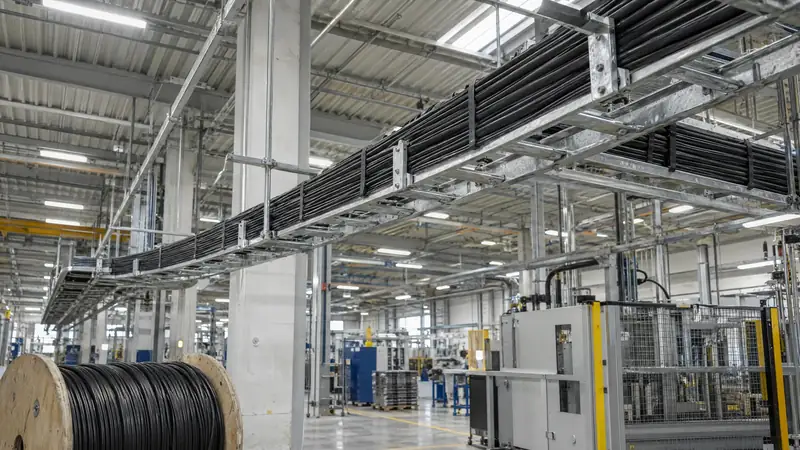
Ohio Wire Buyers buys reusable surplus variable frequency drive cable from businesses anywhere in Ohio, including full reels, partial reels and usable cut lengths. To sell VFD cable, send the manufacturer and product number, footage, condition and photographs of the jacket legend and existing cut ends; we review the material for resale and reuse, not scrap metal by the pound. We provide a written offer before pickup and confirm payment method and timing in writing before pickup.
How can you distinguish VFD cable from ordinary tray cable?
VFD cable is designed for the connection between a variable frequency drive's inverter output and a motor. That service involves fast switching waveforms, electrical noise and insulation stresses that differ from an ordinary power feed. The identifying details are the cable's insulation system, shield, grounding arrangement and manufacturer designation—not simply a black jacket.
Start with the complete jacket print. Look for the manufacturer, catalog number, conductor size, VFD designation and applicable listings. Compare those details with the original datasheet rather than assigning a construction from appearance alone.
A TC-ER marking does not automatically mean VFD cable. Drive cable may also be tray cable, but ordinary TC and TC-ER surplus includes other power and control constructions. Likewise, a metallic shield does not settle the identity: shielded instrumentation cable serves a different purpose. Keep unidentified reels separate within your wire and cable inventory until the print can be checked.
Why do symmetrical grounds and shields matter for resale?
A symmetrical design commonly has three phase conductors with three smaller ground conductors distributed in the spaces between them. This is often called a 3+3 construction. Southwire explains that the symmetrical arrangement helps reduce induced ground currents compared with an asymmetrical arrangement.
The overall metallic shield helps control electromagnetic interference and provides a path for high-frequency common-mode current. Copper tape and combined foil/braid shields are different constructions, not interchangeable descriptions. A shield's effectiveness also depends on proper termination, so reusable cable needs enough sound material at the ends for the next installation.
Not every manufacturer's VFD design has three grounds. Belden also documents versions with a single full-sized insulated ground. Photograph the actual arrangement and preserve the shield rather than peeling it away to expose copper. A buyer needs the original assembly intact, not just the phase conductors.
What do the voltage and TC-ER markings actually tell you?
VFD product families include 600 V, 1 kV and 2 kV ratings, but those numbers must stay attached to the applicable listing. Southwire SPEC 45443, for example, prints a 600 V TC-ER designation alongside 1000 V flexible motor supply and WTTC designations. Calling that cable simply “1000-volt tray cable” can erase an important distinction.
TC-ER identifies tray cable with an exposed-run rating; it is not blanket permission for every route or environment. Record separate sunlight, oil, wet-location or direct-burial markings when present. The future installer must check the listing, installation conditions and drive manufacturer's requirements.
XLPE means cross-linked polyethylene insulation. Many VFD cables use it, but the outer jacket may be PVC, TPE or another material. Do not describe a PVC-jacketed cable as PVC-insulated without checking the conductor insulation.
Which product details should stay with each reel?
These manufacturer examples show why gauge alone is not a sufficient lot description. They identify specific product families, not universal specifications for every VFD cable.
| Manufacturer example | Documented construction | Detail to retain in the lot list |
|---|---|---|
| Prysmian CVTC VFD, SPEC 4580 | 14 AWG–500 kcmil copper; XLPE; three symmetrical grounds; copper-tape shield; 2000 V TC-ER | Catalog number and exact phase conductor size |
| Southwire Machine Flex, SPEC 45443 | XLPE; three tinned grounds; foil plus tinned-copper braid; TPE jacket | Complete voltage and listing legend |
| Belden Classic VFD families | Single-ground foil/braid and symmetrical-ground copper-tape versions | Full part number, including any suffix |
| Alpha Wire V-Flex | XLPE insulation; foil/braid shield; TPE jacket | V-Flex designation rather than a generic control-cable label |
LAPP's ÖLFLEX VFD lineup also separates power-only, signal-pair and symmetrical versions. Keep LAPP ÖLFLEX surplus and Belden cable lots organized by exact part number. For General Cable-labeled material, retain the original name and documentation rather than relabeling it from a similar Prysmian product. Manufacturer names and trademarks belong to their owners; Ohio Wire Buyers is not affiliated with or endorsed by these manufacturers.
How do partial reels and cut lengths affect an offer?
Usable continuous length matters because another installation needs a complete run. Several separate cuts are not equivalent to the same footage on one continuous reel. List each length independently, and disclose splices, damaged sections or previously trimmed terminations.
On a partial reel, the factory tag normally describes the original put-up, not necessarily what remains. Jacket footage marks can help establish remaining length when the relevant endpoints are accessible and the sequence is understood. Our guide to measuring wire left on a reel explains ways to document footage without treating an old tag as a current count.
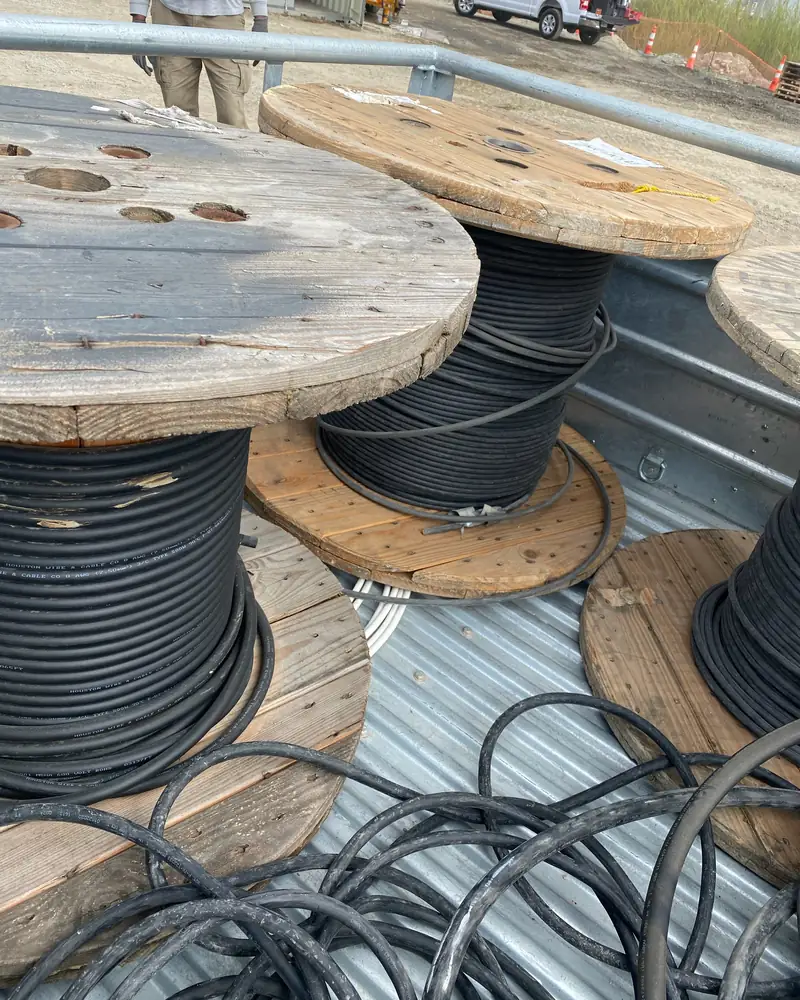
Leave cable on sound reels where possible. Photograph cracked flanges, loose winding and any flattened or sharply kinked section. Do not cut a useful length into shorter coils just to make the lot easier to weigh.
Can removed motor cable still be reusable?
Used cable is considered only if it remains reusable. Tell us whether it was installed, pulled back out before startup, or removed after operating service. Those histories are different even when the jackets look alike.
Have qualified personnel handle disconnection and removal under the facility's electrical safety procedures. For already-removed cable, show termination areas, shield damage, jacket cuts, contamination and any evidence of overheating. Include available inspection or test records, but do not present a single test result as proof that every component is sound.
Businesses clearing plant maintenance cable inventory should separate unused spares from removed runs. If the assembly is not reusable, we say so; the surplus-versus-scrap distinction then becomes the deciding issue.
What should you send for a VFD cable offer?
Send photographs that establish construction as well as quantity. Use existing cut ends where accessible; do not damage an unopened reel just to create a sample. If a detail cannot be seen, mark it unknown and include the datasheet or purchase description.
| Send this detail | Why it matters for VFD cable |
|---|---|
| Whole lot and individual reel photos | Shows packaging, reel condition and separate lengths |
| Reel tag and complete jacket legend | Connects product number, size and listings to the actual cable |
| Existing cut-end close-up | Shows phase conductors, ground arrangement and shield type |
| Footage list with measured or estimated status | Separates continuous runs from multiple cuts |
| Condition history and ownership paperwork | Distinguishes unused stock from removed cable and documents the seller's ownership |
Mention integrated brake or signal pairs, even if the power conductor size matches another reel. Add the pickup location, access restrictions and available loading equipment. We verify the seller and proof of ownership, such as an invoice, purchase order, closeout paperwork or company letter, and keep a written purchase record.
How do you sell VFD cable anywhere in Ohio?
Ohio Wire Buyers arranges pickup at your Ohio jobsite, warehouse, plant or yard. We have no Ohio street address, office or yard for receiving cable. Keep the reels where they can be safely inspected and loaded rather than transporting them to an assumed receiving yard.
After reviewing the photos and footage list, we reply with questions or a written offer. Payment method and timing are confirmed in writing before pickup, and the count is checked against the written terms at pickup. See how selling surplus wire works for the transaction steps.
To have your drive cable reviewed, request an offer for the surplus lot with the tags, jacket print and length list, or call 951-403-5738. Preserve the cable's identifying details and complete shield system while the material is evaluated for reuse.
Frequently asked questions
Can I sell VFD cable without the original reel tag?
Send clear photographs of the complete jacket legend and any purchase records you have. A manufacturer name and catalog number may allow the construction to be identified even when the tag is missing. Include photographs of existing cut ends and state whether the footage is measured or estimated. Missing identification can limit the evaluation; do not guess a voltage or shield rating.
Is a cable with one ground conductor still VFD cable?
It can be. Manufacturer VFD families include designs with one insulated ground as well as symmetrical designs with three distributed grounds. The ground count alone does not settle the question. Match the catalog number to the manufacturer's documentation and record the insulation, shield system and listings before describing the cable as a particular VFD product.
Do you buy VFD cable with a brake or signal pair?
Ohio Wire Buyers reviews reusable surplus cable with integrated brake or signal conductors. Identify the full product number and show the additional pair at an existing cut end if it is accessible. Its conductor size and shielding distinguish that construction from a power-only version. Keep those versions separate in your footage list rather than combining them under one gauge description.
Does flexible VFD cable mean continuous-flex cable?
No. A product described as flexible may be intended for installation or occasional movement rather than repeated travel in a cable carrier. Belden's product literature distinguishes extra-flexible and continuous-flex constructions. Use the exact manufacturer's product designation, and disclose any previous moving-machine service so the cable is not offered as unused or assigned a flex rating it does not have.
Should I strip the copper shield before selling surplus VFD cable?
Leave the cable intact while it is being evaluated for reuse. Removing the shield or jacket destroys part of the manufactured assembly and changes what you have to sell. Ohio Wire Buyers buys reusable wire and cable as product, not scrap metal by the pound. If damage makes the cable unsuitable for reuse, a scrap metal recycler may be the appropriate buyer.