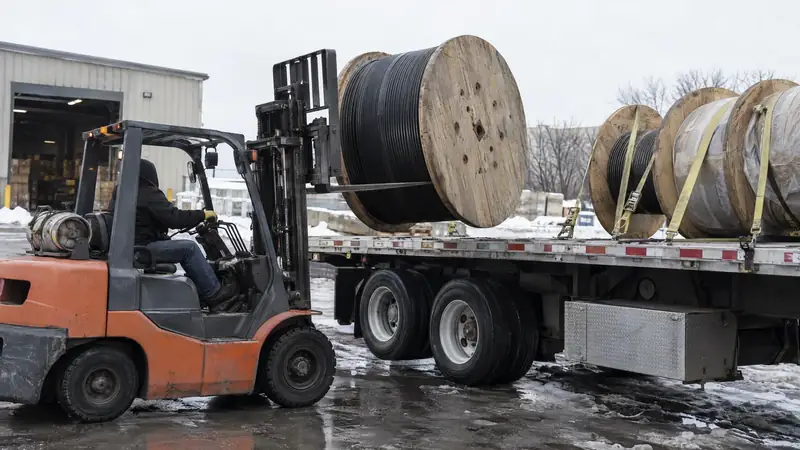
Wire reel sizes describe flange diameter, winding width and drum diameter; loaded weight also depends on the cable, footage and empty package weight. Ohio Wire Buyers buys reusable surplus electrical wire and cable from businesses anywhere in Ohio, and these measurements help us review the lot and plan pickup without guessing from a photograph.
What measurements define wire reel sizes?
The flange is the round side of the reel. Measure its outside diameter, then distinguish the traverse—the clear winding space between flanges—from overall width, which includes the flanges and projecting hardware. Overall width matters for access and loading; traverse describes the space available for cable.
The drum, or barrel, is the center cylinder carrying the innermost cable layer. The arbor hole takes the supporting shaft. Record all these dimensions when accessible without moving an unsafe reel, and label each measurement rather than sending an unexplained pair of numbers. Our wire selling guides cover the separate tasks of identifying, measuring and documenting surplus.
Wooden and steel reel dimensions: verified examples
These examples come from Southwire's Reel Packaging Information. Dimensions are in inches; empty weights are approximate manufacturer figures, not loaded weights or safe working loads. They illustrate specific packages rather than a universal wooden reel size chart.
| Southwire reel | Construction | Flange | Traverse | Drum | Overall width | Approx. empty weight, lb |
|---|---|---|---|---|---|---|
| N-5 | Plywood | 23.75 | 17 | 12 | 18.5 | 20 |
| A-10 | Nailed wood | 30 | 22 | 16 | 25 | 66 |
| A-38 | Nailed wood | 48 | 28 | 24 | 32 | 212 |
| A-62 | Nailed wood | 60 | 28 | 28 | 34 | 397.45 |
| S-120 | Steel | 84 | 36 | 42 | 43 | 895 |
| S-300 | Steel | 96 | 60 | 42 | 68 | 1,082 |
Do not identify a reel model from diameter alone. Southwire uses different constructions for different products, including reinforced wood for heavier cable and steel for heavy conductor loads. Steel reels may also be returnable; check ownership and return obligations before including one in a sale.
Keep the reel stencil and tag visible. Our guide to reading a wire reel tag explains which product and package details to capture.
How much does a loaded cable reel weigh?
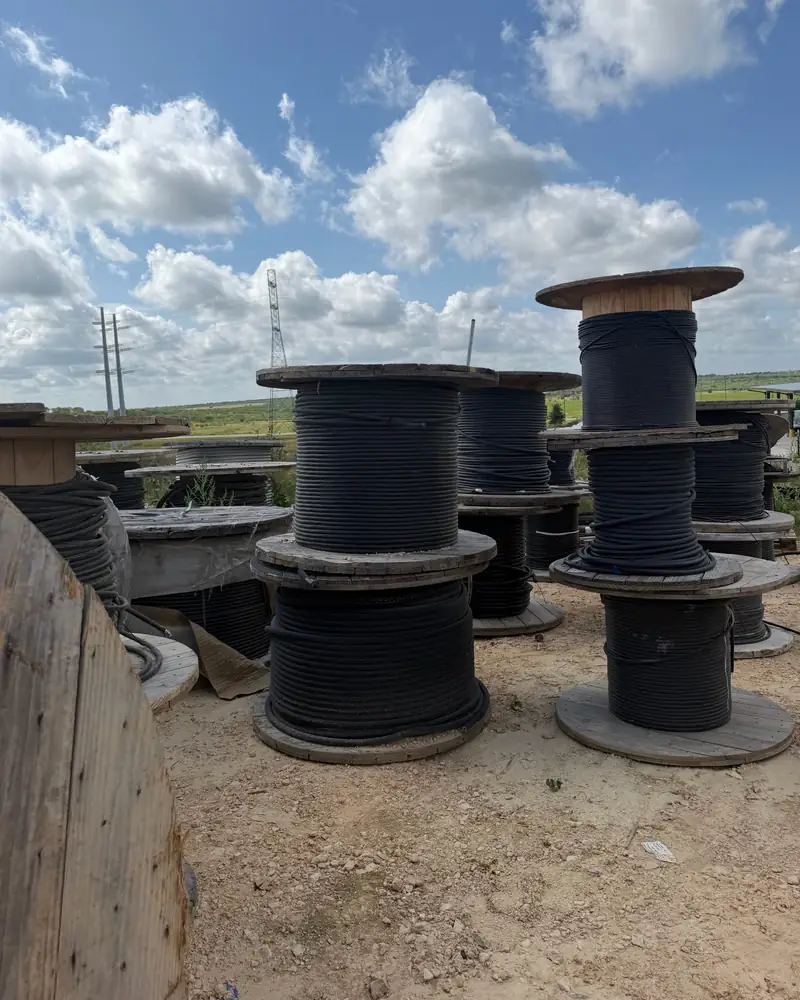
Tare means empty package weight. Net means cable weight, while gross means the complete loaded package. Southwire lists gross, tare and net among its reel-tag information. A current scale reading is more useful for loading than the original gross weight after cable has been removed.
For an estimate, multiply footage by the manufacturer's approximate complete-cable weight per foot, then add tare and any packaging not already included. Southwire's product specifications list approximately 719 pounds per 1,000 feet for its 4/0 AWG copper THHN/THWN-2 and 1,662 pounds per 1,000 feet for its 500 kcmil version.
| Illustrative cable load | Approx. cable weight, lb | Hypothetical tare, lb | Estimated loaded weight, lb |
|---|---|---|---|
| 1,000 ft of 4/0 AWG copper THHN | 719 | 100 | 819 |
| 1,000 ft of 500 kcmil copper THHN | 1,662 | 200 | 1,862 |
| 500 ft of 500 kcmil copper THHN | 831 | 200 | 1,031 |
The tare figures are assumptions for arithmetic, not weights assigned to particular reel models. These examples are not approval to load those lengths onto any reel or lift them with particular equipment.
Use complete insulated-wire weight, not copper-only weight. Jackets, insulation and armor remain on reusable cable. The wire weight-per-foot chart explains that distinction when comparing specifications.
Why can't reel diameter tell you the footage?
A wide traverse holds a different winding volume than a narrow traverse, even with matching flanges. Drum diameter changes the available space too. Cable outside diameter, winding pattern and fill level all affect what fits, while cable bending requirements constrain the package choice.
A partial reel may contain a continuous length, several separate cuts or parallel conductors. An original footage tag does not resolve those differences after material has been used or rewound. Note the actual arrangement instead of calling every nearly full-looking reel a factory-full package.
Use jacket footage marks, inventory records or a documented estimate following our guide to measuring wire left on a reel. A capacity chart is not proof of remaining length, cable condition or reel strength.
Forklift or crane: what decides a safe lift?
Start with current gross weight, reel dimensions, condition and the equipment manufacturer's instructions. OSHA explains that forklift capacity applies at the load center shown on its data plate. An oversized load can move that center forward and reduce usable lifting capacity; a weight below the headline rating does not by itself establish a safe lift.
Prysmian directs forklift operators to support both flanges with forks long enough for the full reel width. Forks must not bear directly on the cable between flanges. Do not push a reel sideways with fork tips or lift it by the top flange.
For heavy high-voltage cable drums, Prysmian's handling guide specifies crane lifting with a spreader bar designed for the particular drum size, weight and width. Have trained personnel determine the lifting arrangement under the manufacturer's requirements rather than improvising around short forks. Flag large medium-voltage cable reels before pickup planning.
How should reels sit on stands and trucks?
Prysmian calls for appropriate payoff stands that hold the drum firmly and allow smooth rotation. Check the stand and shaft manufacturer's fit and capacity requirements against the actual reel. Its drum-handling guide also calls for controlled payout and braking to prevent cable overrun; makeshift supports are not a substitute.
Store and transport reels upright, with flanges vertical and the barrel axis horizontal. Restrain them against rolling, and keep neighboring flanges from touching cable. Do not drop reels from a truck or put tie-down pressure directly across exposed cable.
Report broken flanges, loose hardware, damaged lagging or missing end seals. For material awaiting collection outdoors, our Ohio winter reel-storage guide covers storage preparation without sacrificing product identification.
What should you send for an offer on wire reels?
Give each reel a distinct inventory label and use it in the footage list and photos. State whether weight is from the factory tag, a current scale reading or a calculation. Photograph damage instead of hiding it behind wrapping.
| Send for each reel | Why it helps |
|---|---|
| Whole reel, both flanges and nearby access | Shows package condition and handling constraints |
| Reel tag and readable jacket print | Identifies cable rather than just its container |
| Cut ends and footage marks | Helps assess construction, condition and remaining length |
| Labeled dimensions, weight basis and footage estimate | Supports pickup planning and inventory review |
Include whether there is a dock, usable forklift or restricted yard access. Follow the offer-photo guide for close-ups, and review the options for selling full and partial wire reels.
Keep the cable intact until pickup terms are settled
We verify the seller and proof of ownership, review the material, and provide questions or a written offer before pickup. Payment method and timing are confirmed in writing before pickup, and the count is checked against the written terms. The selling process explains those steps; non-reusable material may belong with a scrap recycler instead.
Send your reel measurements, photos and footage list to request an offer, or call Ohio Wire Buyers at 951-403-5738. We arrange pickup at the seller's Ohio jobsite, warehouse, plant or yard.
Frequently asked questions
Does a 48-inch cable reel have a standard weight?
No. Flange diameter alone does not identify the reel construction, traverse, drum diameter or cable load. Southwire's A-38 nailed-wood reel has a 48-inch flange and an approximate empty weight of 212 pounds, but that figure does not apply to every reel with the same diameter. Use the actual reel designation, tag or measured tare when available.
Is the gross weight on an old reel tag still accurate?
It describes the package when the tag was issued, not necessarily what remains today. If cable has been pulled off, the original gross and net weights no longer describe the partial reel. Keep the tag because it identifies the original product, but pair it with current footage information or a current scale weight and explain any changes to the package.
Does Ohio Wire Buyers purchase empty wooden spools?
Ohio Wire Buyers buys reusable surplus electrical wire and cable as product for resale and reuse, not empty reels or scrap metal by the pound. A spool's return or disposal route is separate from selling the cable wound on it. Tell us if the reel is returnable or belongs to a manufacturer, distributor or another company before including it in a proposed sale.
Can I estimate remaining cable length from its weight?
Yes, as an estimate when the cable identity, current gross weight and actual tare are known. Subtract the empty package weight, then divide the remaining cable weight by the manufacturer's approximate complete-cable weight per foot. Do not use copper-only weight for insulated cable. Extra packaging, uncertain tare or multiple cable types can make the estimate unreliable.
Should I transfer cable to a smaller reel before selling?
Do not transfer it merely to save pickup space. Rewinding introduces handling risk and can separate the cable from its original identification. Prysmian recommends a replacement barrel at least as large as the original when rewinding. The cable's own requirements still apply. Photograph the existing package and discuss any damaged reel before deciding whether a transfer is necessary.
Sources and further reading
- Southwire Reel Packaging Information
- Southwire 4/0 AWG SIMpull THHN/THWN-2 Copper, Product 20508801
- Southwire 500 kcmil SIMpull THHN/THWN-2 Copper, Product 20513801
- Prysmian Transport, Handling and Storage Procedures for Cable Products
- Prysmian Cable Drum Handling Guide
- OSHA Powered Industrial Trucks eTool: Load Composition