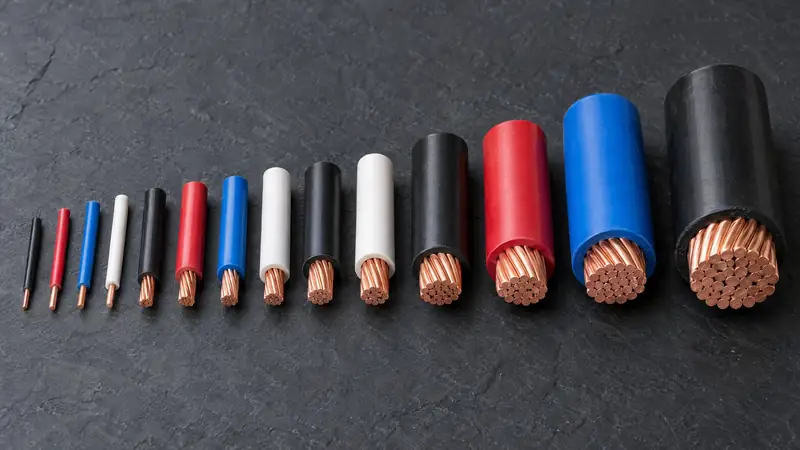
Copper wire weight per foot depends on conductor size and whether you mean copper alone or the complete insulated wire: Southwire lists stranded 4/0 bare copper at approximately 0.653 lb/ft and 4/0 THHN at 0.719 lb/ft. Ohio Wire Buyers buys reusable surplus electrical wire and cable from Ohio businesses as product, not scrap by the pound, so weight helps document a lot but does not determine its offer.
Copper wire weight per foot chart: bare versus THHN
All figures below are approximate, in pounds, and exclude the reel. Bare weights come from Southwire SPEC 10080; total THHN weights come from SPEC 10003 for 14–10 AWG and SPEC 10000 for larger sizes. Per-foot values are the published per-1,000-foot figures divided by 1,000, not separate measurements.
| Conductor size | Bare copper lb/1,000 ft | Bare copper lb/ft | Total copper THHN lb/1,000 ft | Total THHN lb/ft |
|---|---|---|---|---|
| 14 AWG | 12 | 0.012 | 16 | 0.016 |
| 12 AWG | 20 | 0.020 | 24 | 0.024 |
| 10 AWG | 32 | 0.032 | 39 | 0.039 |
| 8 AWG | 50 | 0.050 | 63 | 0.063 |
| 6 AWG | 81 | 0.081 | 95 | 0.095 |
| 4 AWG | 128 | 0.128 | 153 | 0.153 |
| 3 AWG | 162 | 0.162 | 189 | 0.189 |
| 2 AWG | 204 | 0.204 | 235 | 0.235 |
| 1 AWG | 258 | 0.258 | 301 | 0.301 |
| 1/0 AWG | 325 | 0.325 | 374 | 0.374 |
| 2/0 AWG | 410 | 0.410 | 464 | 0.464 |
| 3/0 AWG | 518 | 0.518 | 578 | 0.578 |
| 4/0 AWG | 653 | 0.653 | 719 | 0.719 |
| 250 kcmil | 771 | 0.771 | 844 | 0.844 |
| 300 kcmil | 926 | 0.926 | 1,016 | 1.016 |
| 350 kcmil | 1,081 | 1.081 | 1,180 | 1.180 |
| 400 kcmil | 1,235 | 1.235 | 1,341 | 1.341 |
| 500 kcmil | 1,544 | 1.544 | 1,662 | 1.662 |
| 600 kcmil | 1,853 | 1.853 | 1,992 | 1.992 |
| 750 kcmil | 2,316 | 2.316 | 2,470 | 2.470 |
| 1000 kcmil | 3,088 | 3.088 | 3,264 | 3.264 |
The selected rows use stranded conductors: 19 strands through 4/0, 37 strands for the listed 250–500 kcmil sizes, and 61 strands for 600–1000 kcmil. These are specification examples, not a stock-availability list. For help matching AWG, aught and kcmil markings, use our conductor-size explanation.
Which weight should you use?
Use the bare column when estimating a matching length of uninsulated conductor. Use total THHN weight when weighing insulated THHN/THWN-2 building wire, because the scale also weighs its PVC insulation and nylon sheath. Neither column includes packaging, reel flanges or pallets.
Bare-product weight is not always identical to the copper-content entry in an insulated-wire sheet. For example, SPEC 10080 lists the selected 1/0 bare construction at 325 lb/1,000 ft, while SPEC 10000 lists 326 lb/1,000 ft of copper in its 1/0 THHN construction. Keep each specification's figures together rather than treating the table as an exact recovery formula.
For bare copper offered for reuse, also record its strand construction and condition. Do not strip insulated wire just to make it match the bare column; that changes the product being evaluated.
How do you estimate footage from a partial reel's weight?
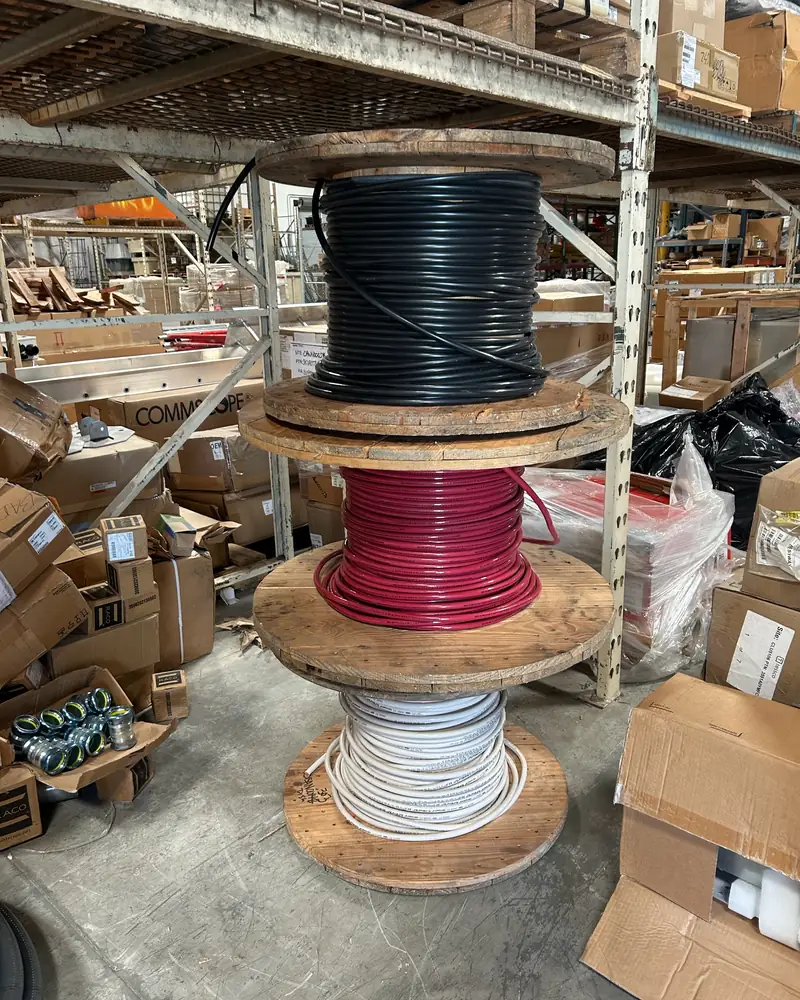
The useful relationship is estimated feet = net wire pounds ÷ insulated-wire pounds per foot. Net wire weight means gross loaded-reel weight minus the empty reel and any separately included packaging. A platform-scale reading without a credible tare is only a gross weight.
Consider an illustrative 4/0 THHN reel weighing 460 pounds with an established empty-reel tare of 100 pounds. Net wire weight is 360 pounds; dividing by Southwire's approximate 0.719 lb/ft gives about 501 feet. Dividing that same insulated weight by the bare figure would suggest about 551 feet, overstating the estimate.
Keep the scale reading, tare basis and product specification with your calculation. An empty reel of a different design is not a confirmed tare for this one. Our partial-reel footage guide explains how to document an estimate alongside available markings.
Why won't every manufacturer's chart agree?
Southwire labels these dimensions nominal and subject to normal manufacturing tolerances. Its small-gauge sheet also separates solid from stranded construction: approximate total 12 AWG THHN weight is 23 lb/1,000 ft for solid and 24 lb/1,000 ft for stranded. A chart that silently switches between those rows can confuse a closeout inventory.
Use the exact manufacturer specification when the brand and product are known. Record whether your number is published, calculated or measured; extra decimal places do not make an approximate source more precise. This page's per-foot values preserve a convenient conversion, not a promise that each foot weighs exactly that amount.
Read the cable jacket legend before choosing a row. Copper and aluminum markings are not interchangeable, and a THHN total weight is not a valid substitute for XHHW-2, welding cable or a jacketed cable assembly of the same conductor size.
What changes when several conductors share a reel?
For parallel single conductors, calculate each wire's weight and add the results. As an illustrative example, three 250-foot lengths of the listed 500 kcmil copper THHN total approximately 1,246.5 pounds before adding the reel. That is three separate lengths, not 750 feet of one continuous usable conductor.
A multiconductor cable needs its own finished-cable specification. An outer jacket, grounds, shields and armor can add weight that this single-conductor chart does not cover. Do not multiply a power-conductor row and assume the result equals a complete armored or tray cable's weight.
Loading plans also need actual gross weight and sound packaging, not just a copper estimate. Include flange condition, pallet weight where applicable and how the reel can be accessed. The reel sizes and weights guide covers the distinction between wire inventory and handling information.
What should you send with a weight-based offer request?
Send photos of the whole lot, reel tags, readable jacket print and existing cut ends. Attach a line for each reel identifying manufacturer, type, conductor material, size, color and footage. If footage came from weight, include the gross reading, tare and calculation rather than presenting the result as a verified length.
| Information to send | What it clarifies |
|---|---|
| Loaded-reel weight and tare source | Whether net wire weight can be calculated |
| Tag and jacket-print photos | Which manufacturer's weight row applies |
| Known cuts, splices or separate lengths | Whether estimated footage is continuous |
| Condition photos and storage history | Whether the material may remain reusable |
| Invoice, purchase order or ownership paperwork | Who owns the surplus being offered |
A readable reel tag helps connect the estimate to a specific product. Note any mismatch between the tag and the wire wound on that reel. Ohio Wire Buyers verifies the seller and proof of ownership and keeps a written purchase record.
Does more copper weight mean a better surplus offer?
Not necessarily. Weight does not establish footage continuity, intact insulation, clear identification or suitability for reuse. A heavier unidentified lot can be harder to evaluate than a documented partial reel, and an estimate cannot reveal damage hidden inside the winding.
Our surplus value versus scrap-price guide explains why usable product should be assessed before it is cut or stripped. If wire is not reusable, we say so; a scrap metal recycler may be the right buyer. More preparation guidance is available in our wire selling guides.
Ohio Wire Buyers reviews the photos and footage list, replies with questions or a written offer before pickup, and confirms payment method and timing in writing before pickup. We arrange pickup anywhere in Ohio at the seller's jobsite, warehouse, plant or yard and check the count against the written terms.
Keep each reel intact, label weight-derived footage as an estimate, and send your wire lot for an offer. Call 951-403-5738 if you need help deciding which tags, weight readings or footage details to include.
Frequently asked questions
How much does 500 feet of 4/0 THHN copper wire weigh?
Using Southwire SPEC 10000's approximate total weight of 719 pounds per 1,000 feet, 500 feet of stranded 4/0 THHN weighs approximately 359.5 pounds without its reel. The same sheet lists copper content at 653 pounds per 1,000 feet, or approximately 326.5 pounds for that length. Actual measured weight can differ from these nominal figures.
Does solid 12 AWG THHN weigh the same as stranded?
Not in the Southwire SPEC 10003 rows used here. The sheet lists approximate total weight of 23 pounds per 1,000 feet for solid 12 AWG and 24 pounds for its stranded version. This page's main chart uses stranded wire throughout. For an inventory calculation, match your jacket print and reel tag to the appropriate product specification.
Can I identify an unknown wire gauge by weighing a coil?
Weight alone cannot reliably identify an unknown gauge. You would need accurate footage, conductor material and construction information, and different insulation systems can produce different total weights. Read the jacket print and reel tag first. If markings are missing, send clear photos of the wire and existing cut ends rather than assigning a size from weight alone.
Is the copper weight column the number a scrap recycler will pay on?
It is an approximate bare-conductor reference, not a guaranteed payable metal weight. A recycler's treatment of insulated wire depends on its own grading and purchasing terms. Ohio Wire Buyers evaluates reusable surplus wire as product for resale and reuse, not scrap by the pound. Keep identifiable lengths intact while checking whether they have a reuse buyer.
Does a weight estimate guarantee that a partial reel has usable footage?
No. Weight estimates cannot establish that the wire is one continuous length, undamaged or suitable for reuse. A reel can contain separate pieces, damaged sections or a different product than its original tag describes. Include footage marks, condition photos and any known splice or cut information when submitting a lot for review.