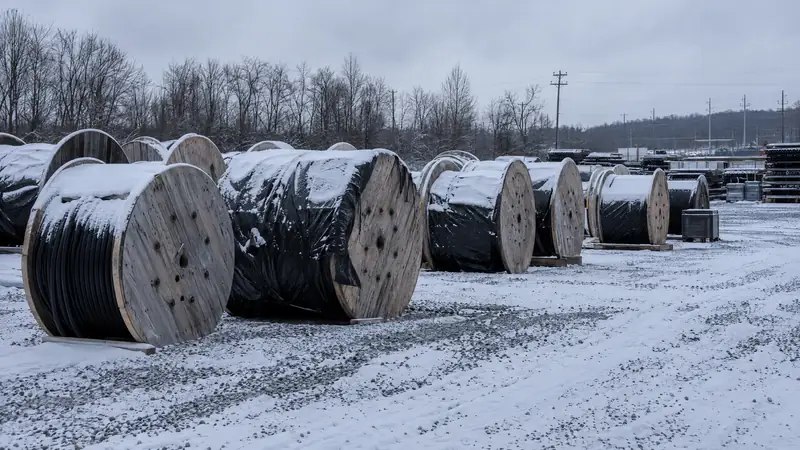
Storing wire reels outdoors through an Ohio winter requires manufacturer-approved storage, sealed cable ends, weather protection and supports that keep the reel out of standing water. Ohio Wire Buyers buys reusable surplus electrical wire and cable from businesses anywhere in Ohio; protecting the product and its identification gives us better information to review before an offer.
Is storing wire reels outdoors appropriate for your cable?
Start with the manufacturer's storage instructions, not the assumption that a black jacket means outdoor storage is acceptable. Southwire's handling guide directs indoor storage for its building wire, including THHN/THWN-2 and XHHW-2, even though particular products have wet-location ratings. Indoor-only or dry-rated products need a controlled environment.
This table summarizes Southwire's guidance, not a blanket rule for every brand. Check the actual product before assigning yard space.
| Product group | Southwire storage guidance | Practical action |
|---|---|---|
| THHN/THWN-2 and XHHW-2 building wire | Indoors | Move reels inside; preserve color identification |
| NM-B and voice/data/electronic wiring | Indoors | Keep coils and cartons in controlled storage |
| MC cable, jacketed or unjacketed | Indoors | Do not treat armor as weatherproof packaging |
| UF-B and RHW-2/USE-2 | Outdoors acceptable with regular inspection | Seal ends and protect packaging |
| Medium-voltage, utility and specified jacketed industrial cable | Outdoors acceptable with regular inspection | Follow product-specific instructions and inspect seals |
For mixed leftovers, separate THHN/THWN-2 building wire from yard-suitable products rather than covering everything together. Our wire selling guides help with identification and inventory preparation.
How should reels be supported above wet ground?
Use a firm, level, well-drained surface. Keep large cable reels upright, with both flanges vertical, and support wooden reels on suitable pallets or spacers rather than soil. Southwire recommends elevation of at least 4 inches where an uncovered location has a risk of minor flooding; that clearance does not make a flood-prone site suitable.
Chock reels against rolling and leave room for inspection. Do not lay a large reel flat on a flange to fit it beneath a cover or stack yard reels to save space. Check supports for deterioration and watch whether a flange has begun sinking or leaning.
Confirm handling requirements before relocating anything. The reel sizes and weights guide explains why flange dimensions and load information belong in the inventory record. Never let forklift forks contact the cable or protective wrap.
Why do cable ends need more than a loose tape wrap?
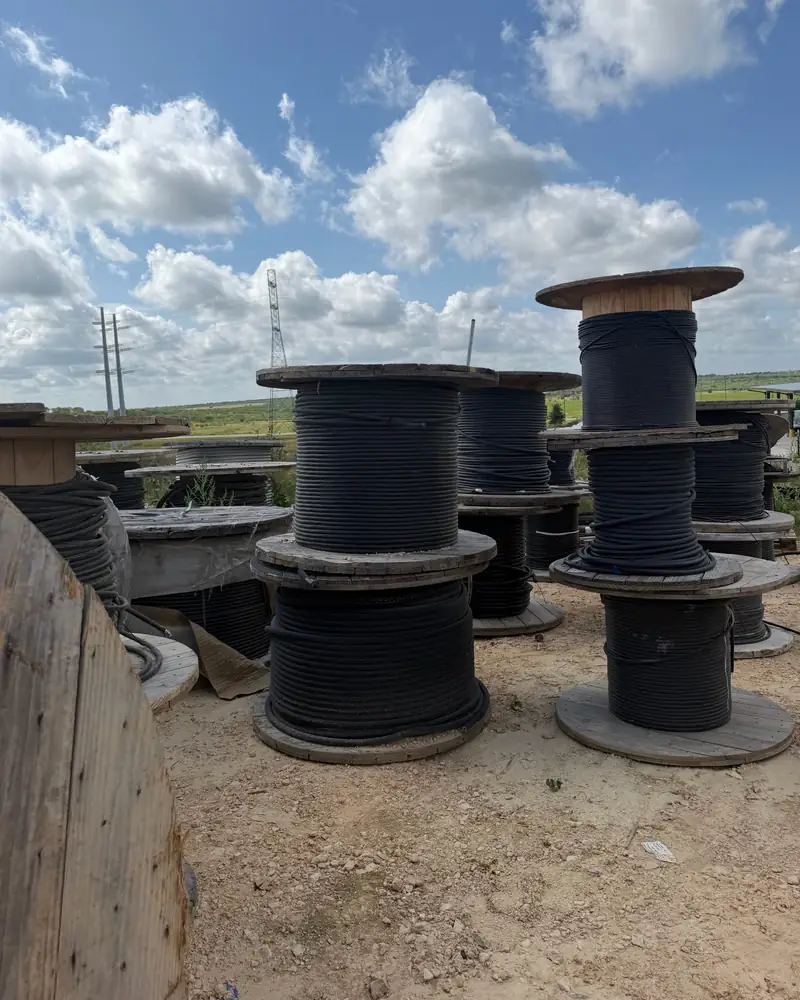
The jacket protects the cable's length, but an open cut end still needs protection against moisture entry. Southwire calls for an airtight seal on stored insulated cable and identifies heat-sealable caps or cold-shrink protection after cutting. Prysmian likewise directs immediate resealing when part of a reel is used.
Use an end-sealing method approved for the actual cable and installed by someone familiar with that method. A loose bag or tape wrap should not be assumed to provide the specified seal. Secure the capped end within the flange so it cannot trail, unwind or catch during movement.
Inspect accessible ends without unwinding a frozen reel. For medium-voltage surplus cable, record missing caps or damaged seals before anyone trims the end. Resealing protects against further entry; it does not prove previously exposed cable is dry or reusable.
What changes when Ohio snow melts and refreezes?
NOAA's Ohio climate summary identifies winter Arctic air incursions and lake-effect snow along Lake Erie's southeastern shoreline. A storage plan there should account for snow accumulation as well as cold. Elsewhere in the state, drainage and weather protection still matter without relying on a statewide snowfall estimate.
When snow thaws, check where the meltwater goes. A reel that was above dry ground can end up beside a puddle, and refreezing can leave unsafe access for handling. Reinspect after storms and thaws instead of waiting until pickup day.
Southwire recommends weather-resistant tarps for exposed outdoor-rated products while warning against moisture buildup underneath. Keep air circulation around the reels and do not block drainage with the cover. Continue protection into summer: sunlight can fade identification colors, and a sunlight-resistant marking does not eliminate every storage concern.
Can cold cable crack when the air feels warmer?
Yes. Southwire explains that PVC and other thermoplastic materials become stiffer in cold weather, and the inner layers of an outdoor reel can remain cold after the air warms. Bending, pulling or impacting that material can damage the insulation or jacket.
Southwire's storage guide identifies temperatures below −10°C, or 14°F, as a concern for thermoplastic stiffening and warns against flexing or handling cable below that temperature. Do not present this as a universal minimum installation temperature for every THHN product. Follow the actual manufacturer's limits; a low-temperature marking is not permission for unrestricted cold handling.
Southwire recommends at least 24 hours in heated storage before cold-weather preparation or installation, with warming time dependent on the reel and conditions. Keep reels away from excessive heat sources. Read the cable jacket print to identify the product before requesting its handling instructions.
What should you inspect during a long winter hold?
Inspect flange wood, fasteners, supports, wraps, ties and end caps. Soft or degraded wood and a loose flange can make a reel unsafe to move even when the cable appears intact. Do not add nails through a flange or improvise a repair that could puncture the winding.
Prysmian's storage procedure specifies rolling drums through 90 degrees every three months and checking bolts regularly. Treat that as manufacturer-specific maintenance performed with appropriate equipment and safe conditions, not a reason to hand-roll a heavy reel across ice. Rotation helps expose previously hidden packaging and flange areas for inspection.
Keep the original tag attached and photograph it while readable. The reel tag guide explains which details identify the product. Maintain a storage log noting inspections, seal replacements, exposure incidents and any movement indoors.
How does winter exposure affect a resale review?
An unused reel is not automatically undamaged. Missing seals, split jackets, water exposure, unreadable tags and unsafe flanges create different questions; describe them separately instead of labeling the whole lot as good or bad.
Do not strip, shorten or re-reel material merely to improve its appearance. A dry-looking exterior does not establish electrical integrity, and photos cannot rule out internal moisture. Questionable cable may require manufacturer guidance or assessment by qualified personnel before reuse can be considered.
Ohio Wire Buyers buys wire as reusable product, not scrap metal by the pound. If it is not reusable, we say so. The surplus value versus scrap price guide explains that distinction without treating stored inventory as guaranteed resale stock.
What should you send for an offer on winter-stored reels?
Send whole-lot photos plus each reel's tag, jacket legend, accessible cut ends and visible packaging damage. Include storage history: indoors or outdoors, approximate duration, whether ends remained sealed, and any known flooding. Do not move an unsafe reel or uncoil stiff cable just for a photograph; use the wire photography guide.
List type, conductor material, size and remaining footage, marking estimates clearly. Our remaining-footage guide helps distinguish factory put-up from what remains. Add proof of ownership using the seller paperwork checklist, and describe loading access, available equipment and reel-condition concerns.
We review the information and reply with questions or a written offer before pickup. Payment method and timing are confirmed in writing before pickup; we arrange pickup at your Ohio jobsite, warehouse, plant or yard and check the count against the written terms.
To discuss winter-stored surplus, request an offer or call 951-403-5738. Send the storage history with the photos so the condition review starts with the full picture.
Frequently asked questions
Does a THWN-2 wet-location rating allow outdoor reel storage?
Do not assume it does. A wet-location rating describes an allowed application, not blanket approval for leaving a reel exposed. Southwire's storage guidance lists its THHN/THWN-2 building wire among products for indoor storage. Check the instructions for the actual manufacturer and product, including packaging and sunlight exposure, before choosing a storage location.
Can winter-stored cable still be sold as reusable surplus?
Possibly, but outdoor exposure alone cannot establish whether the cable remains reusable. Ohio Wire Buyers reviews identification, footage, condition and storage history. Send photos of the reel, tag, jacket print and accessible ends, and disclose missing seals, flooding or visible damage. If the material is not reusable, we say so; a scrap metal recycler may be the appropriate buyer.
Does older wire have an automatic expiration date?
Southwire states that its wire and cable products do not have a defined shelf life when properly stored and undamaged. That is not a guarantee for unidentified or weather-damaged surplus. Keep the manufacture date and storage history with the reel, and ask the actual manufacturer about questionable material rather than judging it by age alone.
Should I strip insulation to check cable that has been outside?
Do not strip usable wire merely to prepare an offer. Photograph existing cut ends and visible jacket condition without creating more exposed conductor. Missing caps or suspected moisture should be disclosed, not hidden by trimming the end. A qualified assessment may be needed; a photograph does not establish the electrical integrity of the cable.