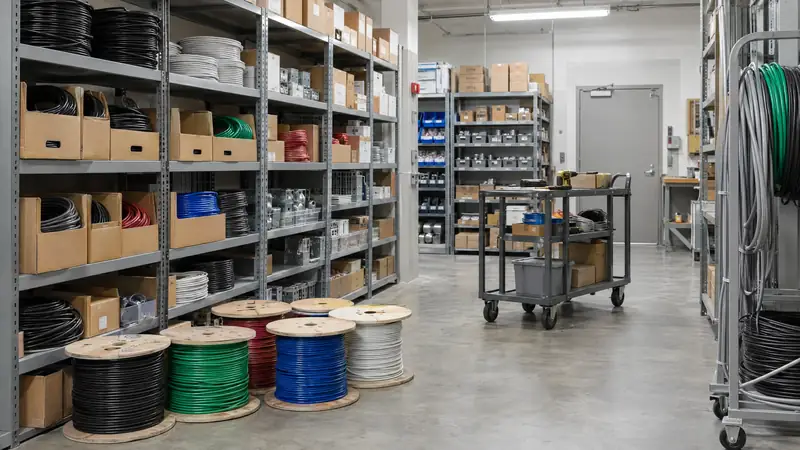
Ohio Wire Buyers buys reusable facility surplus wire and cable from hospitals, universities, school districts and other facilities anywhere in Ohio. We review unused reels, partial reels, boxed coils and useful cut lengths as product for resale and reuse, not scrap metal by the pound. Public facilities must establish the permitted disposal process before agreeing to a sale or releasing material.
Which facility surplus wire belongs in a sale lot?
Start by separating project leftovers from maintenance reserves. An unused feeder reel from a canceled renovation may be available for sale, while an identical reel reserved for an approved repair should stay out of the lot. Ask the maintenance lead and project manager to reconcile the proposed sale list before photographing everything together.
Keep contractor-owned material separate from facility-owned stock. A reel left beside a loading dock is not proof that the institution owns it. Our overview of the businesses and facilities we buy from explains the seller categories; the sale itself still needs an authorized owner and identifiable, reusable material.
What should you record for each cable family?
A storeroom shelf location is useful internally, but it does not identify the product. Record the manufacturer, catalog number, cable designation, conductor material and remaining length. Keep different constructions on separate inventory lines even when the coils look similar.
| Material in the proposed lot | Identification to retain | Condition detail to disclose |
|---|---|---|
| THHN/THWN-2 building wire | Jacket legend, conductor size, copper or aluminum, color | Original reel or re-reeled; continuous footage available |
| HCF or other armored cable | Exact product name, conductor arrangement, grounding construction | Crushed armor, kinks, damaged ends or missing labels |
| Fire alarm cable | Part number, conductor count, shield and printed listing | Opened package, splices or uncertain remaining length |
| Data cable | Category and jacket listing from the box or cable | Box condition and whether the remaining cable is continuous |
| Feeder cable | Full printed designation and conductor material | Storage history, jacket damage and end protection |
For separate stock groups, see our pages on surplus THHN/THWN-2 building wire and boxed Cat6 and data cable. Do not combine their quantities into a single entry called “electrical cable.”
How do you identify healthcare and fire alarm cable correctly?
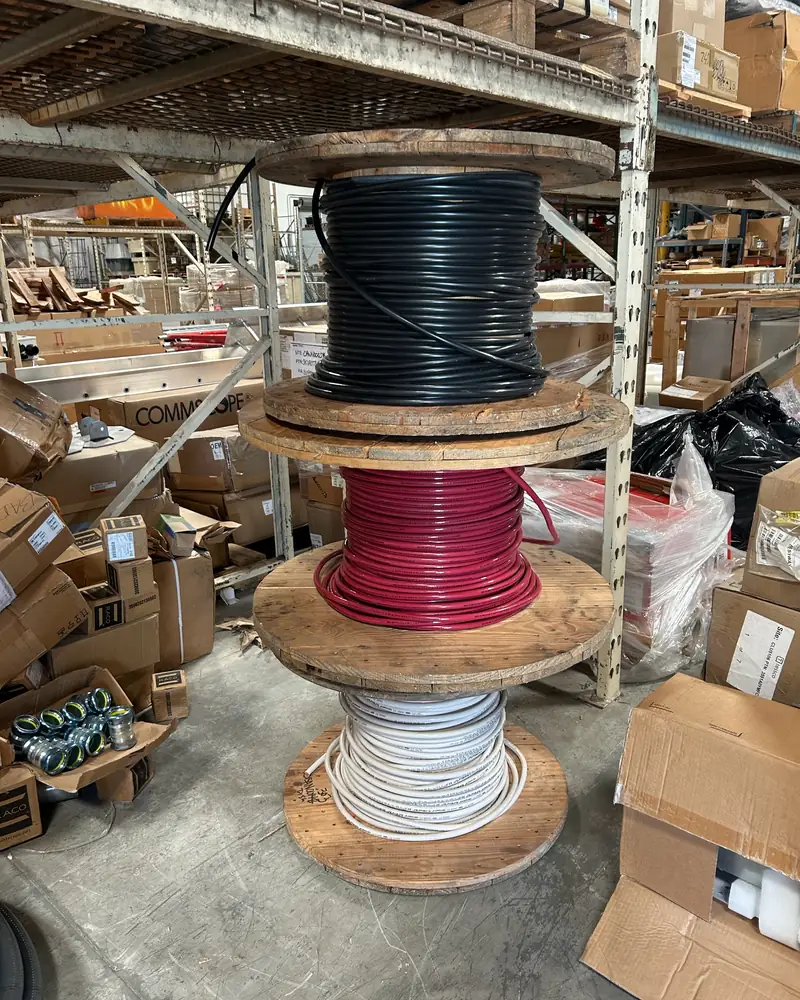
Healthcare-facility cable needs more detail than “green armor.” Southwire's MC-AP HCF multi-neutral specification describes green aluminum interlocked armor, insulated copper circuit conductors and a bare aluminum grounding/bonding conductor. It identifies the armor as a component of a redundant grounding path. That construction is product-specific, not a rule for every armored cable.
Photograph the package label and any accessible printed identification. Our MC and armored cable buying page is a useful next step for sorting the lot. Preserve the exact designation rather than treating HCF, ordinary MC and AC cable as interchangeable inventory descriptions; acceptance for a future installation depends on the product and applicable requirements.
Fire alarm cable also needs its printed designation. For example, Belden identifies its 5322FL as FPLR riser cable with four 18 AWG solid copper conductors and an overall shield. That is an identification example, not a description of every red cable. Include shielding and the actual jacket listing when submitting surplus fire alarm cable.
Who must approve a public facility's disposal?
Do not assume all Ohio public entities follow the same sale rules. Ohio Revised Code Section 721.15 addresses municipal personal property and includes authorization, advertised-sale and internet-auction provisions. Section 3313.41 addresses school-board property disposal, with auction requirements and exceptions. Neither is a universal permission slip for every institution.
Universities can also have institution-specific controls. Ohio University's surplus-property rule directs departments through its disposition process and prohibits disposal outside that policy. That is an example of why a storeroom employee's willingness to release cable does not establish sale authority.
Ask purchasing, the treasurer, the surplus office or counsel to identify the governing procedure. Confirm whether the material requires internal redistribution, a declaration of surplus, bidding, auction or another approved route. A buyer's offer does not waive those requirements. Send the applicable sale instructions before assuming a direct purchase is available.
What records establish ownership after project closeout?
Match the cable to an invoice, purchase order, closeout record or company letter establishing ownership. If a contractor is handling the sale, clarify whether it owns the leftovers or is acting for the facility. Keep the owner's authorization with the lot record rather than relying on a verbal handoff.
Ohio Wire Buyers verifies the seller and proof of ownership and keeps a written record of each purchase. Our wire seller paperwork guide helps organize the supporting documents. For institutional material, also identify the person authorized to approve the terms and the office that must receive the transaction record.
What should a facility send for an offer?
Send a lot list that can be matched to photographs without entering the storeroom. Use a temporary lot label on each reel, coil or box, but do not cover the manufacturer label. Separate approved surplus from material still awaiting a decision.
Include:
- Whole-lot photos showing the reels, boxes and coils being offered.
- Readable reel tags, box labels and cable jacket print for each distinct product.
- Accessible cut-end photos showing the conductors and construction without dismantling usable cable.
- Footage by lot, stating whether it is confirmed, estimated or unknown.
- Ownership records, disposal authorization status and the facility's sale instructions.
- The pickup location, loading contact and any access or appointment restrictions.
Belden notes sequential jacket footage markings on its fire alarm cable range; photograph available markings rather than copying the original package length after material has been used. Where footage remains uncertain, our guide to measuring wire left on a reel explains ways to document an estimate. Do not report an estimate as a measured balance.
How should storeroom and removed cable be prepared?
Leave reusable wire intact. Do not strip insulation, cut long lengths into short pieces or remove armor to make handling easier. Retain packaging and tags, and disclose crushed sections, damaged jackets, splices or uncertain storage history. An unopened box is helpful evidence, but it does not replace checking its identity and condition.
Removed cable is considered only if still reusable. Have qualified personnel handle isolation and removal; do not disturb an installed circuit simply to obtain a photo. Describe service and removal history alongside the available lengths. Photos are for purchase review, not electrical clearance. If material is not reusable, we say so; the surplus-versus-scrap comparison explains when a recycler is the appropriate buyer.
How is pickup arranged at an operating campus?
Explain the loading route, not just the mailing address. Identify the dock or service entrance, the authorized loading contact, available handling equipment and any security check-in. Tell us if material sits in several buildings or must be moved out of an occupied corridor before loading. Do not promise lifting equipment that has not been approved for the move.
We review the photos and footage, reply with questions or a written offer before pickup, and confirm payment method and timing in writing before pickup. We arrange pickup at the seller's Ohio location and check the count against the written terms. Ohio Wire Buyers has no Ohio street address, office or yard.
Once ownership and the disposal route are settled, request an offer for your facility's surplus wire with the labeled lot list and photos, or call 951-403-5738. Keep the approved sale lot separate from maintenance stock until the written terms and pickup arrangements are confirmed.
Frequently asked questions
Can a hospital sell unopened wire that was ordered for a canceled project?
Yes, reusable unused wire can be reviewed for purchase once the hospital confirms ownership and authorizes its disposal. Keep the original reel tags, purchase records and packaging together. Check whether the material belongs to the hospital or its contractor, and whether it should be retained for maintenance. Send photos and footage for review rather than assuming an unopened reel guarantees an offer.
Do you buy cable removed during a campus renovation?
Used cable is considered only when it remains reusable. Describe its service history, removal method, remaining continuous lengths and any damage or splices. Removal must be handled by qualified personnel after proper electrical isolation. Photos help with initial review but do not establish electrical suitability. If the cable is not reusable, Ohio Wire Buyers will say so; a scrap metal recycler may be the appropriate buyer.
Can we include material from several facility storerooms in one request?
You can submit several storerooms for review, but identify the material and ownership at each location separately. Use lot labels that match the photographs and footage list. Explain which items are approved for sale and whether they can be consolidated safely. Pickup arrangements depend on the written terms and access information; do not assume separate locations can share a single loading plan.
Is a buyer's written offer enough to authorize a public school wire sale?
No. A written offer documents proposed purchase terms; it does not replace the school district's disposal authority, applicable law or internal approvals. The district's treasurer, purchasing staff or counsel should determine the permitted sale route. Ohio's school-board property disposal statute includes auction requirements and exceptions. Resolve that process before accepting terms or releasing the cable.
Do we need to strip insulation before requesting an offer?
No. Ohio Wire Buyers buys reusable electrical wire and cable as product for resale and reuse, not scrap metal by the pound. Leave insulation, armor and jackets intact, and preserve readable tags and markings. Cutting or stripping material can eliminate its usefulness as cable. Photograph its present condition and disclose damage so the review addresses the actual material available.
Sources and further reading
- Southwire MC-AP HCF multi-neutral cable specification
- Belden 5322FL shielded riser fire alarm cable
- Belden fire alarm cable features and footage markings
- Ohio Revised Code Section 721.15: Municipal property disposition
- Ohio Revised Code Section 3313.41: School-board property disposal
- Ohio Administrative Code Rule 3337-55-71: Ohio University surplus property