
Ohio Wire Buyers is a business serving sellers looking for decommissioned cable buyers in Ohio: we buy used electrical cable only when it remains reusable, as product for resale rather than scrap metal by the pound. Businesses can submit long continuous lengths with identifiable construction and intact jackets for review, with a written offer before pickup and payment method and timing confirmed in writing beforehand.
What do decommissioned cable buyers consider reusable?
A cable removed because equipment was relocated is a different proposition from cable removed after a fault, fire or flood. Start with what the cable is, why it came out and whether each length remains usable. An intact outer jacket is important, but appearance alone cannot establish the condition of insulation, shields or conductors underneath.
| Detail in the recovered lot | Why it matters for review | What the seller should provide |
|---|---|---|
| Continuous lengths | Each piece must suit a future use; combined footage is not a continuous run | Length of each piece and any splices |
| Legible jacket print | Identifies the product rather than just its conductor metal | Clear photographs of the complete printed legend |
| Intact jacket and armor | Cuts, crushing and deformation raise condition concerns | Close-ups of damage and representative undamaged areas |
| Documented removal reason | Planned teardown differs from removal following a failure | Equipment or circuit description and removal history |
| Protected cut ends | Open ends can admit moisture during storage | End photographs and how they have been protected |
Separate promising lengths from damaged remnants rather than presenting everything as one pile. Our surplus-versus-scrap guide explains why reusable product and scrap metal require different assessments.
Make electrical isolation the first teardown decision
Do not cut or disconnect cable because a building looks abandoned or a machine has stopped running. Have qualified electrical personnel establish safe isolation, apply the required lockout/tagout procedures and verify the de-energized condition before removal. Sales photos and scheduling must never take priority over the site's electrical safety program.
OSHA's electrical work-practice requirements address disconnection from electrical energy sources and qualified-person verification, including checks for induced voltage or unrelated backfeed. A control push button is not a substitute for isolation. The applicable procedures depend on the work and facility; this page is not a removal procedure or authorization to work on electrical equipment.
Coordinate cable recovery with the electrical contractor and demolition supervisor before machinery reaches the cable route. A salvage plan should identify what can be recovered safely, not encourage crews to pull cable from uncertain circuits.
Preserve the product identity and service history
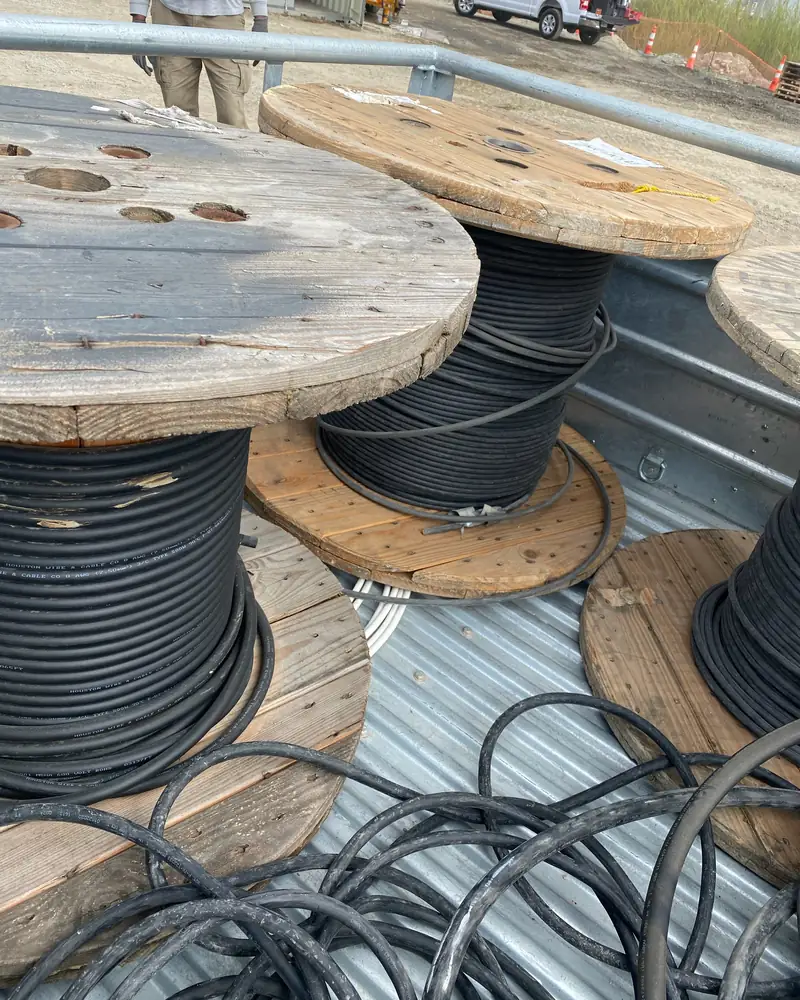
Photograph jacket legends while the recovered lengths are accessible. Record the manufacturer, cable designation, conductor size, copper or aluminum construction, conductor count and voltage marking exactly as shown. Our guide to reading cable jacket print helps organize that information without guessing from cable diameter.
For industrial tray cable, include the complete type marking and describe any shield or armor visible at an already exposed end. For medium-voltage cable, retain records identifying its construction and any existing test reports. Do not dismantle a sound end merely to obtain a photograph.
State whether the cable served fixed equipment, temporary power or another application, and disclose known overheating, faults, chemical exposure or water intrusion. If installation age or operating history is unknown, say so. A missing record is better handled as an unanswered question than filled in with an estimate presented as fact.
Do lugs or splices make recovered cable unusable?
An attached lug does not, by itself, answer whether the cable remains reusable. Photograph the lug, the prepared end and the jacket behind it after safe removal. Note corrosion, heat discoloration, broken strands or damage near the termination. Avoid cutting off every lug before asking for review; trimming can reduce an otherwise useful length.
Lugged DLO cable lengths should be listed individually, with identification taken from the cable itself rather than inferred from the connector. A lug marking describes the connector, not necessarily all the cable's ratings.
Disclose every splice you know about and its position. Do not describe joined pieces as one unspliced length. Existing terminations also do not establish that the cable or connector is suitable for a different installation.
Re-reel without adding removal damage
Preserving length helps only if recovery does not damage the cable. Southwire's installation guide treats pulling tension, bending radius and pressure at bends as cable-specific limits. Qualified crews should plan recovery and re-reeling around the manufacturer's requirements, rather than dragging cable over sharp edges or forcing it onto an undersized drum.
Use a sound reel suitable for the cable and its load. Keep individual lengths labeled, and attach the original product information to the replacement reel while making clear that it was re-reeled. The original factory footage on an old tag should not be presented as the amount now remaining. See the guide to selling cable reels for packaging details.
Southwire's handling guidance calls for protected cable ends, secured loose ends and reel flanges kept vertical. Keep lifting equipment away from the cable itself, and follow the product's storage requirements. Re-reeling improves organization; it does not repair insulation damage or establish electrical fitness.
What should a teardown crew send for an offer?
Send a whole-lot photo first, then photographs tied to individual reel or coil identifiers. Include jacket print, original tags if available, already exposed cut ends, lugs and damage. A close-up without a matching lot identifier can leave us unable to connect the specification to the material being offered.
Prepare a footage list showing each continuous length, cable type, conductor size and count, packaging and known condition concerns. For uncertain footage, label it as estimated and explain the basis. Our reel footage measurement guide can help distinguish a measurement from an approximate inventory figure.
Add the reason for removal and whether the cable is already disconnected and staged. Tell us about remaining recovery work so we do not mistake installed cable for pickup-ready inventory. Include ownership documentation and existing inspection or test records where available; do not perform unsafe handling or improvised testing just to complete the submission.
When should reclaimed cable go to a recycler instead?
Cable with burned insulation, severe crushing, extensive cuts or uncertain contamination should not be represented as sound reusable product. Disclose those conditions before discussing an offer. Ohio Wire Buyers says so when material is not reusable; a scrap metal recycler may then be the right buyer.
Water exposure needs particular care. NEMA's water-damage guidance distinguishes dry-location cable from wet-location products and warns about corrosion, exposed ends and contaminants. Drying the outside is not proof that cable can return to service. Refer questionable exposure to qualified evaluation and the specific manufacturer rather than assuming a wet-location marking resolves everything.
Close out ownership and pickup before the site changes
Ohio Wire Buyers buys from business sellers, including demolition and decommissioning firms. We verify the seller and proof of ownership, such as an invoice, purchase order, closeout paperwork or company letter, and keep a written purchase record. Our seller paperwork guide helps distinguish possession of cable from authority to sell it.
After review, we reply with questions or a written offer. Payment method and timing are confirmed in writing before pickup; we arrange pickup anywhere in Ohio and check the count against the written terms. Tell us about gate access, loading equipment and any restrictions before the teardown site closes. The selling process explains the sequence; we arrange pickup rather than accept seller deliveries.
Before reusable lengths become mixed demolition debris, send your reclaimed cable lot for an offer or call 951-403-5738. Clear identification, honest condition notes and a footage list give Ohio Wire Buyers a useful starting point for review.
Frequently asked questions
Can a demolition contractor sell cable owned by the building owner?
The contractor needs documentation showing ownership or authority to sell the material. Ohio Wire Buyers verifies the seller and proof of ownership before purchasing. A demolition contract should not be assumed to transfer cable ownership automatically. Send the relevant closeout paperwork or a company letter identifying the cable and who has authorized its sale.
Is there a minimum length for selling reclaimed cable?
There is no single footage rule that establishes whether all cable is reusable. Type, size, condition and the length of each continuous piece matter together. Send a list of individual lengths rather than only the combined total. Ohio Wire Buyers reviews that information and says so if the cable is not reusable; a scrap recycler may then be the appropriate buyer.
Does a successful insulation test guarantee that used cable can be resold?
An existing test report can add useful condition information, but it does not replace product identification, inspection or disclosure of service history. Include the test method, date and which cable was tested if those records are available. Do not energize recovered cable or perform improvised tests to obtain an offer. Testing and installation suitability require qualified evaluation appropriate to the cable.
Can I deliver removed cable to Ohio Wire Buyers?
No. Ohio Wire Buyers has no Ohio street address, office or yard and does not accept seller deliveries. We arrange pickup at the seller's Ohio jobsite, warehouse, plant or yard after reviewing the material and agreeing to written terms. Tell us where the cable is staged, whether it is on reels or pallets, and what loading equipment and access are available.